
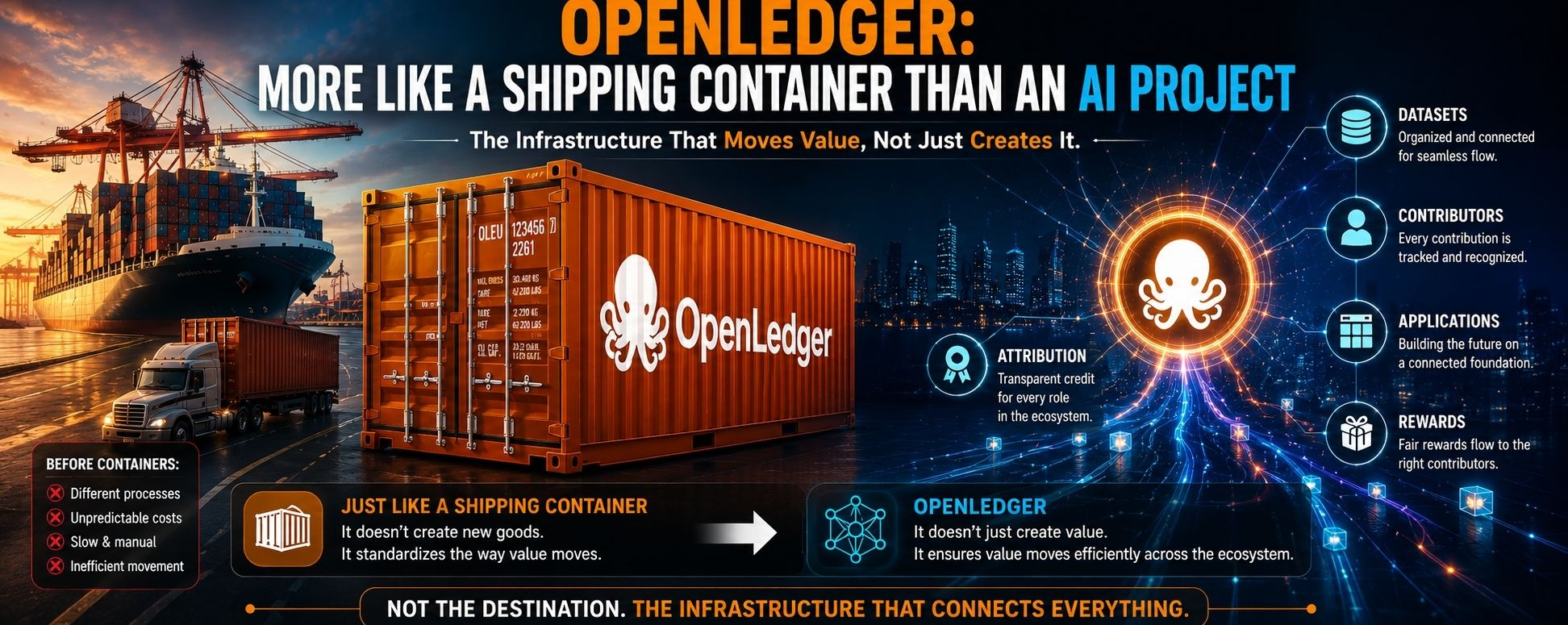
@OpenLedger When I think about OpenLedger, I don't see it as just another AI project. Instead, it reminds me of one of the most overlooked innovations in modern history: the shipping container.
Before shipping containers became the global standard, moving goods around the world was far more complicated than most people realize. Every port had its own way of handling cargo. Loading and unloading took time, costs were difficult to predict, and supply chains depended on countless manual processes. The problem wasn't that goods couldn't move. The problem was that there was no standard way for value to move efficiently between different participants.
The shipping container didn't become revolutionary because it created new products. Its real impact came from creating a common system that allowed goods to move faster, cheaper, and more reliably. Once that problem was solved, global trade expanded on a scale that few people had imagined.
OpenLedger gives me a similar feeling.
Most conversations around AI focus on models, outputs, and capabilities. People are usually interested in what AI can create. But much less attention is given to the systems that connect datasets, contributors, applications, and the value generated between them. For me, that is where things become truly interesting.
If an ecosystem is creating value, there also needs to be a way for that value to move. Information, contributions, attribution, and rewards all need to stay connected to the people and resources that helped create them. Without that connection, ecosystems become fragmented, incentives weaken, and growth becomes harder to sustain.
What stands out about OpenLedger is that it seems focused on this infrastructure layer. It is not only about creating value; it is about making sure value can flow through the ecosystem in a transparent and efficient way. When multiple people, tools, and data sources contribute to a digital economy, understanding who contributed what and how rewards should be distributed becomes increasingly important.
Technology history shows that some of the most important innovations are often the least visible. Consumers remember the products they use every day, but entire industries are usually built on standards and systems operating behind the scenes. These foundational layers rarely attract the same attention as consumer-facing products, yet they often determine which ecosystems scale successfully and which ones struggle.
That is why OpenLedger feels less like a bet on a single AI trend and more like a bet on the infrastructure that future AI economies may need. As digital ecosystems become more complex, the ability to move attribution, ownership, and rewards as efficiently as information itself could become incredibly valuable.
Sometimes the biggest opportunities are not found in building the next destination. They come from improving the roads that connect all the destinations together. The shipping container changed global trade not because people were excited about containers, but because it made everything around it work better.
OpenLedger gives me the same impression. The most important thing it may build is not a single application, but the invisible infrastructure that helps an entire AI economy operate more effectively.