
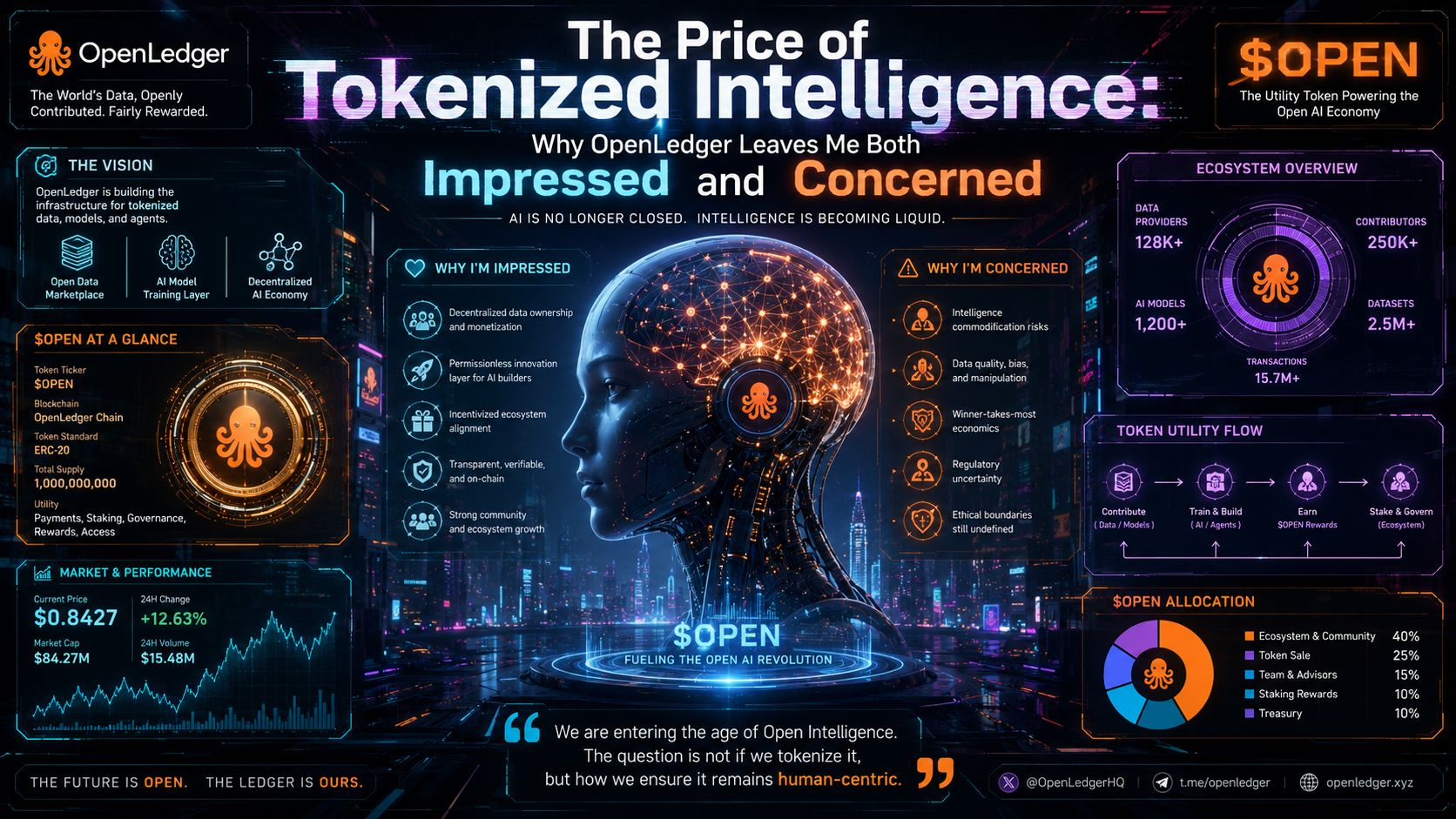
 I’ve always been drawn to ideas that try to change the rules of the game, and OpenLedger is one of those ideas that immediately grabs my attention. The promise sounds almost irresistible: a world where data, AI models, and autonomous agents are no longer locked inside giant corporations but become assets that ordinary people can contribute to, own, and monetize. On the surface, it feels like a correction to a growing imbalance. AI is built on enormous amounts of human-generated data, yet most of the value seems to flow upward. OpenLedger presents itself as a different path, one where liquidity reaches the people creating the fuel that powers these systems.
At first, that vision feels refreshing. It feels fair. If data has value, why shouldn't the people generating it share in the rewards? If AI models benefit from countless human contributions, why shouldn't those contributions be recognized as economic assets rather than invisible inputs? The combination of blockchain and AI appears to offer a new kind of marketplace, one where intelligence itself becomes something that can be exchanged, rewarded, and tracked transparently.
But the longer I sit with the idea, the more uncomfortable questions begin to surface.
The entire concept depends on turning things that were once difficult to price into things that can be traded. Data becomes an asset. Models become assets. Agents become assets. And while that sounds efficient, I keep wondering what happens when human behavior starts adapting to those incentives. People do not simply participate in systems. They respond to them. They optimize for them. They learn how to extract value from them.
What happens when the pursuit of monetized data becomes more important than the quality of that data?
What happens when contributors flood a network with information designed to earn rewards rather than provide truth?
What happens when an AI model becomes profitable not because it is accurate or beneficial, but because it attracts attention, speculation, or transactions?
That’s the part that keeps pulling me back. The technology may be sophisticated, but incentives have a way of exposing weaknesses that technical diagrams rarely show.
I think about real-world situations rather than white papers. Imagine a healthcare-related AI model trained through contributions from thousands of people. Imagine errors hidden deep inside the data. Imagine those errors spreading through systems that influence recommendations, decisions, or services. When something goes wrong, who is responsible? The individual contributor? The model creator? The network validators? The platform itself?
The answer often sounds clear in theory and blurry in reality.
Blockchain projects frequently emphasize decentralization as a strength. Sometimes it is. But decentralization can also become a convenient place for accountability to disappear. When responsibility is distributed everywhere, it can start feeling like responsibility exists nowhere. If harm occurs, people do not suffer from abstractions. They suffer from consequences. A wrong medical suggestion, a flawed financial recommendation, a biased AI decision—these are not technical events. They are human experiences.
That’s the part I struggle with most. The conversation often revolves around ownership, rewards, liquidity, and infrastructure. Those are important topics, but they can overshadow the people who end up living with the outcomes. The excitement around monetizing intelligence can make it easy to forget that intelligence is not the same thing as wisdom, and value is not the same thing as trust.
I also find myself questioning the assumption that every useful thing should become a market. There is a growing belief across technology that if something can be measured, it can be tokenized, and if it can be tokenized, it can be monetized. Yet some of the most valuable human contributions are messy, contextual, and difficult to price accurately. The moment those contributions enter a market structure, their meaning can change. Their purpose can change. People can change.
And then there is the issue of power. OpenLedger presents an image of openness, but history has shown that open systems do not automatically produce equal outcomes. Resources accumulate. Influence accumulates. Expertise accumulates. Early participants often gain advantages that later participants struggle to match. Over time, the gap between the ideal and the reality can quietly widen. A network built to democratize opportunity can slowly begin reproducing the same concentrations of power it originally claimed to challenge.
What happens when ownership becomes concentrated again?
What happens when the marketplace for AI value ends up being dominated by the same groups with the most capital, the best infrastructure, and the strongest influence?
What happens when decentralization becomes more of a story than a lived reality?
These questions do not make the vision worthless. In fact, they exist precisely because the vision is compelling. If the idea were obviously flawed, it would be easy to dismiss. The difficulty is that the promise feels plausible enough to believe in while the risks feel real enough to worry about.
I find myself caught between admiration and skepticism. I can see why people are excited. I can see why investors, developers, and contributors might view OpenLedger as an important step toward a new AI economy. Yet I cannot ignore the possibility that monetizing data, models, and agents may create pressures that are far harder to govern than they are to build.
In the end, I keep returning to a simple thought: if a system creates enormous value from human contributions, the real test is not how efficiently that value moves, but who carries the cost when something goes wrong—and whether anyone is truly willing to own it.