
The Trillion-Dollar Bridge: Why Tokenized Real-World Assets (RWAs) Are Rewriting the Rules of Finance in 2026
Imagine trying to move a million dollars in U.S. Treasuries at 2 AM on a Sunday. In the traditional finance (TradFi) world, you’re met with closed markets, T+2 settlement delays, and a web of intermediaries. In the crypto world, that same transaction settles in seconds.
For years, the promise of "putting everything on the blockchain" was little more than a slick conference slide. But fast-forward to 2026, and Tokenized Real-World Assets (RWAs) have transitioned from a niche experiment to the fastest-growing sector in decentralized finance. We are witnessing a historic migration of capital.
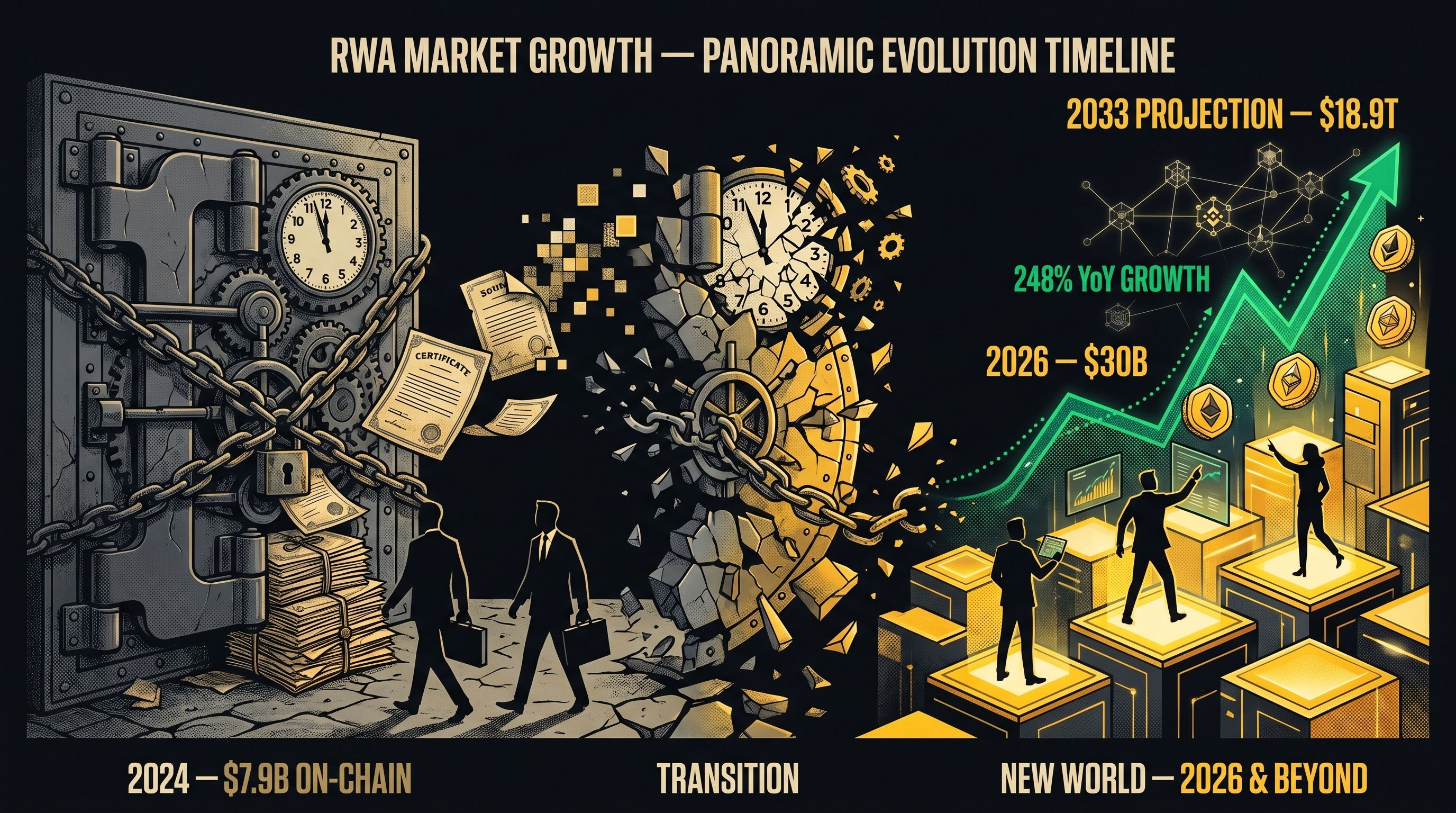
On-chain RWAs (excluding stablecoins) have skyrocketed from about $7.9 billion in 2024 to nearly $30 billion by the second quarter of 2026. Looking ahead, major consulting firms like Boston Consulting Group project this market will surge to between $10 trillion and $18.9 trillion by 2033.
If you are a crypto investor today, you can no longer afford to ignore RWAs. Here is your definitive guide to understanding how these assets are structured, where the yield comes from, and how the boundaries between traditional markets and crypto are vanishing.
What Are Tokenized RWAs?
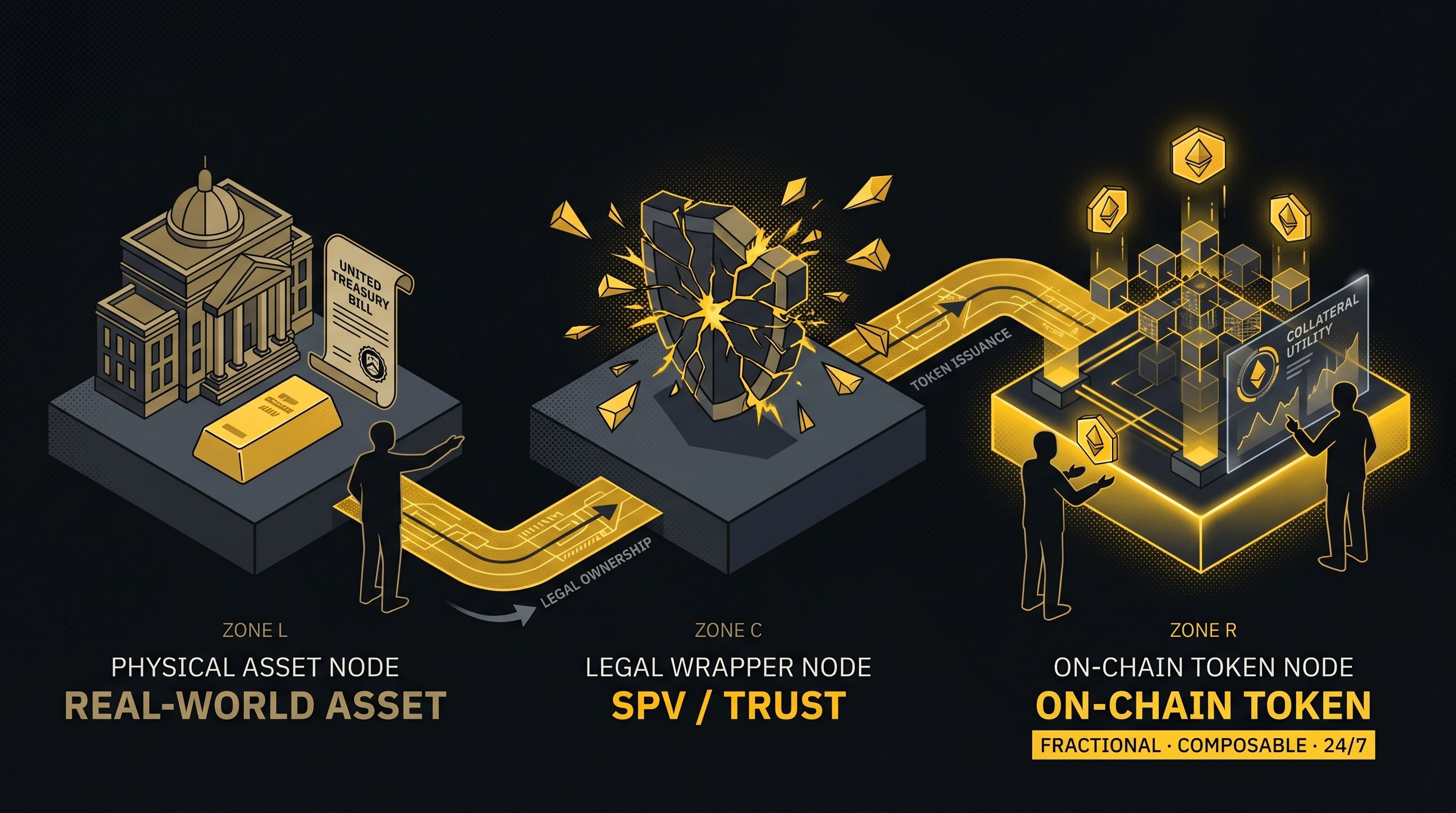
At its core, RWA tokenization is the process of creating a digital representation of a tangible or financial asset on a blockchain. The underlying asset could be a U.S. Treasury bill, a commercial skyscraper, a bar of gold, or a share in a private credit fund.
A regulated legal entity (like an SPV or a trust) legally owns the underlying asset and issues tokens on a blockchain that represent fractional shares or claims on its cash flows. Tokenization doesn't miraculously change the underlying economics of the asset; instead, it supercharges how ownership is recorded, transferred, and utilized as collateral.
The Heavyweights: Treasuries, Credit, and Commodities
So, what exactly is moving on-chain? The market is currently dominated by a few massive asset classes:
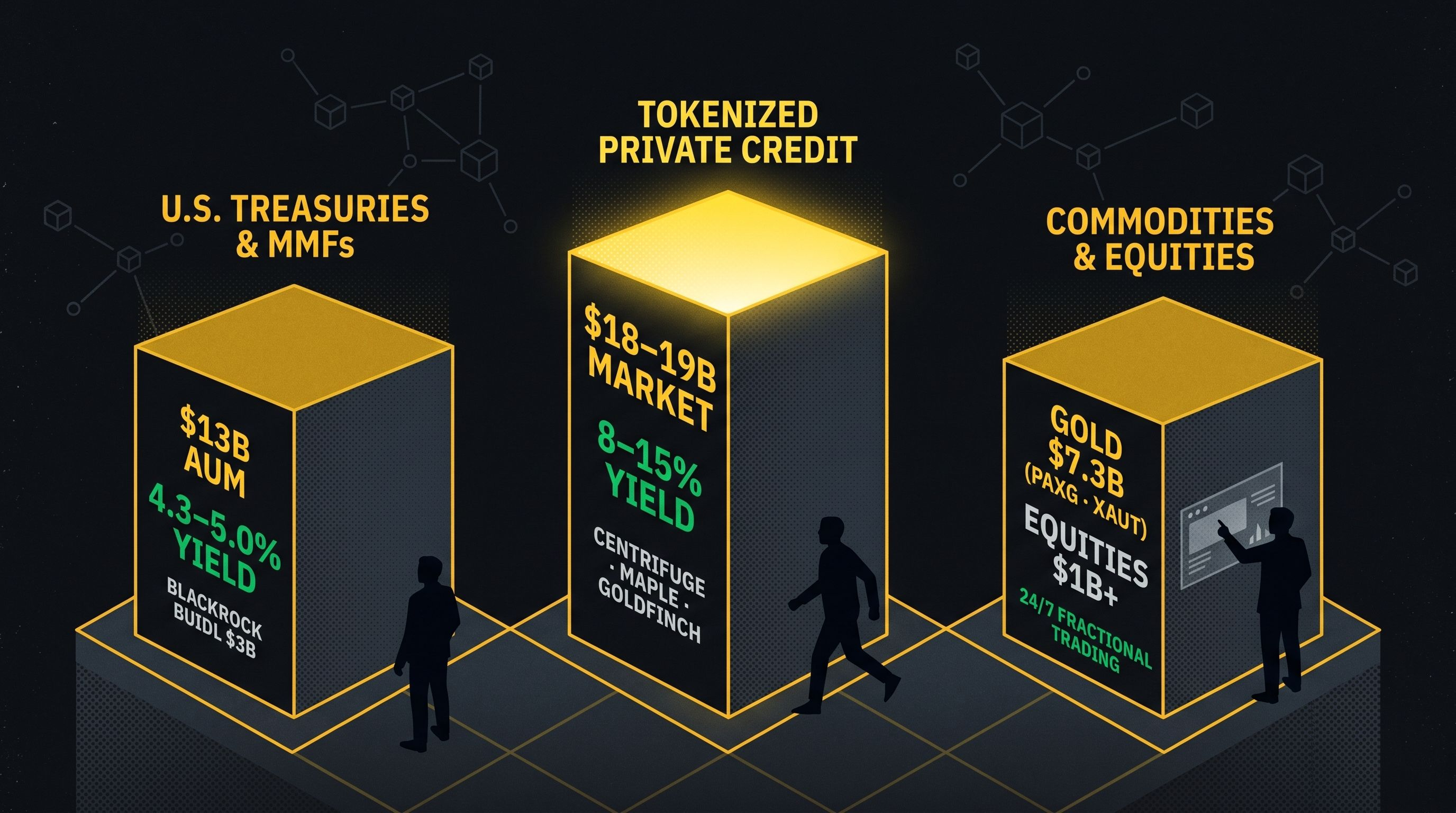
U.S. Treasuries and Money Market Funds: This is the undisputed heavyweight champion of RWAs, boasting over $13 billion in assets under management (AUM) in early 2026. Giants like BlackRock and Franklin Templeton have fully entered the chat. BlackRock’s BUIDL fund alone has crossed $3 billion in AUM. These tokens deliver risk-free traditional yields (roughly 4.3% to 5.0%) while operating 24/7 on crypto rails.
Tokenized Private Credit: Protocols like Centrifuge, Maple Finance, and Goldfinch are bridging DeFi liquidity with real-economy borrowers, pooling everything from fintech receivables to emerging market debt. The broad tokenized private credit market sits between $18 billion and $19 billion, offering yields ranging from 8% to 15%.
Tokenized Commodities & Equities: Tokenized gold (like PAXG and XAUT) holds over $7.3 billion in value. Meanwhile, tokenized public equities represent over $1 billion in value, allowing global investors to trade fractional shares of Apple or Tesla around the clock.
The "TriFi" Era: Where Binance Bridges the Gap
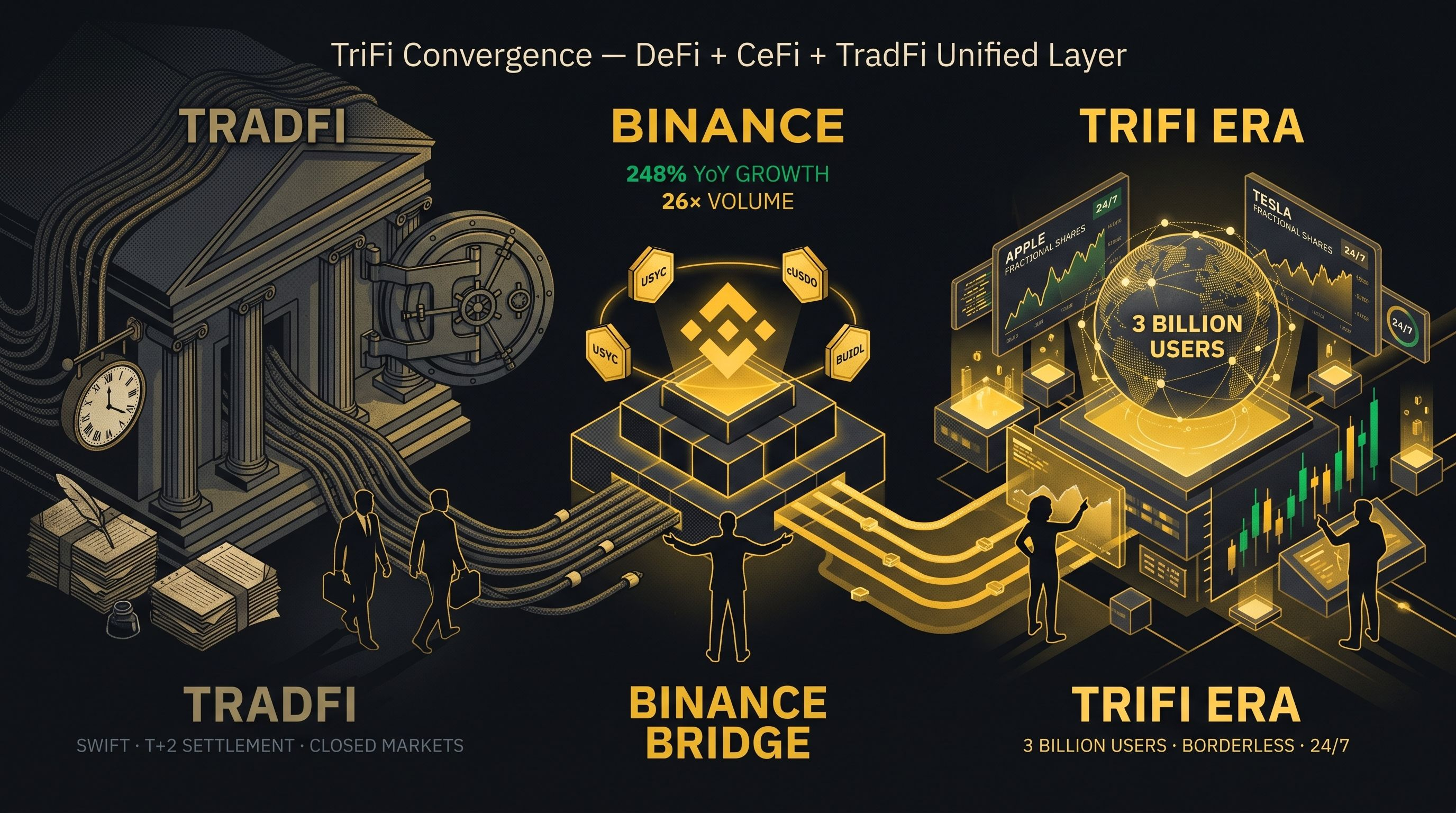
We are rapidly entering what industry insiders are calling the TriFi Era—the seamless convergence of Decentralized Finance (DeFi), Centralized Finance (CeFi), and Traditional Finance (TradFi). In this new paradigm, these systems no longer compete; they merge into a single global operating layer.
Binance has proven to be a pivotal architect in this TriFi transition. According to Binance Research, the tokenized RWA market grew an astonishing 248% year-over-year, while tokenized stock trading volume multiplied 26-fold in just 12 months. But Binance isn't just observing the trend; it is actively building the infrastructure to support it:
Collateral Utility: One of the greatest advantages of RWAs is composability. Binance has pioneered this by enabling institutional investors to use tokenized RWAs—such as Hashnote’s USYC and Ondo Finance’s cUSDO—as off-exchange, yield-bearing margin collateral. Furthermore, BlackRock’s BUIDL is increasingly being accepted as collateral in institutional DeFi trading, bridging directly with platforms like Binance.
Equities for the Crypto-Native: Binance recently relaunched tokenized stock trading in partnership with Ondo Finance, vastly expanding the distribution of tokenized equities to its massive user base.
A Borderless Vision: At the 2026 Hong Kong Web3 Festival, Binance Co-Founder Yi He articulated that crypto is crossing the chasm into global infrastructure. She highlighted a future where FX settlements migrate away from legacy systems like SWIFT and onto blockchain rails. For Binance, the ultimate goal has expanded to serving 3 billion users—transitioning from being just a centralized exchange to becoming the very financial layer the world runs on.
The Reality Check: Risks You Must Price In
As exciting as 10% APYs and 24/7 liquidity sound, "on-chain" does not mean "risk-free". Before allocating capital, investors need to be aware of the structural realities:
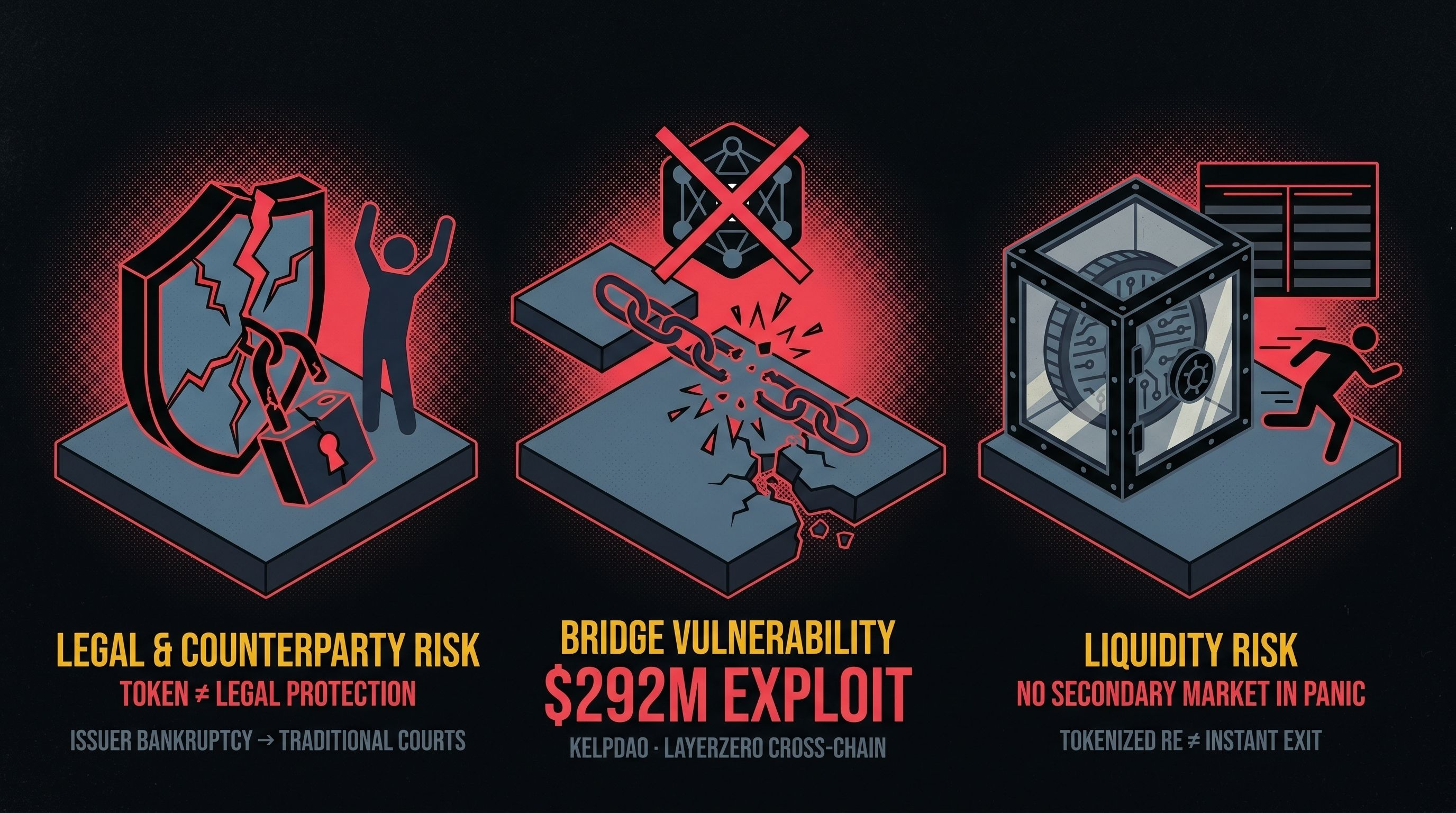
Legal and Counterparty Risk: Your digital token is only as secure as its legal wrapper. If the issuer mismanages the off-chain assets or goes bankrupt, your recovery depends entirely on traditional legal frameworks, not smart contracts.
Bridge and Technical Vulnerabilities: Moving assets across different blockchains can be treacherous. For instance, the KelpDAO protocol recently suffered a $292 million exploit due to a cross-chain bridge vulnerability involving LayerZero.
Liquidity Risk: Just because an asset is on-chain doesn't mean it's highly liquid. While a tokenized Treasury might feature instant redemptions, a tokenized real estate fraction might have virtually no secondary market buyers during a panic.
The Bottom Line
Tokenized Real-World Assets are not just another fleeting crypto narrative; they represent the structural evolution of global finance. By marrying the legal security and yield of TradFi with the composability and 24/7 liquidity of DeFi, RWAs are unlocking unparalleled capital efficiency.
As infrastructure providers like Binance seamlessly connect these worlds, the lines between traditional banking and crypto will continue to blur until they disappear completely. The future of finance won't ask you to choose between TradFi, DeFi, or CeFi. It will simply be one unified, borderless system—and the transition is already well underway.