I was sitting at my desk sometime around midnight, three browsers open, a cold cup of coffee next to me, doing what I always end up doing when something gets stuck in my head — just digging. Not looking for anything specific. Just following threads. And the thread I kept pulling on that night was this one question that sounds almost too simple: when a billion-dollar AI model gets trained on data that millions of people created, where does the money actually go?
I already knew the answer before I finished typing the question. It goes to the company that owns the compute. Not the writers whose work got scraped without permission. Not the researchers who published papers that got ingested into foundation models. Not the developers who spent weekends cleaning and uploading datasets they thought would benefit everyone. The people who literally built the foundation of these systems are invisible to the systems they built. And I remember just sitting back and staring at the ceiling thinking — this is the most expensive invisible problem in the history of technology, and the crypto space keeps walking right past it.
That's the night #Openledger started making a different kind of sense to me.
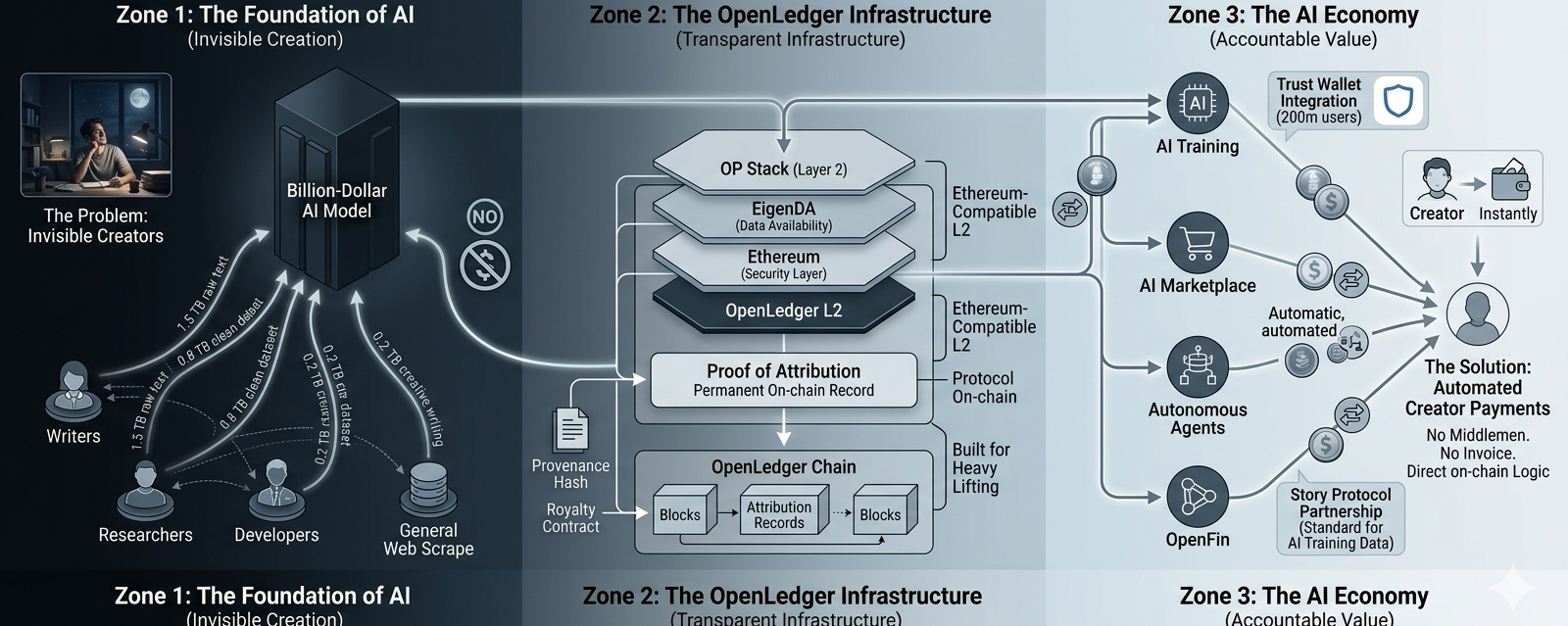
I think a lot of people see the "AI blockchain" label and immediately tune out, and honestly, fair enough. That phrase has been stapled to so many half-baked projects over the last two years that it's basically lost all meaning. But what pulled me into OPEN wasn't the label — it was the specific problem they're actually solving, and the mechanism they built to solve it. They call it Proof of Attribution. The way I'd explain it simply is this: every piece of data uploaded to the network, every model trained, every autonomous agent deployed, generates a permanent record on-chain of where it came from and who contributed to it. That record isn't just sitting there looking pretty. It's connected to payment logic that fires automatically when that data gets used. Somebody uses your dataset to train a model — you get paid. No middleman. No invoice. No waiting 90 days for a check that might never come.
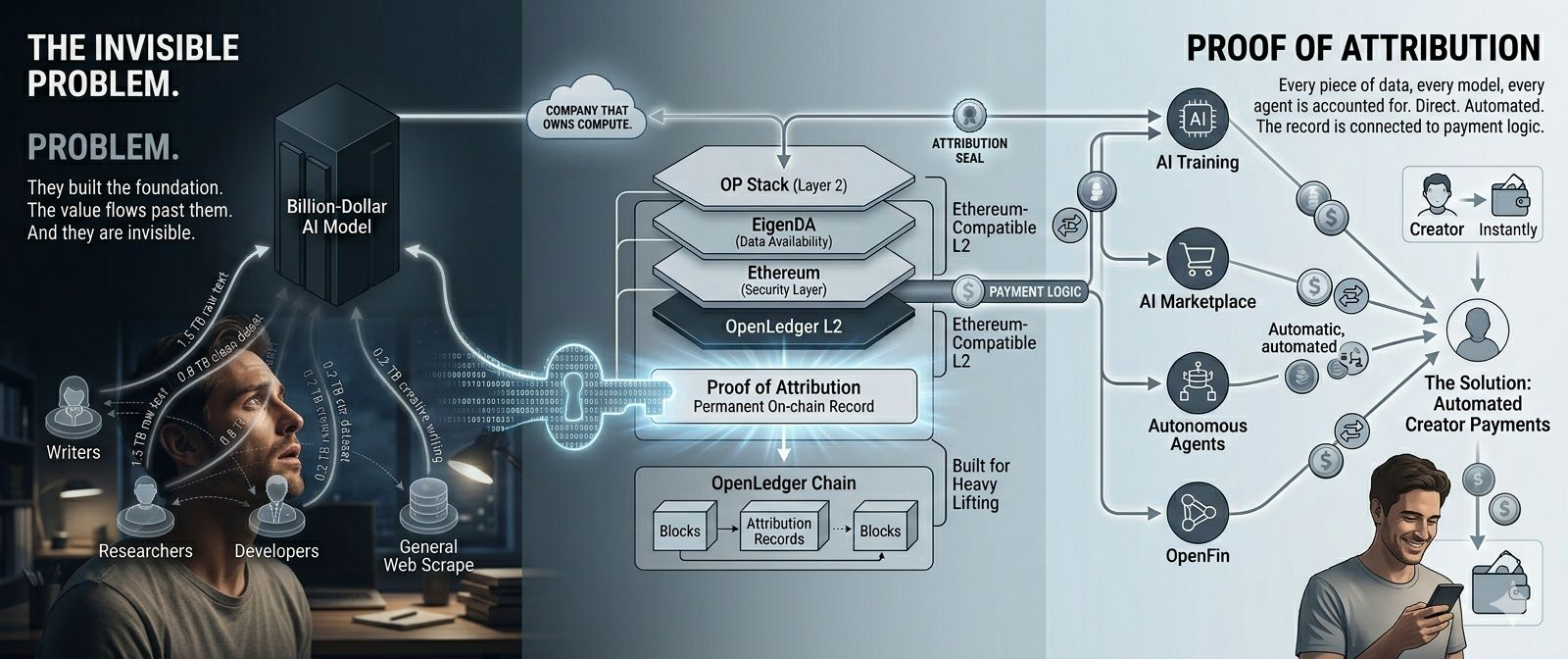
Think about what Ethereum — the second largest cryptocurrency by market cap — did for programmable money. Before smart contracts existed on ETH, if you wanted automatic, trustless transactions between parties, you needed lawyers, escrow accounts, and a whole infrastructure of trust intermediaries. Ethereum removed the intermediary and made the agreement itself execute on-chain. OpenLedger is attempting to do the same thing, but for intellectual property in the AI economy. The attribution and payment happen at the protocol level, not through a legal agreement that someone has to enforce after the fact.
What makes this more than just a good idea is the infrastructure underneath it. OpenLedger is built as an Ethereum-compatible Layer 2 — meaning it sits on top of Ethereum's security while handling transactions faster and cheaper than Ethereum mainnet can alone. They're using the OP Stack, the same foundation that powers Optimism and Base, combined with EigenDA for data availability. That combination isn't chosen for optics. It's specifically built for the kind of data throughput that AI workloads generate — we're talking about large dataset uploads, model parameter records, continuous agent interactions. This isn't designed for simple token swaps. It's designed for heavy lifting.
From my experience in this space, one of the most honest signals you can read on an early project is who showed up with money before there was any price action worth chasing. Polychain Capital led the $8 million seed round. Balaji Srinivasan — former Coinbase CTO, the guy who spent years writing and arguing that data ownership is one of the defining freedom issues of the digital age — put capital behind this. Sreeram Kannan from EigenLabs, who built the restaking concept that's now securing billions in crypto infrastructure, is in the cap table. So is Sandeep Nailwal, one of the architects behind Polygon. These aren't people who show up for a good story. They show up when the underlying architecture is genuinely sound.
The TGE — Token Generation Event, basically the official launch of the OPEN token — happened in September 2025 on Binance. Not a quiet debut on some obscure exchange. Binance. Multiple trading pairs went live including OPEN/USDT and OPEN/USDC. For anyone unfamiliar, USDC is a stablecoin pegged 1:1 to the US dollar — so trading OPEN against USDC means people can buy or sell OPEN without needing to hold Ethereum or Bitcoin. It keeps the entry point accessible. The airdrop ran alongside the listing, and what I liked was that holders could stake immediately for boosted rewards rather than being handed tokens with nothing to do but sell them. That design choice alone tells you something about how the team thinks about token holder incentives.
November 2025, the mainnet launched. I want to dwell on this for a second because "mainnet launch" is one of the most abused phrases in crypto. Half the time it means a testnet got rebranded. This wasn't that. Verifiable data provenance went live. Automated creator payments went live. The chain is actually running and processing real attribution records. That's not marketing — that's a shipped product.
What followed is honestly what kept building my conviction. The Trust Wallet partnership brought OpenLedger's AI layer into a wallet with 200 million active users — letting people execute Web3 commands through plain language. Just tell your wallet what you want. Swap ETH for USDC. Bridge to a different chain. Move assets without having to navigate five different interfaces. ETH here acts as the native asset most of these users are already holding, and the integration means OpenLedger's infrastructure is quietly sitting underneath interactions those 200 million people are already having. That's distribution that most projects spend their entire existence trying to build from scratch.
And then January 2026 — the Story Protocol partnership. This one I think is the most structurally important thing OpenLedger has done and the market has barely priced it. Together they built a legal standard for AI training data — where creative works get licensed for model training with automatic royalty payments going to rights holders the moment their content gets used. The EU AI Act is already demanding that AI companies document where their training data came from. Lawsuits against major labs are stacking up. OpenLedger just quietly built the compliance infrastructure for an industry that is about to desperately need it.
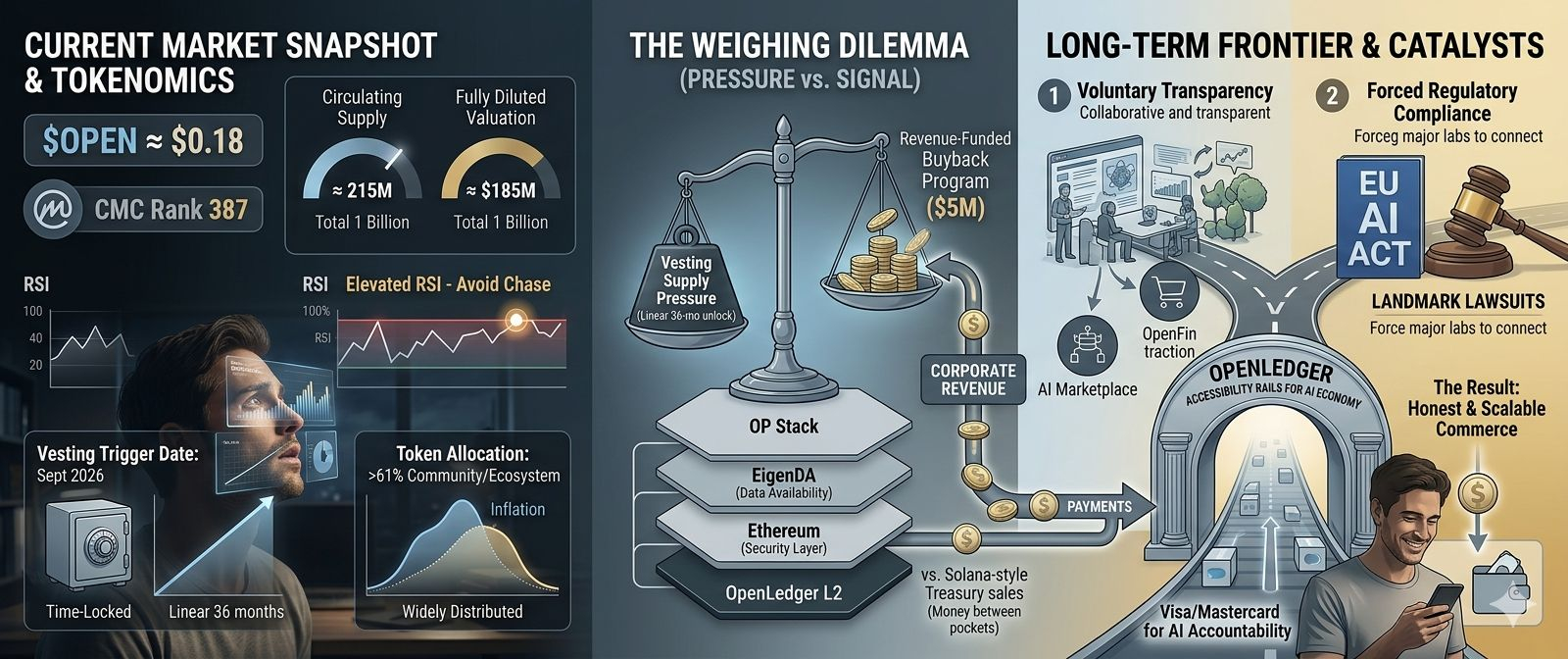
Now, I'll be honest about the token because anything else is just noise. OPEN is trading around $0.18, sitting at roughly rank 387 on CoinMarketCap with a market cap somewhere in the $50-55 million range. Fully diluted valuation — meaning what the market cap would be if all 1 billion tokens were circulating today — is around $185 million. Right now only about 215 million are actually in circulation. That gap matters because starting around September 2026, the team and investor vesting schedules begin their 36-month linear unlock. Real supply pressure, real and predictable. Anyone pretending otherwise isn't paying attention.
What I weigh against that is a couple of things. Over 61% of total token supply is allocated to community and ecosystem — so when inflation comes, it's distributed broadly, not concentrated through a small group of insiders cashing out. And the $5 million buyback program, funded by actual corporate revenue rather than treasury tokens, tells me there's a real business generating income underneath this. Compare that to projects on Solana — the high-speed blockchain often used for meme coins and high-frequency trading apps — where token buybacks routinely get funded by selling other treasury tokens, which is essentially moving money from one pocket to another. A revenue-funded buyback is a different signal entirely. It means someone is paying for the product.
From a pure chart standpoint the RSI has been elevated and I wouldn't chase it right now. But the window between now and the September unlock is the one I'm watching. If the AI Marketplace and OpenFin get real traction in that period, the demand story becomes hard to argue with regardless of what the supply schedule looks like.
The framing I keep landing on is this. Before Visa and Mastercard built payment rails in the 1970s, businesses could technically move money across borders — it was just slow, expensive, inconsistently tracked, and full of disputes. The rails didn't create commerce. They made commerce honest and scalable at a level it had never been before. OpenLedger is trying to build that layer for the AI economy. Not the AI itself. The accountability infrastructure underneath it.
What I genuinely can't answer yet is whether that infrastructure gets adopted because the industry chooses transparency — or whether it takes a wave of landmark lawsuits and regulatory mandates before anyone powerful enough to matter actually plugs in.