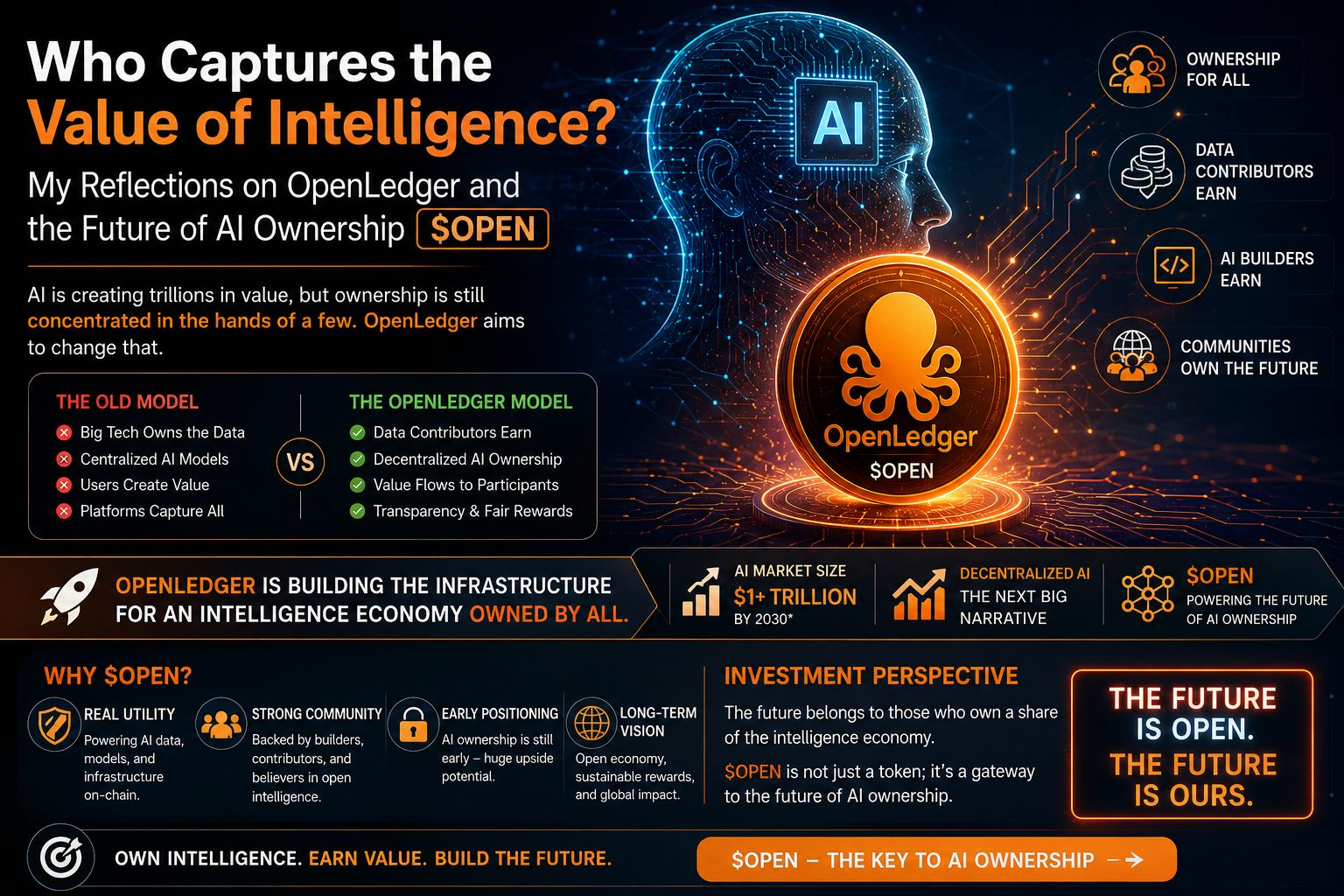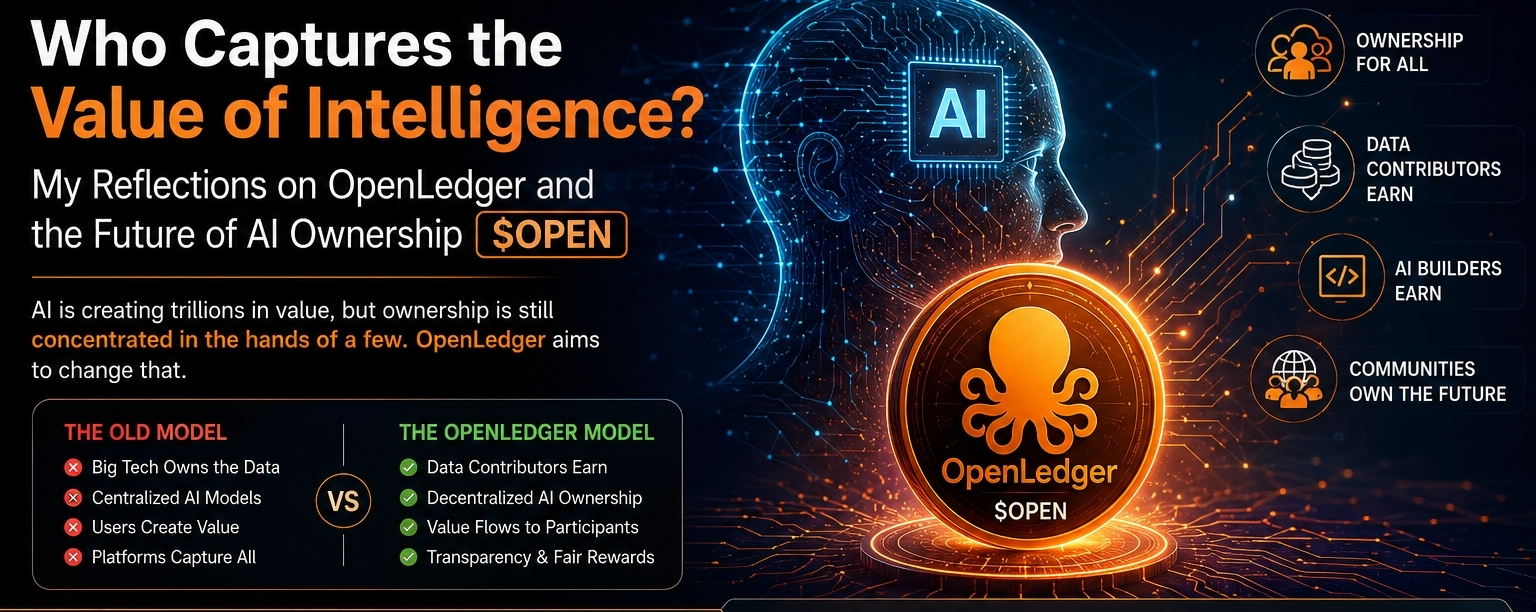
Artificial Intelligence is rapidly becoming the most valuable technology of our generation. Every day, millions of people interact with AI systems, generate data, create content, and contribute knowledge that helps intelligent models become smarter. Yet there is one question that almost nobody is asking:
Who actually captures the value created by intelligence?
Today, the answer is simple.
Mostly large corporations.
They collect the data, build the infrastructure, train the models, and monetize the intelligence layer that powers the modern digital economy. Meanwhile, the people who contribute the data, insights, and interactions that make these systems valuable often receive little or no direct ownership in the value they help create.
This is where I believe one of the most interesting narratives of the next crypto cycle begins.
And that narrative is represented by $OPEN and OpenLedger.
The AI Revolution Has a Value Distribution Problem
For years, the internet has operated on a familiar model.
Users create value.
Platforms capture value.
Whether it was social media, search engines, streaming platforms, or e-commerce ecosystems, the majority of economic rewards flowed toward centralized entities.
AI is following a similar path.
Every prompt, every dataset, every human feedback loop, and every interaction contributes to making AI systems better. Yet ownership remains concentrated.
As AI becomes a trillion-dollar industry, the gap between value creation and value ownership may become even larger than what we witnessed during the rise of Web2.
This creates a massive opportunity for decentralized alternatives.
Not because decentralization sounds attractive.
But because economic incentives matter.
And people naturally gravitate toward systems where they can participate in the upside.
Why OpenLedger Stands Out
OpenLedger is attempting to address one of the biggest challenges in AI:
Creating an ecosystem where intelligence itself becomes an ownable and rewardable asset.
Instead of concentrating value among a small group of centralized entities, OpenLedger focuses on building an infrastructure where contributors, developers, and data providers can participate in the economic value generated by AI.
That idea may sound simple.
But the implications are enormous.
Imagine a future where:
✅ Data contributors are rewarded.
✅ AI model creators earn directly from usage.
✅ Communities own parts of the intelligence economy.
✅ Value flows back to participants rather than exclusively to centralized corporations.
If AI truly becomes the most important technological infrastructure of the next decade, ownership models could become just as important as the technology itself.
And this is exactly where OpenLedger enters the conversation.
The Emerging Narrative Wall Street Hasn't Fully Priced In
Many investors remain focused on familiar crypto sectors:
Layer 1 blockchains
Meme coins
DeFi protocols
Gaming tokens
Meanwhile, AI infrastructure is quietly becoming one of the strongest narratives in both traditional finance and crypto.
Institutional capital is pouring billions into AI.
Governments are investing heavily in AI development.
Major corporations are racing to secure computing power and proprietary datasets.
Yet crypto investors often focus only on AI-themed speculation rather than infrastructure projects positioned to benefit from long-term industry growth.
OpenLedger represents exposure to a narrative that sits at the intersection of two of the fastest-growing sectors globally:
Artificial Intelligence + Decentralized Ownership.
Historically, the largest gains in technology revolutions rarely came from the end-user applications alone.
They often came from the infrastructure powering the ecosystem.
Why the Market May Be Underestimating $OPEN
The market frequently struggles to value projects that introduce entirely new economic frameworks.
Investors are comfortable evaluating exchanges, DeFi protocols, and payment systems because they have historical comparisons.
But valuing an intelligence economy is different.
There is no perfect precedent.
This uncertainty creates opportunity.
When a market does not fully understand an emerging category, assets within that category can remain undervalued until adoption accelerates.
The most significant opportunities often emerge before the broader market consensus forms.
By the time everyone understands the narrative, the easy upside is usually gone.
This doesn't guarantee success.
But it does explain why early positioning around powerful structural trends can be so rewarding.
AI Ownership Could Become the Next Major Crypto Theme
The crypto market evolves through narratives.
We witnessed:
The ICO era
The DeFi boom
The NFT explosion
The Layer 1 wars
The Real World Asset narrative
The AI infrastructure narrative
The next evolution may focus less on AI itself and more on ownership of AI-generated value.
This distinction matters.
Building intelligence is important.
Owning a share of intelligence-generated economic activity may be even more important.
As awareness grows around data rights, model ownership, decentralized AI infrastructure, and contributor incentives, projects positioned at this intersection could attract increasing attention from both retail and institutional participants.
OpenLedger appears to be positioning itself directly within that future.
The Investment Perspective on $OPEN
From an investment standpoint, I believe the appeal of $OPEN goes beyond short-term market movements.
The real thesis revolves around exposure to a structural shift.
Investors are no longer just evaluating blockchain adoption.
They are evaluating the future architecture of the intelligence economy.
Questions worth considering include:
How will AI-generated value be distributed?
Who owns the datasets powering future intelligence?
How can contributors participate economically?
What infrastructure enables decentralized AI ownership?
If OpenLedger successfully addresses even a portion of these questions, its long-term significance could extend far beyond typical crypto market cycles.
That is why many forward-looking investors are paying attention.
Not because of hype.
But because ownership has historically been one of the most powerful wealth-generating mechanisms in technology.
Final Thoughts
The AI revolution is no longer a future event.
It is happening now.
The question is not whether artificial intelligence will create enormous economic value.
The question is who will own that value.
For decades, technology has concentrated ownership into the hands of a few powerful platforms.
OpenLedger presents a different vision.
A future where intelligence is not only created collaboratively but also owned collaboratively.
Whether this vision ultimately succeeds remains to be seen.
However, one thing is becoming increasingly clear:
The conversation around AI is gradually shifting from "How intelligent can machines become?" to "Who benefits from the intelligence they create?"
And if that shift continues, $OPEN could become one of the most fascinating projects to watch as decentralized AI ownership moves from theory to reality.
In a market constantly searching for the next transformative narrative, OpenLedger is not simply betting on artificial intelligence.
It is betting on something potentially even more powerful:
The democratization of intelligence ownership itself. 🚀