
Market Overview
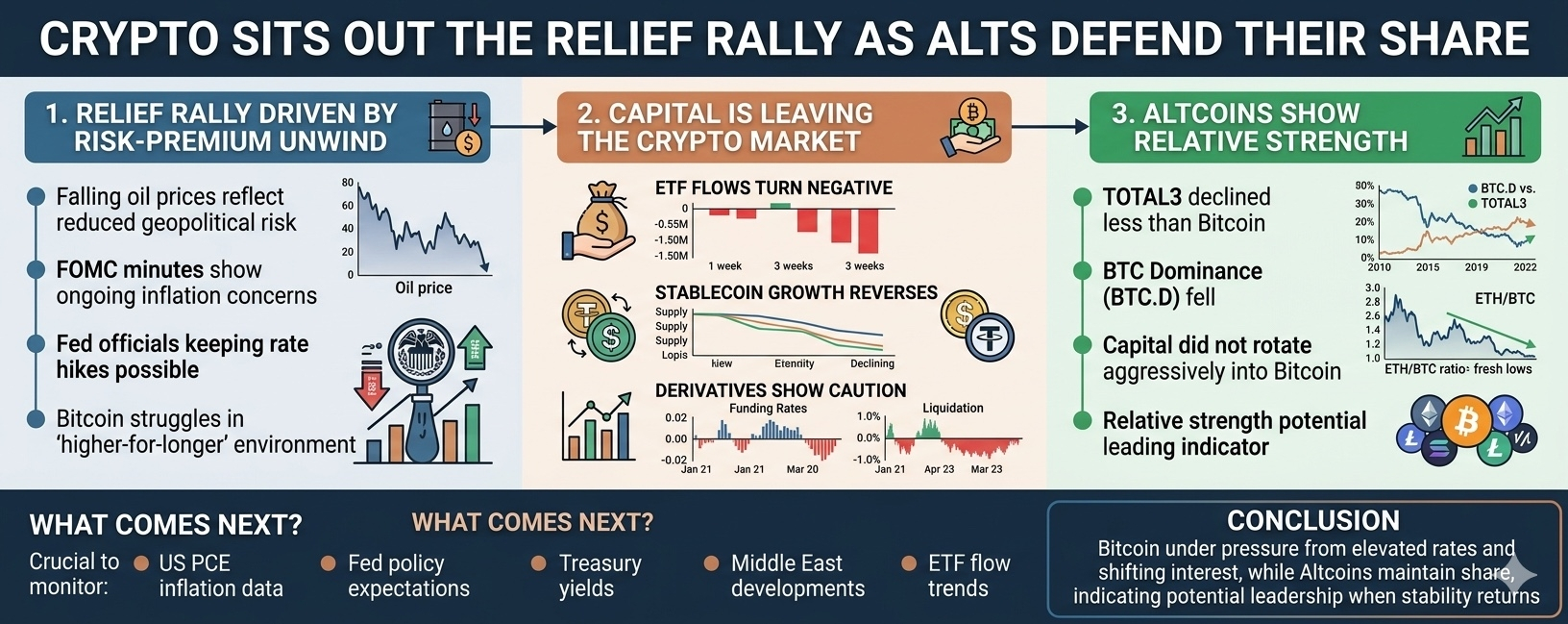
While global markets welcomed a relief rally driven by falling oil prices and easing bond yields, the cryptocurrency market remained notably subdued. Bitcoin underperformed traditional risk assets, capital flows weakened across multiple channels, and institutional attention continued shifting toward AI-related investments. Despite the broader weakness, altcoins displayed surprising resilience, potentially setting the stage for future outperformance.
1. Relief Rally Driven by Risk-Premium Unwind, Not Monetary Easing
The recent decline in crude oil prices and long-term Treasury yields was largely a result of easing geopolitical concerns rather than a shift toward accommodative monetary policy.
Progress in negotiations surrounding Middle East shipping routes reduced fears of an energy supply shock, causing oil prices to retreat and helping equities recover. However, investors should not mistake this development for the beginning of a new easing cycle.
Key Takeaways
◾ Falling oil prices reflect a reduction in geopolitical risk premium.
◾ FOMC minutes indicate policymakers remain concerned about inflation risks.
◾ Several Federal Reserve officials are reportedly moving away from an easing bias and keeping the possibility of future rate hikes on the table.
◾ The "higher-for-longer" interest-rate environment continues to pressure risk assets, particularly Bitcoin.
As a non-yielding asset, Bitcoin tends to struggle when real interest rates remain elevated. Without a strong crypto-specific catalyst, macroeconomic developments continue to dominate market direction.
2. Capital Is Leaving the Crypto Market
Despite improvements across equities and fixed-income markets, crypto liquidity conditions weakened throughout the week.
ETF Flows Turn Negative
Bitcoin spot ETFs recorded a third consecutive week of net outflows, effectively reversing much of the capital that entered during previous weeks.
Stablecoin Growth Reverses
Stablecoin supply, often viewed as a proxy for incoming crypto liquidity, shifted from rapid expansion to net outflows, signaling reduced investor participation.
Derivatives Show Continued Caution
Funding rates remain positive, but long liquidations continue to outpace short liquidations, suggesting leveraged bullish positions are still being unwound.
Market participants are beginning to see conditions that could support a short-term rebound, but risk appetite remains restrained.
Options Market Signals
◾ Demand for downside protection has eased from recent extremes.
◾ Traders remain willing to pay premiums for deep downside hedges.
◾ Markets are not yet pricing a complete return to risk-on conditions.
The foundation for a bounce is forming, but confirmation remains absent.
3. Altcoins Show Relative Strength
The most notable development this week came from the altcoin market.
Historically, Bitcoin weakness often results in capital rotating back toward BTC dominance. This time, the opposite occurred.
Evidence of Altcoin Resilience
◾ TOTAL3 declined only about half as much as Bitcoin.
◾ Bitcoin Dominance (BTC.D) fell approximately 0.3 percentage points during the selloff.
◾ Capital did not aggressively rotate back into Bitcoin despite broader market uncertainty.
This type of relative strength is often an early indicator of future altcoin leadership once Bitcoin stabilizes.
The primary exception remains Ethereum, which continues to underperform against Bitcoin and has recently reached fresh lows on the ETH/BTC ratio.
Nevertheless, broader altcoin participation suggests investors are selectively positioning for the next phase of the market cycle.
What Comes Next?
The current environment remains heavily dependent on macroeconomic developments.
Investors should closely monitor:
◾ US PCE inflation data
◾ Federal Reserve policy expectations
◾ Long-term Treasury yields
◾ Middle East geopolitical developments
◾ Bitcoin ETF flow trends
A stabilization in these factors could provide the foundation for renewed crypto strength. Until then, range-bound trading and selective altcoin opportunities remain the most likely scenario.
Conclusion
The latest relief rally across traditional markets was driven by a reduction in geopolitical risk rather than a shift toward easier monetary policy. As a result, Bitcoin remained under pressure from elevated real rates, weakening liquidity conditions, and ongoing institutional competition from the AI investment narrative.
While ETF outflows and stablecoin contraction signal continued caution, altcoins have quietly demonstrated relative strength. Their ability to maintain market share during a difficult period could become an important leading indicator if Bitcoin eventually finds stability and risk appetite returns.
Key Message
The crypto market may be cooling, but beneath the surface, altcoins are showing resilience that traders should not ignore.
#Bitcoin #Altcoins #CryptoMarkets #CryptoEducation #ArifAlpha