
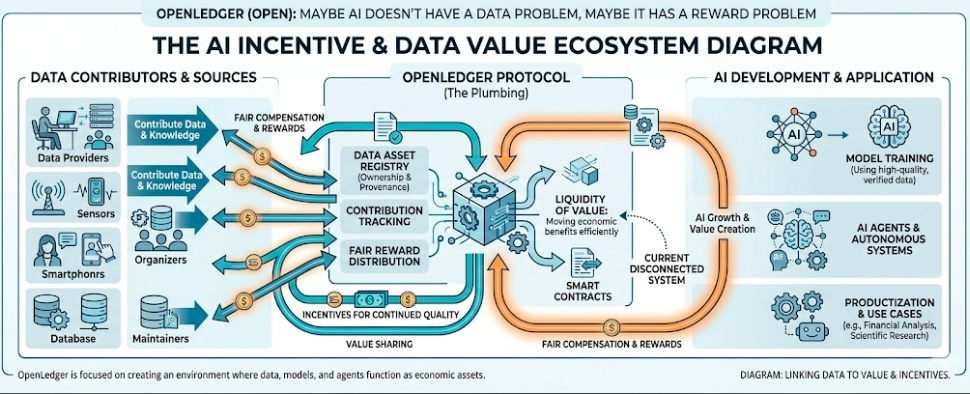
The more I watch the AI space grow, the more obvious the problem becomes.
Everybody wants data.
Everybody needs data.
Everybody says data is valuable.
But somehow the people creating that data usually get the worst deal in the entire system.
That's the part nobody likes talking about.
Companies build billion-dollar AI products. Models get smarter. Investors get excited. New startups pop up every week. Yet the people who actually provide the information that feeds these systems often get nothing after handing it over.
Their data disappears into a black box.
That's it.
No visibility. No ownership. No real share in the value that comes later.
And honestly, that's been bothering me for a while.
The AI industry keeps acting like bigger models are the answer to everything. More parameters. More computing power. More funding. More hype. But none of that changes a basic fact.
Garbage data creates garbage results.
Good data creates better results.
The entire machine depends on information.
Without data, AI is just an expensive calculator staring into space.
That's why projects like OpenLedger caught my attention.
Not because it's another blockchain. God knows we already have enough of those.
Every week there's a new chain claiming it will change everything. Most of them spend more time talking about future partnerships than building something people actually need.
After years of watching crypto, I've become pretty skeptical of big promises.
So when I look at OpenLedger, I try to ignore the marketing and focus on the actual problem it's trying to solve.
The problem is simple.
Data creates value.
Models create value.
AI agents create value.
The people contributing to those systems often don't.
That doesn't make much sense.
Think about it.
Someone provides useful information.
That information helps train a model.
The model becomes part of a product.
The product earns money.
The company grows.
The investors celebrate.
The original contributor usually gets forgotten.
The chain of value gets broken somewhere in the middle.
OpenLedger seems to be built around fixing that.
At least that's the idea.
Instead of treating data like some free resource floating around the internet, the network treats it as something that has actual economic value attached to it.
Which sounds obvious.
Because it is obvious.
But for some reason the AI world has spent years acting like data magically appears from nowhere.
It doesn't.
People create it.
People organize it.
People maintain it.
People spend time collecting it.
And if AI companies are going to build businesses on top of that work, there should probably be a better way to connect contributors to the value being generated.
That's where OpenLedger starts getting interesting.
The project talks a lot about liquidity.
Normally when people hear that word, they think about trading and finance.
I get it.
Crypto has beaten that idea into everyone's head.
But liquidity here feels a little different.
It's more about moving value around efficiently.
How does a data provider get rewarded?
How does a model creator earn from their work?
How does an AI agent participate in an economy?
How do all these pieces connect without some giant middleman taking control of everything?
Those questions matter.
Especially now.
Because AI is changing fast.
A couple of years ago everyone was obsessed with chatbots.
Now people are talking about agents.
Autonomous systems.
AI that can perform tasks.
AI that can make decisions.
AI that can handle workflows.
Whether that future arrives exactly as advertised is another discussion.
But it's clear we're moving toward systems that do more than answer questions.
And those systems will need data.
Lots of it.
Not just random internet content either.
Specialized information.
Financial information.
Medical information.
Scientific information.
Industry-specific information.
The kind of stuff that's hard to collect and expensive to maintain.
That raises a huge question.
Who gets paid?
Because right now the answer often feels like "not the people doing the work."
That's a problem.
A big one.
If contributors don't see value coming back to them, eventually incentives start falling apart.
People stop caring.
Quality drops.
Trust disappears.
The whole thing becomes weaker.
We've seen this happen before in tech.
Platforms become successful because of their communities.
Then the communities realize they're creating all the value while somebody else captures most of the rewards.
The relationship starts breaking down.
AI could run into the same issue.
Maybe it already is.
That's why I think infrastructure projects are more important than people realize.
Everyone gets excited about flashy applications.
Nobody gets excited about plumbing.
But good plumbing matters.
A lot.
OpenLedger feels like one of those projects trying to build the plumbing before the house gets too crowded.
The goal seems to be creating an environment where data, models, and agents can actually function as economic assets instead of isolated pieces sitting in separate systems.
That sounds boring compared to the usual crypto promises.
Which is probably a good sign.
I've reached a point where boring sounds better than revolutionary.
Boring means somebody might actually be solving a real problem.
The challenge, of course, is execution.
Ideas are cheap.
Crypto has never had a shortage of ideas.
Execution is where things get ugly.
Building fair reward systems isn't easy.
Tracking contributions isn't easy.
Preventing manipulation isn't easy.
Creating sustainable incentives definitely isn't easy.
People will try to game the system.
They always do.
Markets create opportunities.
They also create loopholes.
Any project trying to connect data ownership, AI development, and economic rewards is walking into a minefield of technical and economic challenges.
There's no way around that.
So no, I don't think OpenLedger has magically solved everything.
Nobody has.
But I do think they're looking in the right direction.
Because the biggest AI question isn't necessarily how smart the models become.
The biggest question might be who benefits when those models create value.
That conversation is coming whether people want it or not.
AI keeps getting more powerful.
The money flowing into the sector keeps increasing.
The number of companies building on top of AI keeps growing.
Eventually people are going to start asking harder questions about ownership, compensation, and fairness.
And honestly, they should.
Because technology doesn't exist in a vacuum.
Every system creates winners and losers.
Every platform creates incentives.
Every economy distributes value somehow.
The question is whether those systems are designed thoughtfully or whether they just happen by accident.
OpenLedger seems to be betting that the future AI economy needs better rules than the ones we have today.
Maybe they're right.
Maybe they're wrong.
But at least they're focused on a real issue instead of inventing another solution looking for a problem.
And after years of listening to crypto projects promise to reinvent civilization every six months, that alone is refreshing.
At the end of the day, AI runs on data.
That's the reality.
Not hype.
Not marketing.
Not fancy presentations.
Data.
People create that data.
People maintain it.
People improve it.
The future AI economy will eventually have to figure out how those people get rewarded.
The projects that solve that problem might end up being far more important than the projects with the loudest marketing campaigns.
OpenLedger is trying to be part of that conversation.
Now it just has to prove it can actually deliver.
