
@OpenLedger A few months ago, I came across a simple thought experiment.
Imagine the AI industry ten years from now.
Not next year.
Not after the next model release.
Ten years.
AI agents manage businesses.
Personal assistants negotiate services on your behalf.
Research systems generate discoveries.
Specialized models solve problems for entire industries.
Intelligence becomes abundant.
And suddenly a strange question appears.
If intelligence becomes everywhere, what becomes valuable?
At first, I thought the answer was obvious.
Better models.
But the more I considered it, the less convinced I became.
History usually works differently.
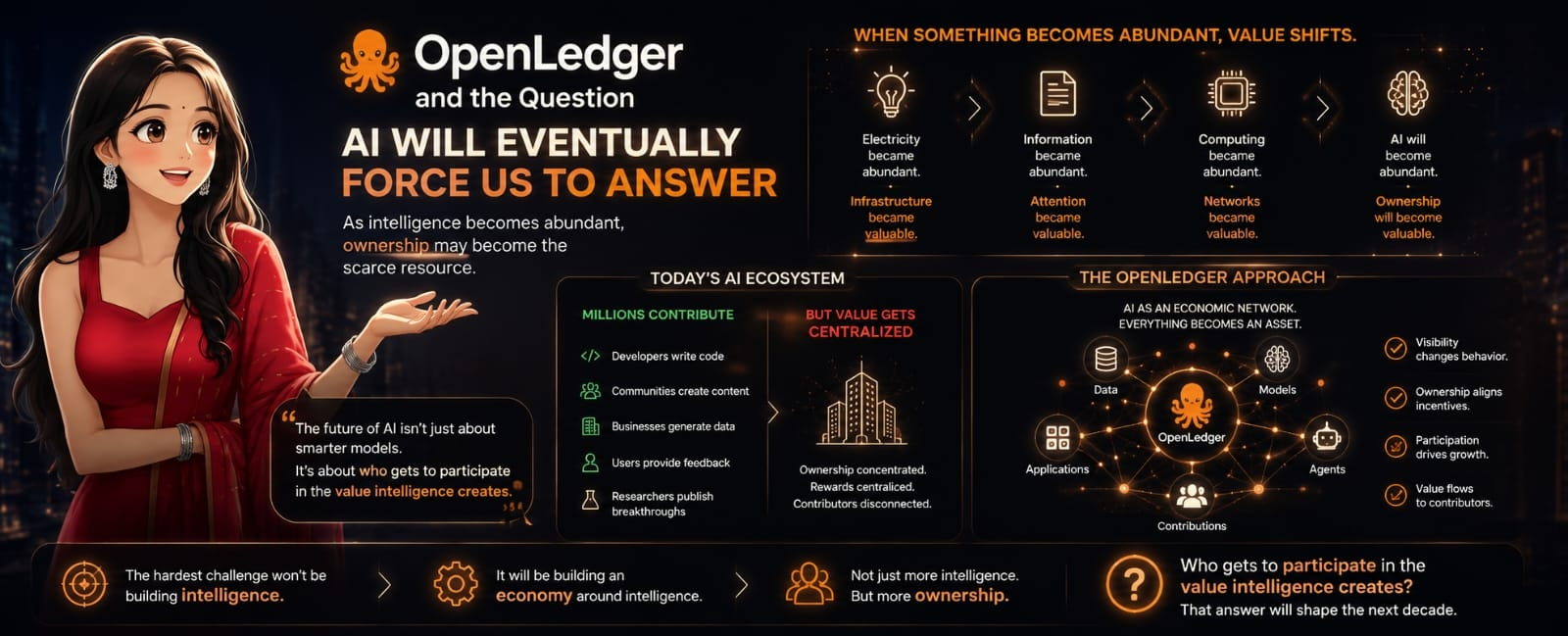
When something becomes abundant, value often shifts elsewhere.
Electricity became abundant.
Infrastructure became valuable.
Information became abundant.
Attention became valuable.
Computing became abundant.
Networks became valuable.
AI may be heading toward the same transition.
As intelligence becomes increasingly available, ownership may become the scarce resource.
And that's where OpenLedger starts becoming interesting.
Because #OpenLedger isn't built around the assumption that AI itself will remain scarce.
It's built around the idea that participation in the AI economy may become more important than the intelligence alone.
That sounds subtle.
But it's a huge difference.
Most AI conversations focus on outputs.
How smart is the model?
How good are the responses?
How fast can it reason?
OpenLedger seems focused on a different question:
Who benefits when intelligence creates value?
The first time I started thinking about that question, I realized how unusual today's AI ecosystem really is.
Millions of people contribute to it.
Developers write code.
Communities create content.
Businesses generate data.
Users continuously provide feedback.
Researchers publish breakthroughs.
Yet when value is created, ownership often becomes concentrated.
The contributors remain distributed.
The rewards become centralized.
That model worked during the early growth phase of AI.
But I'm not sure it works forever.
Because future AI systems won't just be products.
They'll be economies.
And economies need participants.
The more advanced AI becomes, the more interactions emerge between independent actors.
Datasets interact with models.
Models interact with applications.
Applications interact with agents.
Agents interact with other agents.
The network becomes increasingly complex.
At some point, the challenge stops being intelligence.
The challenge becomes coordination.
Who owns what?
Who contributed what?
How does value move?
How are incentives aligned?
Those questions start looking surprisingly important.
OpenLedger appears to be building around exactly that idea.
Rather than viewing AI as a collection of isolated systems, the protocol treats AI as an economic network.
Data becomes an asset.
Models become assets.
Agents become assets.
Contributions become assets.
Everything becomes economically visible.
That's a powerful concept because visibility changes behavior.
People contribute differently when ownership exists.
Developers innovate differently when rewards are transparent.
Communities grow differently when participation has economic meaning.
The system becomes stronger because incentives become aligned.
The more I think about it, the more OpenLedger reminds me of something that happened during the rise of the internet.
In the beginning, the internet was mostly about access.
Could people connect?
Could information move?
Could websites function?
Eventually those problems became solved.
Then attention became the valuable layer.
Then platforms.
Then networks.
The infrastructure evolved as the ecosystem matured.
AI may be entering a similar phase.
The technical breakthroughs are still important.
But increasingly, the larger question is economic.
How do we organize a world where intelligence is no longer rare?
How do we create ownership structures around digital labor?
How do autonomous systems participate in value creation?
How do contributors remain connected to the upside of the networks they help build?
These aren't questions for the distant future anymore.
They're beginning to emerge right now.
That's one reason I find OpenLedger more interesting the longer I follow the project.
It isn't trying to predict the next AI capability breakthrough.
It's trying to prepare for what happens after those breakthroughs become normal.
Because eventually the industry may discover something surprising.
The hardest challenge wasn't building intelligence.
The hardest challenge was building an economy around intelligence.
And those are very different problems.
One requires algorithms.
The other requires incentives.
One creates capability.
The other creates sustainability.
OpenLedger appears to be betting that both will matter.
Not just smarter AI.
But better participation.
Not just more intelligence.
But more ownership.
And if AI truly becomes one of the defining technologies of this century, that may end up being one of the most important questions anyone can ask.
Who gets to participate in the value intelligence creates?
The answer could shape the next decade of the AI economy far more than people realize today.
@OpenLedger #OpenLedger
#openledger $OPEN $OPENAI