
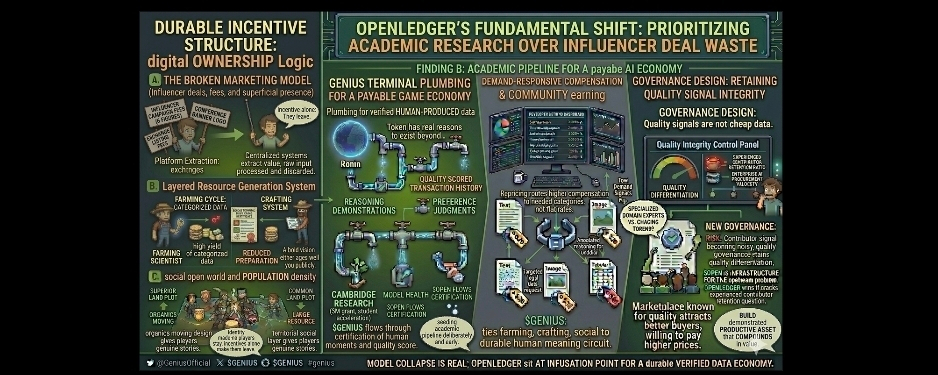
And Exchange Listings So When I Saw OpenLedger Put Five Million Into Cambridge University Research I Had To Read The Announcement Three Times
I have been in this industry long enough to know what most project treasuries actually get spent on. Exchange listing fees. Market maker agreements. Influencer packages that cost six figures for a single post. Conference sponsorships where the logo appears on a banner behind a stage that the project CEO stands on for eight minutes before the next sponsor takes their place. These are the standard line items in the Web3 marketing budget and I am not criticizing them entirely because visibility matters. But I am always paying attention to where the money that doesnt go to marketing actually goes because that allocation tells me something real about how a team thinks about the long-term durability of what they are building.
When @OpenLedger announced a five million dollar grant program in partnership with the Cambridge University Blockchain Society in December 2025 my first reaction was genuine surprise. Not because the amount is enormous but because the specific use of that capital is something I have almost never seen a crypto project do deliberately and early. The program provides non-dilutive funding specifically to student researchers and open-source teams working on transparent datasets verifiable training pipelines attribution-driven reward systems and language models built directly on the OPEN mainnet. Non-dilutive means the researchers keep their work. Nobody takes equity. Nobody extracts ownership of the output. The grants exist to accelerate research that advances the ecosystem rather than to generate returns for the program operator.
The reason this matters strategically is something most people dont think about until a project has already been around for five years. The developers who build the most important applications on any blockchain infrastructure are disproportionately the people who learned that infrastructure during their research or early career phase. Ethereum became the dominant smart contract platform partly because it was the chain that academic researchers and early developers studied built on and published about during the years when it had no users and negligible token price. Those researchers became the founders of the protocols that eventually drove Ethereum adoption and their familiarity with the base layer from those early days created a compounding network of builders that competing chains have spent years trying to replicate.
@OpenLedger is seeding that same academic pipeline deliberately and early by making sure that the researchers at Cambridge who will graduate in the next two to four years and start building AI-blockchain applications have spent their research period working directly on the OPEN mainnet with funded projects that produced real outputs. That is not a marketing decision. That is a long-term ecosystem development decision and the two things produce very different kinds of compounding value over time.
My hot take is blunt. The projects that spent their 2025 treasury on celebrity Twitter posts and exchange listing packages will spend 2027 wondering why nobody is building on their chain. The project that funded Cambridge researchers to build transparent AI systems on its mainnet will spend 2027 watching those same researchers launch protocols that drive actual usage. I know which outcome I am betting on when I look at a 54 million dollar market cap token with an eight million dollar raise from Polychain and a team that decided academic research was worth more than another influencer campaign.
The five million dollar Cambridge program is the most honest signal I have seen from @OpenLedger about what kind of project this actually is underneath the token price and the partnership announcements.
