

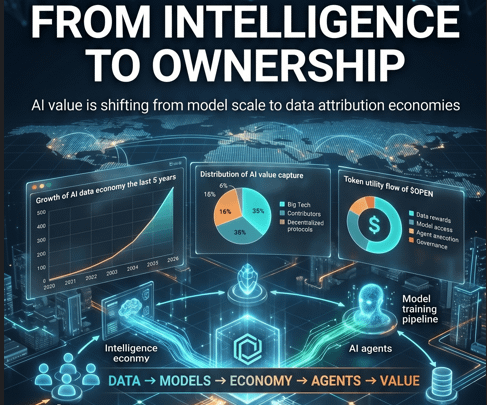
For years, the AI conversation followed a predictable pattern. Bigger models meant progress. More compute meant competitive advantage. Faster inference meant better products. Like most people watching the space, I assumed intelligence itself would become the scarce resource. But recently, I started noticing something strange. AI systems are improving rapidly, yet the economic structure behind them still feels surprisingly incomplete.
The more I looked at it, the more one question kept appearing: who actually captures value when AI creates value? Every day, millions of people generate data, developers build models, contributors refine datasets, and increasingly, agents perform tasks autonomously. Yet most participants contribute inputs while very few capture long-term economic upside. That imbalance feels increasingly difficult to ignore.
This is where @OpenLedger started becoming interesting to me not because it promises another AI narrative, but because it approaches the problem from a different direction. Instead of treating data, models, and agents as isolated components, @OpenLedger appears to be building infrastructure where all three can participate inside the same economic system through attribution, incentives, and on-chain ownership.
What caught my attention most is how this changes incentives. If contributors can prove their data continues improving model outputs, that contribution can remain economically valuable beyond the moment it enters the system. If AI agents generate utility, they become participants rather than simple software. Suddenly, the conversation shifts from simply building intelligence toward creating systems that can measure and reward contribution over time.
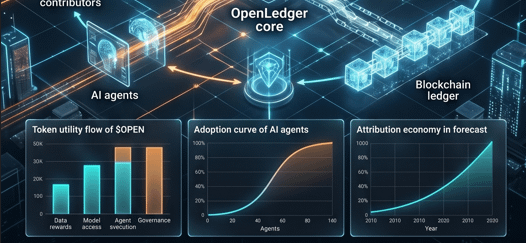
The token itself reflects this broader design. $OPEN is positioned across multiple layers of the ecosystem including transaction fees, governance, inference payments, validator incentives, contributor rewards, model deployment, and ecosystem coordination. The supply structure is also worth paying attention to. With a fixed supply and significant allocation toward ecosystem incentives, builders, contributors, and community growth, the network appears optimized around participation rather than concentrating value exclusively at the beginning.
What makes this thesis interesting is not the technology itself. It's the behavioral shift it could create. Once contribution becomes measurable, participants stop optimizing only for volume. They start optimizing for durability. And historically, systems tend to change when incentives change. Search engines changed content creation. Social media changed distribution. AI ownership infrastructure could potentially reshape how intelligence itself gets built.
Of course, none of this guarantees success. Attribution is difficult. Reward systems are often exploited. Measuring contribution inside complex AI systems is messy by definition. Execution matters far more than narratives, especially in sectors where everyone is competing to become infrastructure. But difficult problems are usually where large opportunities exist in the first place.
I keep coming back to one idea. The internet created massive economies around information distribution. AI may create economies around information ownership. If that happens, the biggest winners may not simply be the projects creating intelligence, but the infrastructure determining who gets rewarded when intelligence creates value.
What do you think?
Will AI economies reward creators, contributors, or infrastructure providers?
