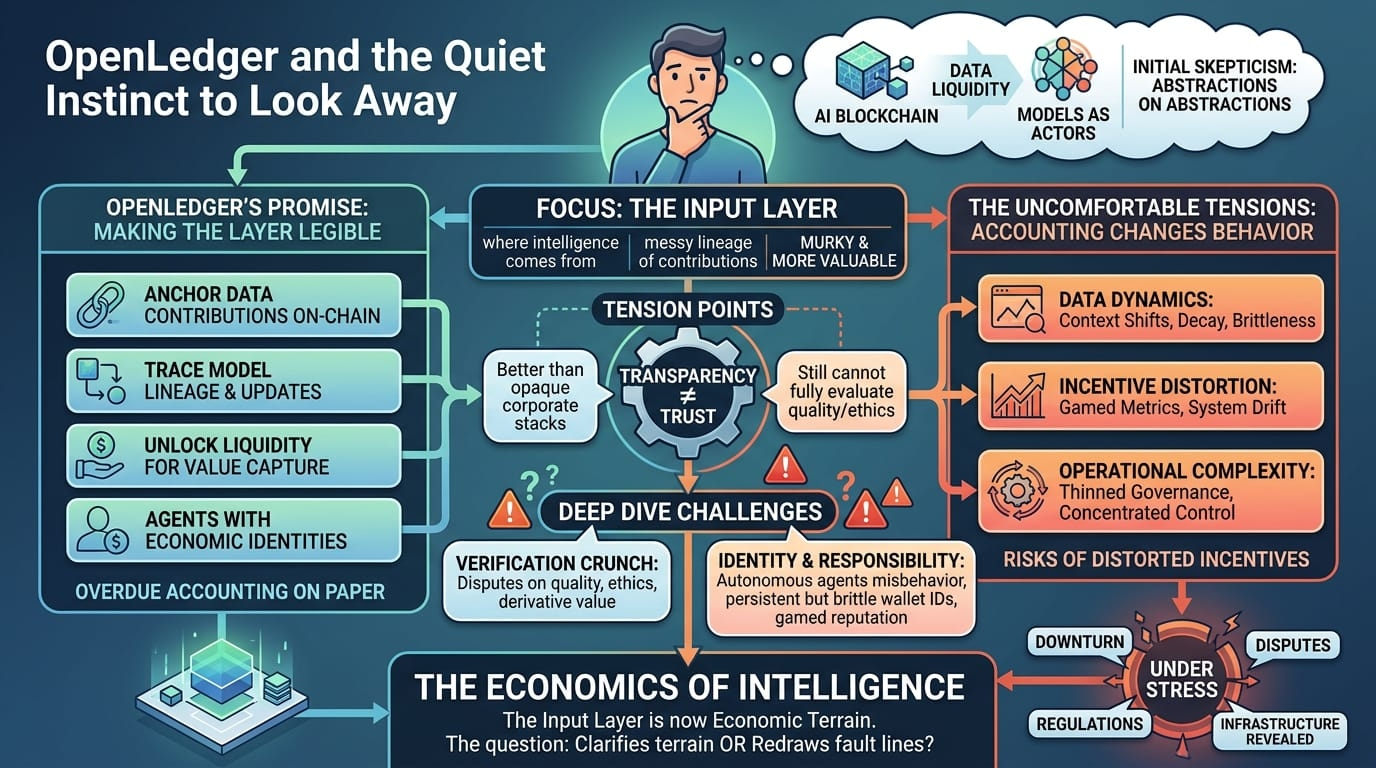
I didn't take it seriously at first. That's become a reflex. AI blockchain. Liquidity for data. Models and agents as economic actors. It sounded like the industry stacking abstractions on top of abstractions again. We've done this before convince ourselves that naming the infrastructure makes it durable.
But I've also learned that sometimes the projects that feel too narrative aligned are the ones circling real tension. And OpenLedger keeps circling one I can’t ignore.
The input layer.
We talk about AI outputs constantly. Performance charts, inference costs agent workflows. The visible surface. What we rarely linger on is where the intelligence actually comes from the data, the iterative model updates, the messy lineage of contributions that accumulate into something that feels coherent.
That layer is murky. And it's getting more valuable.
OpenLedger's premise as I understand it is simple enough make that layer legible. Anchor data contributions and model lineage on chain. Unlock liquidity so participants can capture value from the intelligence they help shape. Let agents transact with persistent economic identities.
On paper it sounds like overdue accounting.
But accounting changes behavior.
That's where things start to feel uncomfortable.
Data is not a static asset. It decays. Context shifts. A dataset that improves performance in one domain might quietly introduce brittleness in another. Once liquidity enters the picture, participants optimize for whatever is rewarded. If contribution metrics are gamed the system drifts.
Crypto has shown us this pattern repeatedly. Incentives align early then distort slowly. Governance participation thins. Operational complexity concentrates in the hands of those who can afford to manage it. The system still runs it just becomes narrower than intended.
Maybe that's too harsh. A transparent ledger does create a kind of accountability. It's better than the alternative of opaque corporate AI stacks where provenance and compensation are hidden behind APIs.
Still transparency isn't the same as trust.
I keep coming back to verification. A blockchain can record that a dataset was submitted. It can timestamp model updates. But it can't fully evaluate the quality or ethical integrity of the data. It can’t resolve disputes about derivative value in a way that satisfies everyone.
And then there's identity. If agents earn and transact autonomously who bears responsibility when they misbehave? Wallet based identity is persistent in theory but brittle in practice. Reputation systems can be gamed. Sybil resistance is always incomplete.
I didn't take it seriously at first because it felt like monetizing the fog. But ignoring the economics of intelligence doesn't dissolve them. If AI is becoming infrastructure someone will own the rails. The question is whether those rails are public and contestable or private and opaque.
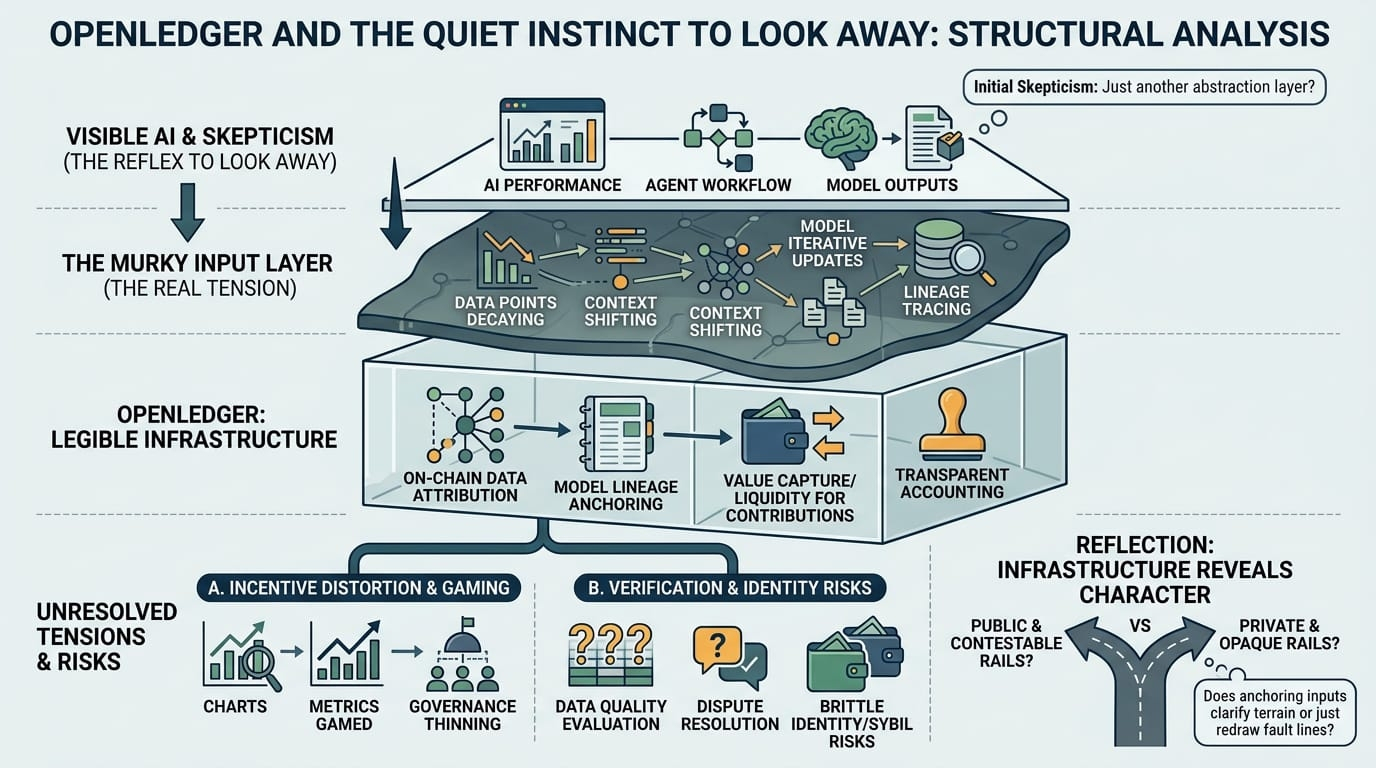
OpenLedger feels like an attempt to build the boring rails early. The attribution layer. The value capture layer. The record keeping layer that no one gets excited about until something breaks.
And things will break.
I keep wondering how this system behaves under stress during a downturn, during a dispute over misattributed contributions during regulatory pressure around data rights. Infrastructure reveals its character in those moments.
I don't have a clean answer. I just know the input layer of intelligence is no longer background noise. It’s economic terrain now.
Whether putting it on chain clarifies the terrain or just redraws the fault lines I'm still thinking about that.