


Stop seeing OpenLedger as one thing! That was honestly the mistake I kept making at first.
I was trying to understand it like a single product. Like okay, is this an AI chain? Is it a data platform? Is it a model marketplace? Is it some rewards system? Is it another AI crypto project with a fancy name around ownership?
But the more I looked at it, the more that framing started feeling too small.
OpenLedger makes more sense when you stop trying to put it into one box.
It’s not just data.
It’s not just models.
And once that loop clicks, the whole thing starts feeling different.
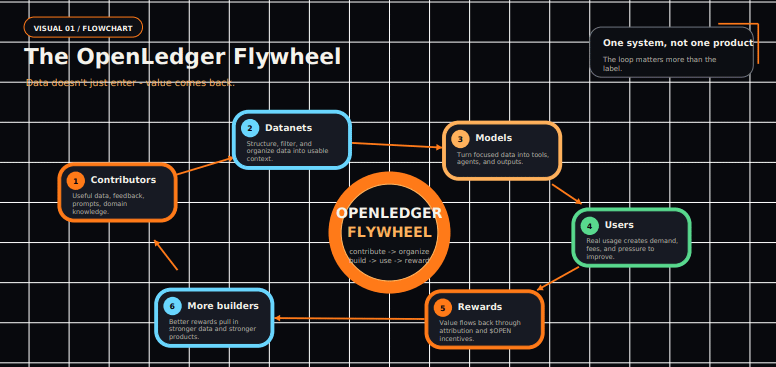
The OpenLedger flywheel is actually pretty simple in theory.
People contribute data.
That data gets organized through Datanets.
Models use that data.
Value flows back.
And if that cycle keeps moving, OpenLedger stops looking like a normal project and starts looking like an ecosystem that can feed itself.
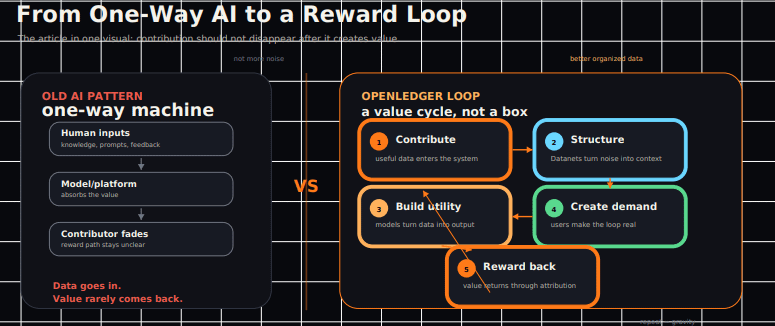
That’s where it gets interesting. Because most AI systems today feel one-directional. Data goes in, but nothing really comes back. People create content, share knowledge, label things, write prompts, provide feedback, build communities, train behavior indirectly, and then somehow all of that disappears into a black box.
The model gets smarter. The platform gets richer. The contributors become invisible. That’s been the normal pattern.
OpenLedger is trying to challenge that pattern.
Not by saying “AI is bad” or “models shouldn’t exist.”
Nah, that’s not the point.
The point is simpler.
Someone adds useful data. Maybe it’s domain knowledge. Maybe it’s niche information. Maybe it’s structured feedback. Maybe it’s a specialized dataset that a general model would never understand properly on its own.
That data alone isn’t enough though.
Raw data is messy.
Random uploads don’t magically become valuable just because they exist on-chain. This is where Datanets matter.
To me, Datanets are the part that makes OpenLedger feel more organized than a basic “upload data and earn” idea.
Because if everyone throws random information into the same giant bucket, you don’t get intelligence.
You get noise.
And AI already has enough noise.
Datanets create structure around the contribution. They make the data more focused. More useful. More connected to a specific purpose.
That matters because specialized AI won’t be built from random scraping forever.
At some point, models need cleaner inputs.
Better context. More relevant data....
Data that actually understands one area deeply instead of pretending to understand everything equally.
That’s why I think the OpenLedger flywheel doesn’t really begin with “more data.”
It begins with better organized data.
There’s a big difference. More data can make a system heavier. Better data can make it sharper.
Once the data is organized, the next stage is models.
This is where the flywheel starts turning from contribution into utility.
Because data only becomes valuable when something useful can be built from it.
A dataset sitting still is just potential.
A model using that dataset turns it into output. Now the contribution becomes part of something people can actually interact with. this is where OpenLedger’s model layer becomes important.
Builders can take focused data and create models around it.
Those models can serve users.
They can answer better.
They can operate in specific markets. They can support agents. But they don’t always explain where demand comes from. Because rewards without demand are just emissions.
That’s not a flywheel.
That’s a leak.
For OpenLedger to work long term, models need actual usage.
People need to use what gets built.
Builders need a reason to create.
Users need a reason to return.
The ecosystem needs demand that isn’t only based on farming or speculation.
That’s the part I keep watching.
Because if users actually need these models, then the rewards become more meaningful.
Usage creates fees.
contribute → organize → build → use → reward → repeat.
Simple, but powerful if it actually works.
The reward part is important because it changes the emotional logic of AI participation.
Right now, most people contribute to AI systems without even thinking about it.
Every post, comment, dataset, correction, prompt, rating, explanation, and niche insight can help shape some kind of intelligence somewhere.
But the reward system is broken.
Most contributors get attention at best.
Sometimes nothing.
Usually nothing.
OpenLedger is trying to create a system where contribution can be traced and rewarded instead of swallowed.
That sounds small until you think about how big AI could become.
If AI becomes part of work, creativity, business, research, automation, and finance, then the question becomes obvious:
Who gets paid when intelligence creates value?
Or also the people whose data, feedback, and knowledge helped make the system useful?
That’s the deeper question inside OpenLedger.
And honestly, this is why I don’t see it as just another AI coin.
The token is only one piece.
The more important thing is the value loop.
If $OPEN is used inside that loop for rewards, fees, incentives, and governance, then it becomes tied to ecosystem activity.
But again, that only matters if the loop actually has real activity.
The system has to prove that useful data attracts builders, builders create useful models, users create demand, and rewards pull in even better contributors.
That’s the whole game.
If one part breaks, the flywheel slows down. It feels like infrastructure that still has to prove itself. But that doesn’t make it less interesting.
Actually, most infrastructure feels boring or incomplete before people understand why it matters.
The internet had protocols before apps.
DeFi had rails before the real liquidity came.
L2s had to build settlement and execution layers before users cared about chain design.
Now AI might need attribution and ownership rails before people realize how broken the current value flow is.
That’s where OpenLedger could fit. Not as the shiny model everyone talks to. Not as the loud app everyone posts screenshots of.
That’s the economic layer of AI.
My personal view is this:
If OpenLedger succeeds, it won’t be because people suddenly love the word “Datanets.”
It won’t be because every trader understands attribution overnight.
It won’t even be because AI is a hot narrative.
It’ll be because the loop starts working.
Contributors see value. Builders see useful data. Models improve.
Users create demand. Rewards flow back. More people join.
The cycle repeats.
That’s when OpenLedger becomes more than a project.
That’s when it becomes a living system.
And that’s the part I think the market might still be underestimating.
Users create demand.
Rewards bring the value back.
That’s the whole flywheel.
And if it keeps spinning, $OPEN starts looking less like a narrative trade and more like the coordination layer behind a new AI economy.
@OpenLedger #OpenLedger $OPEN
