

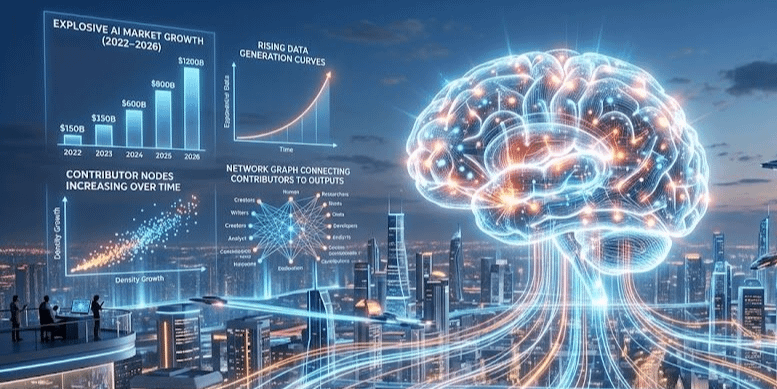
A few days ago I opened an old folder while searching for a document and ended up scrolling through screenshots, saved charts, copied notes, and random files with names I barely understood anymore. What surprised me wasn't the mess itself. It was realizing how difficult it had become to remember where many ideas originally came from. Some notes were mine, some came from articles, some from conversations. Eventually everything blended together until ownership itself started feeling unclear.
That small frustration stayed in my head because AI increasingly feels similar. Most conversations around AI still revolve around the same assumption: better models create more value. Bigger models, faster inference, more parameters. The model usually sits at the center of the story. But the more I use AI tools daily, the more this assumption feels incomplete because models may generate outputs, but outputs are still built on layers of knowledge produced by millions of contributors who rarely appear anywhere in the economic equation.
This creates a strange question. If intelligence increasingly depends on collective contributions, why do our systems still behave as if intelligence comes from isolated machines? That question slowly changed how I think about data itself. People call data fuel, but fuel gets consumed. Data behaves differently. It compounds, interacts with other information, and often becomes more valuable when combined with additional context. Maybe data resembles infrastructure more than fuel.
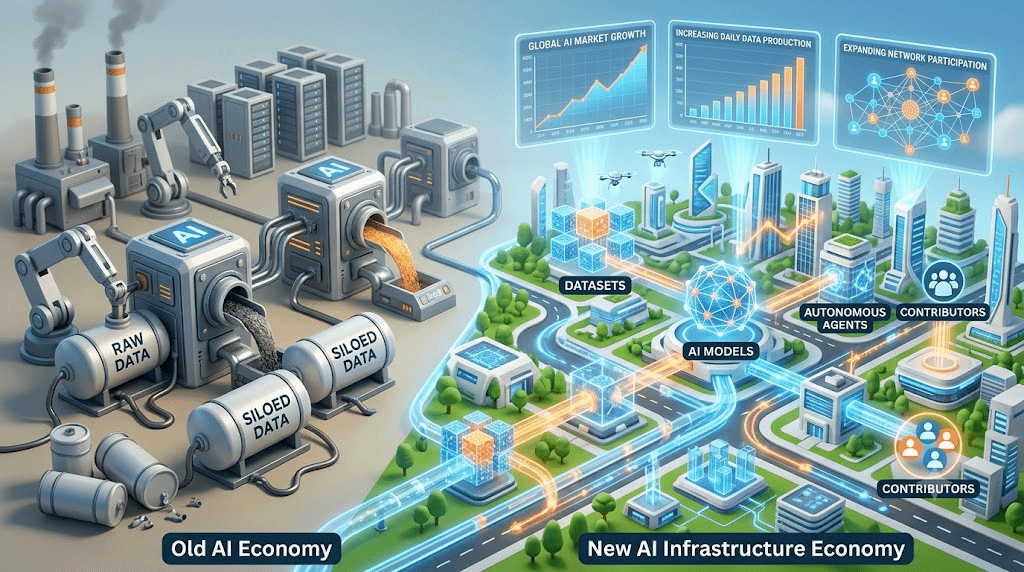
This is partly why @OpenLedger caught my attention. Not because it is another AI narrative, but because it indirectly raises a larger possibility. What if AI is not primarily a model-building problem? What if it is a coordination problem? Because once contributors matter economically, entirely new questions appear. Who gets rewarded? What incentives keep participants contributing useful information repeatedly instead of only once?
Of course, this creates uncomfortable complications. Measuring contribution itself becomes messy. A dataset influences a model, that model influences another model, agents build on previous outputs, and eventually tracing value creation becomes extremely difficult. Some people would argue attribution at scale may simply be impossible. They may be right.
But economic systems rarely wait for perfect measurement. Markets operate with incomplete information constantly. Labor markets, financial markets, even advertising markets function despite enormous uncertainty. Maybe the important question is not whether attribution becomes perfect. Maybe the question is whether economic relationships around intelligence become better than what exists today.
Sometimes I think we may be watching a larger transition happen quietly. Knowledge becoming infrastructure. Ownership becoming participation. Intelligence becoming coordination. If this shift happens, projects like @OpenLedger may matter less because of technical architecture and more because of the economic relationships they attempt to create around intelligence itself.

Or maybe none of this happens. Maybe attribution remains too difficult. Maybe coordination becomes too expensive. Maybe intelligence stays centralized. I still think about that old folder sometimes because AI increasingly feels similar: thousands of fragments, thousands of invisible contributors, and growing uncertainty about where intelligence actually begins.
