
@OpenLedger I’ll be Honest while scrolling through crypto posts with my coffee half-finished beside me, I noticed something funny.
Everyone seems obsessed with the next AI model.
Bigger models.
Smarter agents.
Faster responses.
But almost nobody is asking a question that feels far more important:
Who actually owns the value being created?
The more I thought about it, the more I realized that AI might not have a technology problem at all. It might have an economic problem.
And that’s exactly why OpenLedger caught my attention.
A few weeks ago, I completed some OpenLedger ecosystem tasks and spent time reading through the project’s vision. I expected another “AI + Blockchain” narrative because, let’s be honest, crypto has seen hundreds of those already.
Most disappear as quickly as they arrive.
But OpenLedger felt different.
Not because of flashy marketing.
Not because of promises.
Because it focuses on something people rarely discuss.
Value attribution.
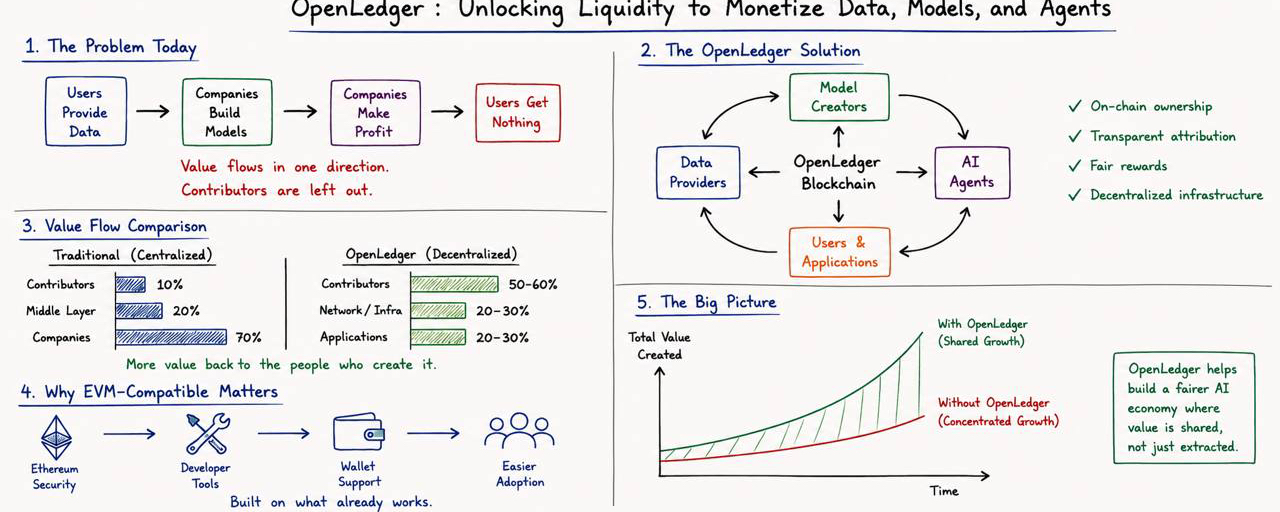
If data trains models, and models power AI agents, shouldn’t the people contributing those resources have a way to participate in the value created?
Seems obvious, right?
Yet most systems today don’t really work that way.
From what I’ve seen, AI is becoming one of the biggest infrastructure layers of the internet.
Companies collect data.
Models get trained.
Products get launched.
Revenue gets generated.
The problem is that contributors often become invisible somewhere along the process.
That’s where OpenLedger enters the conversation.
Instead of treating data as something that disappears into a black box, OpenLedger is building an AI Blockchain designed to make data, models, and agents part of an on-chain economy.
When I first understood that idea, I stopped thinking about OpenLedger as an AI project.
I started thinking about it as an economic network.
And that’s a completely different lens.
I’ve become pretty skeptical whenever I hear people throw around buzzwords.
AI.
Web3.
Decentralized infrastructure.
Autonomous agents.
We’ve all seen projects stack every trending narrative into a single sentence
But in OpenLedger’s case, the Web3 component feels necessary.
Blockchain creates transparent records.
On-chain systems create verifiable ownership.
Decentralized networks allow multiple participants to contribute instead of relying on a single authority.
Without those elements, rewarding contributors fairly becomes much harder.
It’s one of the rare situations where blockchain feels like part of the solution rather than a marketing accessory.
One mistake I made earlier this year was buying into a token mostly because social media was talking about it.
No research.
No understanding of the product.
Just pure narrative.
My PNL reminded me very quickly why that’s a bad strategy
Since then, I’ve started paying closer attention to utility.
What problem is being solved?
Who benefits?
Why does the network need to exist?
OpenLedger scores reasonably well on those questions.
The project isn’t trying to build another meme narrative.
It’s trying to create infrastructure where contributors, developers, and AI systems can interact within a shared economic framework.
That’s a lot more interesting to me than another token promising “revolutionary” speed improvements.
One detail I appreciate is OpenLedger’s EVM compatibility.
That might sound boring, but boring infrastructure often wins.
Developers already know Ethereum tools.
Wallet support already exists.
Smart contract environments are familiar.
Instead of forcing users into an isolated ecosystem, OpenLedger can leverage the foundations that Ethereum helped establish.
From my experience, adoption becomes easier when people don’t need to relearn everything from scratch.
That’s one reason EVM-compatible projects continue attracting builders.
The barrier to entry stays lower.
Something I keep coming back to is the word infrastructure.
Most crypto users focus on applications.
Few pay attention to the systems underneath them.
Roads aren’t exciting until you need them.
Power grids aren’t exciting until they fail.
Infrastructure works the same way.
OpenLedger appears focused on becoming a foundational layer where AI resources can be tracked, attributed, and monetized.
If that vision works, users may never think about the infrastructure itself.
They’ll simply use products built on top of it.
Ironically, that’s usually a sign that infrastructure is doing its job.
That said, I don’t think the story is risk-free.
Far from it.
Building technology is one challenge.
Building participation is another.
For OpenLedger’s model to succeed, contributors need to keep providing valuable data.
Developers need incentives.
Users need reasons to engage.
Maintaining quality across a decentralized network is difficult.
Sometimes very difficult.
If participation slows or incentives become misaligned, even strong technology can struggle.
That’s probably the biggest thing I’ll be watching over the coming months.
I think many people are looking at OpenLedger and seeing an AI Blockchain.
I’m looking at it slightly differently.
I see an attempt to create a market around data, models, and agents.
A system where value can move back toward contributors instead of remaining trapped inside closed ecosystems.
Will it work perfectly?
Probably not.
No emerging network does.
But the idea itself feels relevant because the AI economy is growing whether we’re ready or not.
The bigger question is who gets rewarded when that economy expands.
And honestly, that question feels much more important than whether the next model is 10% smarter than the previous one.