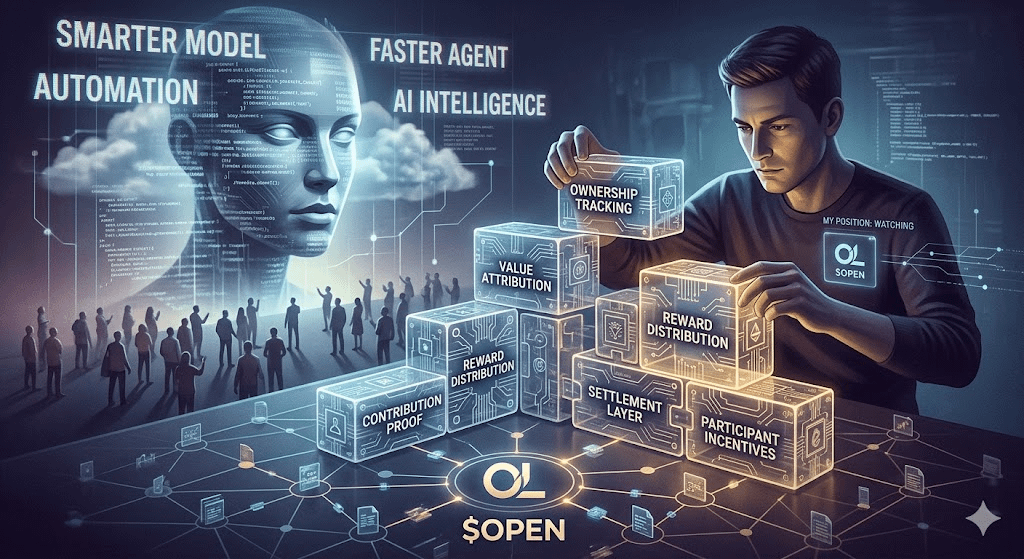
A few days ago, I added a small $OPEN position.
Nothing aggressive. It was one of those "buy enough to pay attention" trades rather than a high-conviction bet. I've learned over the years that putting a little capital at risk forces me to research more seriously than simply reading threads and scrolling timelines.
The interesting thing is that the more I looked into OpenLedger, the less I viewed it as an AI project.
That sounds strange because AI is obviously the headline. Most people see OpenLedger and immediately think about models, agents, and automation.
But that's not what kept my attention.
The question that kept coming back to me was much simpler:
If AI starts creating economic value, who actually gets paid?
Most discussions around AI focus on intelligence. Which model is smarter? Which agent is faster? Which system can perform more tasks?
Those are important questions, but they're not economic questions.
Economic systems need rules around ownership, incentives, attribution, payments, and verification.
Without those layers, value gets created but nobody can clearly determine who deserves the rewards.
That's where OpenLedger started looking different to me.
One thing that stood out was the contrast between the capital they raised and the way they're deploying resources. Plenty of projects raise funding and spend it entirely on product development. OpenLedger appears to be thinking about ecosystem formation as well.
That distinction matters.
Building a product and building an economy are not the same thing.
A product can succeed on its own.
An economy requires participants who all benefit from interacting with one another.
The more I looked at components like Datanets, OpenLoRA, Model Factory, OctoClaw, attribution systems, payments infrastructure, and bridging solutions, the more I stopped seeing separate products.
Instead, I started seeing pieces of a larger framework.
The non-obvious insight for me is that AI may eventually face the same challenge crypto faced years ago.
Creating value is one problem.
Distributing value is another.
In crypto, blockchains solved transaction settlement, but entire industries emerged around custody, liquidity, incentives, governance, and infrastructure.
I think AI could follow a similar path.
Imagine a future where an AI model is trained using contributions from thousands of people.
Someone provides data.
Someone improves the model.
Someone deploys the agent.
Someone supplies computational resources.
Someone integrates it into an application.
The AI generates revenue.
Now what?
Who receives compensation?
How do contributors prove participation?
How is ownership recorded?
How are rewards distributed?
Most AI conversations skip those questions entirely.
OpenLedger seems to be focusing directly on them.
That's why I don't think the project's biggest competitor is another AI model.
It may not even be competing in the same category.
The way I see it, OpenLedger appears to be positioning itself around the infrastructure layer that sits underneath AI activity.
The layer that handles attribution, incentives, verification, coordination, and settlement.
And honestly, that's a harder thesis to evaluate.
It's much easier to measure model performance than it is to measure economic infrastructure before adoption arrives.
That's also why I'm keeping my position relatively small for now.
I still have doubts.
The vision is ambitious, and ambitious visions don't automatically translate into successful execution.
I've made that mistake before—buying into narratives long before the underlying ecosystem was mature enough to support them.
But I also know that sometimes the market spends years focusing on the visible layer while quietly ignoring the infrastructure beneath it.
Right now, most people seem focused on what AI can do.
I'm becoming more interested in how AI-generated value gets tracked, owned, verified, and distributed.
Those aren't the most exciting topics on the surface.
They don't create flashy demos.
But they're the kind of problems every functioning economy eventually has to solve.
That's why I'm watching $OPEN.
Not because I think it's building the smartest AI.
But because I think it might be trying to answer a more important question:
If AI becomes productive, who owns the value it creates?
@OpenLedger $OPEN #OpenLedger