
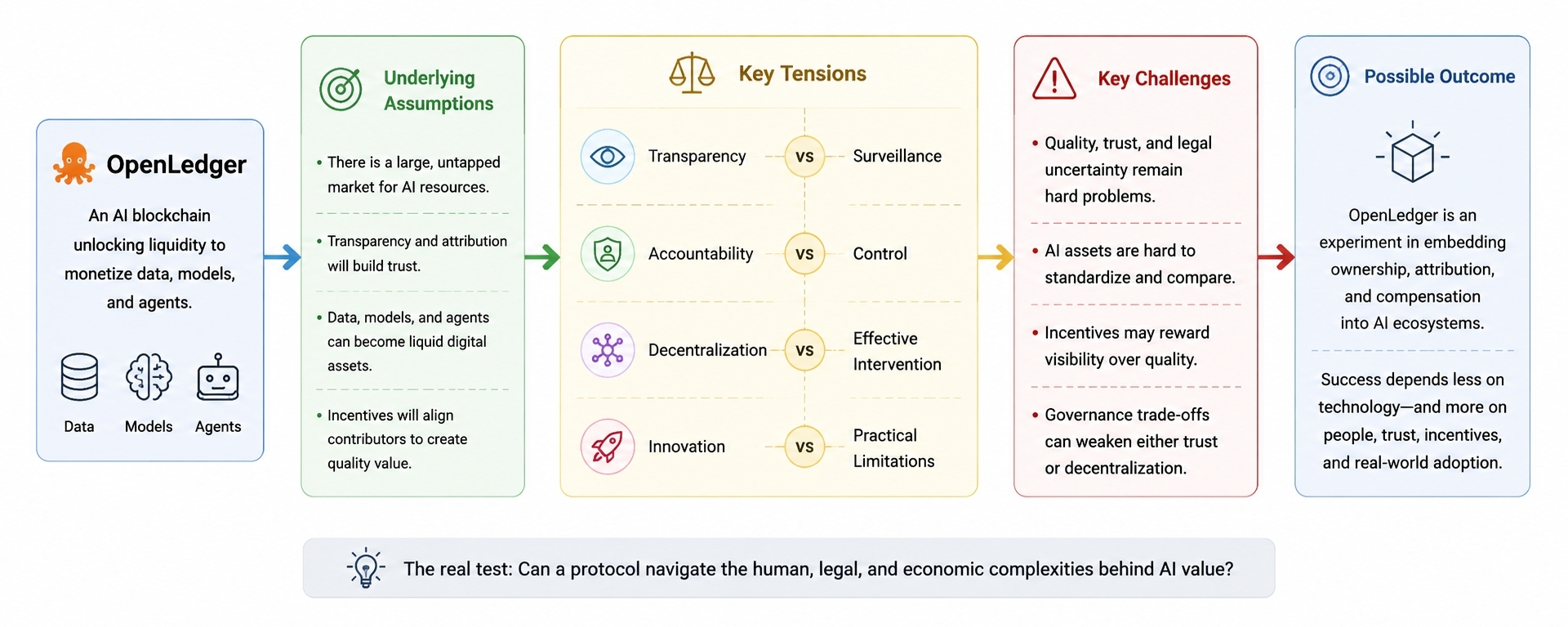

What makes OpenLedger interesting to me isn't really the technology itself. Plenty of projects talk about tokenizing data, AI models, and digital assets. The more interesting question is whether people actually want to treat these things as tradable economic resources in the first place.
The idea sounds logical on the surface. AI systems depend on data, models, and increasingly on autonomous agents. If those resources create value, then the people contributing them should be rewarded. That's a reasonable argument. But turning that principle into a functioning market is where things become less straightforward.
A lot of blockchain projects assume that transparency naturally creates trust. I'm not sure it's that simple. Being able to see transactions and contributions on a public ledger can improve accountability, but it can also create a world where every interaction is tracked and permanently recorded. There's a fine line between transparency and surveillance, and technology doesn't always tell us where that line should be.
I also keep thinking about governance. Decentralization sounds attractive until something goes wrong. If a dataset is misleading, a model is manipulated, or an AI agent causes harm, who steps in? A fully open system can struggle to enforce standards, while a tightly governed one starts looking less decentralized than originally advertised. That tension never really disappears; it just shifts depending on where the power sits.
The economic side raises questions too. Data and AI models are not like cryptocurrencies. Their value is harder to measure and often depends on context. Two datasets that appear similar can produce very different outcomes. Two models solving the same problem can vary dramatically in quality. Creating liquidity around assets that are difficult to compare may prove harder than many people expect.
There's also the risk that incentives shape behavior in unexpected ways. When rewards become attached to measurable contributions, people naturally optimize for whatever is being measured. Sometimes that leads to innovation. Other times it leads to noise, low-quality content, and systems that reward activity more than usefulness. AI already faces enough of those challenges without adding financial speculation into the mix.
None of this makes OpenLedger a bad idea. If anything, it reflects a growing belief that the AI economy should be more open and that contributors deserve a clearer share of the value they create. That's a goal many people can agree with. I just think the outcome will depend less on the protocol itself and more on whether it can navigate the messy realities of trust, incentives, and human behavior.
In the end, projects like this often reveal something important. The technical infrastructure may work exactly as intended, yet adoption still depends on whether people find the system useful, fair, and worth participating in. Those are questions that code alone rarely answers.