
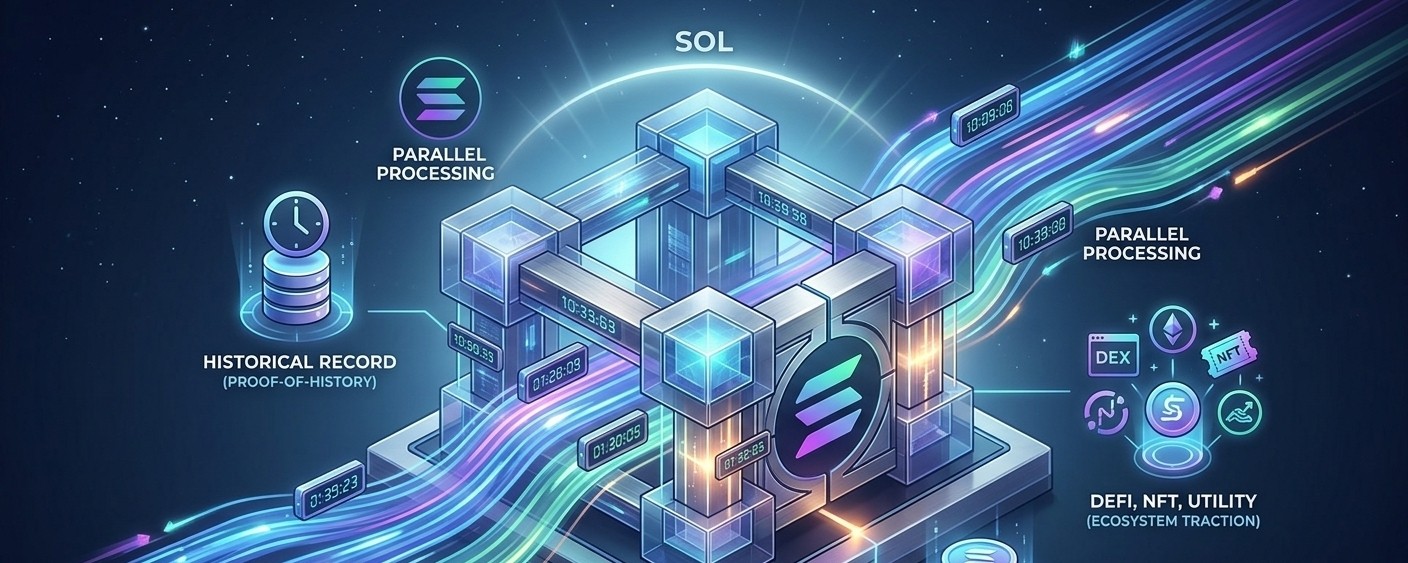
The landscape of layer-one blockchains has long been defined by a balancing act between decentralization, security, and scalability. For years, older networks forced users to tolerate high transaction fees and slow processing times during peak traffic. Solana emerged directly to challenge this status quo. Designed from the ground up as a high-performance network, it operates less like a traditional distributed ledger and more like a finely tuned, global software system.
To understand why this network commands so much attention, one must look closely at its architectural setup, how its underlying engineering functions, and the market numbers it generates today.
The Architecture: Solving Scalability with Time
At the heart of Solana’s technical setup is an engineering concept designed by its founder, Anatoly Yakovenko: Proof-of-History. In traditional blockchains, nodes must constantly communicate with one another to agree upon when a transaction occurred. This continuous back-and-forth communication creates a massive bottleneck, slowing down the entire ecosystem.
Solana bypasses this issue by introducing a cryptographic clock built directly into the ledger. Using a sequential hashing function, Proof-of-History allows nodes to create a historical record proving that an event occurred at a precise moment in time. Think of it as a digital timestamp attached to every packet of data. Because every validator can rely on this internal clock, the network can process transactions in parallel rather than waiting for a global consensus on every single block.
This timestamping mechanism works hand-in-hand with a standard Proof-of-Stake system. While Proof-of-History manages the sequencing and organization of transactions, the Proof-of-Stake layer handles security. Validators stake the network's native asset, SOL, to earn the right to confirm blocks and earn rewards. Together, these mechanisms allow the protocol to achieve sub-second finality and execute thousands of transactions per second for mere fractions of a penny.
Ecosystem Participation and Node Setup
Engaging with Solana's architecture generally happens via two distinct paths: passive delegation or active validation.
Delegation: For the everyday user, the setup is highly accessible. By holding SOL tokens in a compatible decentralized wallet, users can delegate their voting weight to an existing validator. This approach allows participants to help secure the network and earn a portion of the staking yields without giving up ownership of their private keys or running heavy equipment.
Validation: For those aiming to run an independent validator node, the barrier to entry is technical and rigorous. Unlike lightweight blockchains, Solana’s high throughput requires robust hardware infrastructure, including enterprise-grade processors, massive amounts of RAM, and symmetric high-speed internet connections with strict uptime requirements.
Market Dynamics and Ecosystem Traction
The unique engineering of the network has translated into significant economic footprint and market presence. As a fixture among the top digital assets by market value, Solana commands a multi-billion dollar market capitalization and frequently captures billions in daily trading volumes across global spot exchanges.
The tokenomics of the ecosystem rely on an inflationary framework that steadily injects new SOL into the ecosystem to incentivize validators. Launched with an initial inflation rate of eight percent, the protocol is hardcoded to gradually disinflate over time, targeting a stable baseline rate of one and a half percent. This predictable issuance is counterbalanced by a burning mechanism, where a percentage of every transaction fee is permanently removed from circulation, tying network utility directly to token scarcity.
This economic engine directly fuels a massive decentralized economy. Solana has established itself as a primary hub for decentralized finance applications, automated market makers, lending protocols, and non-fungible token marketplaces. This on-chain transactional demand is reinforced by institutional integration. The launch of spot Solana exchange-traded funds and structured financial products has drawn more corporate capital into the asset, providing a steady baseline of inflows that helps stabilize the network against broader retail volatility.
Future Outlook and Headwinds
Solana’s path forward is defined by continuous technical refinement. In its early years, the network suffered from occasional high-profile outages when massive transaction spikes overwhelmed its memory capacity. The community has answered these challenges with core software upgrades and the development of secondary, independent validator clients designed to maximize network resilience and prevent single points of failure.
Ultimately, Solana stands as a testament to specialized infrastructure. By optimizing for raw throughput and low latency at the fundamental base layer, it has successfully carved out an indispensable role in the digital asset landscape—proving that in decentralized economies, speed and efficiency are premium commodities.