

For years, crypto perps have been the most-traded derivative instrument in the world — just not in the United States. That just changed.
The Chart You Already Live In Just Got a Regulator's Stamp of Approval
If you've been in crypto for more than six months, you probably already trade perpetual futures. BTCUSDT Perp. ETHUSDT Perp. Maybe some SOL or BNB. You know the funding rate. You've watched the open interest spike on a Sunday night. You've been liquidated at 3 AM and learned a painful lesson.
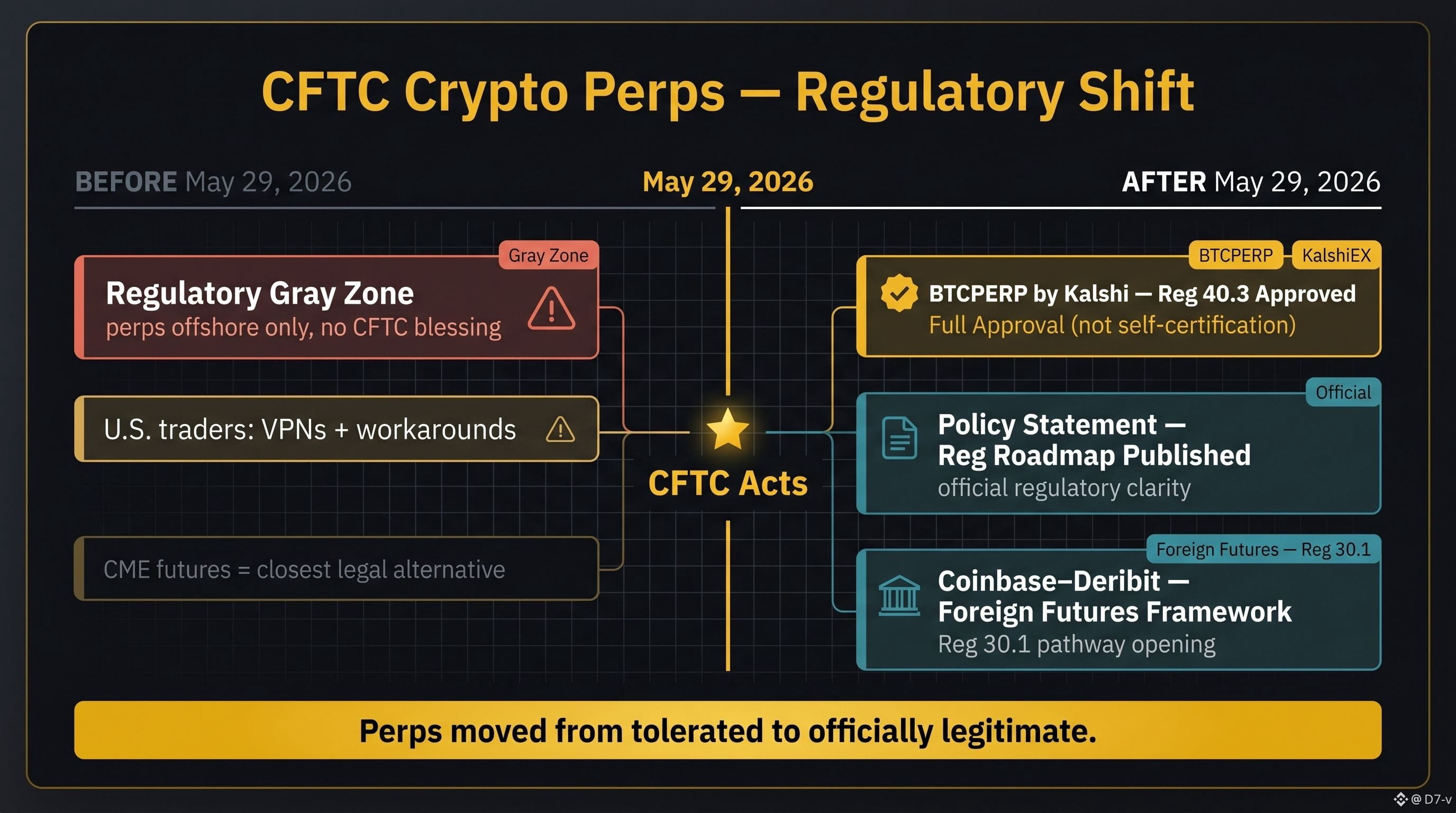
Perps are the heartbeat of the crypto derivatives market — no expiry date, continuous funding, 24/7 liquidity. The only problem? In the United States, they've lived in a regulatory gray zone for years, largely confined to offshore exchanges and technically inaccessible to most U.S. traders without workarounds.
On May 29, 2026, that changed.
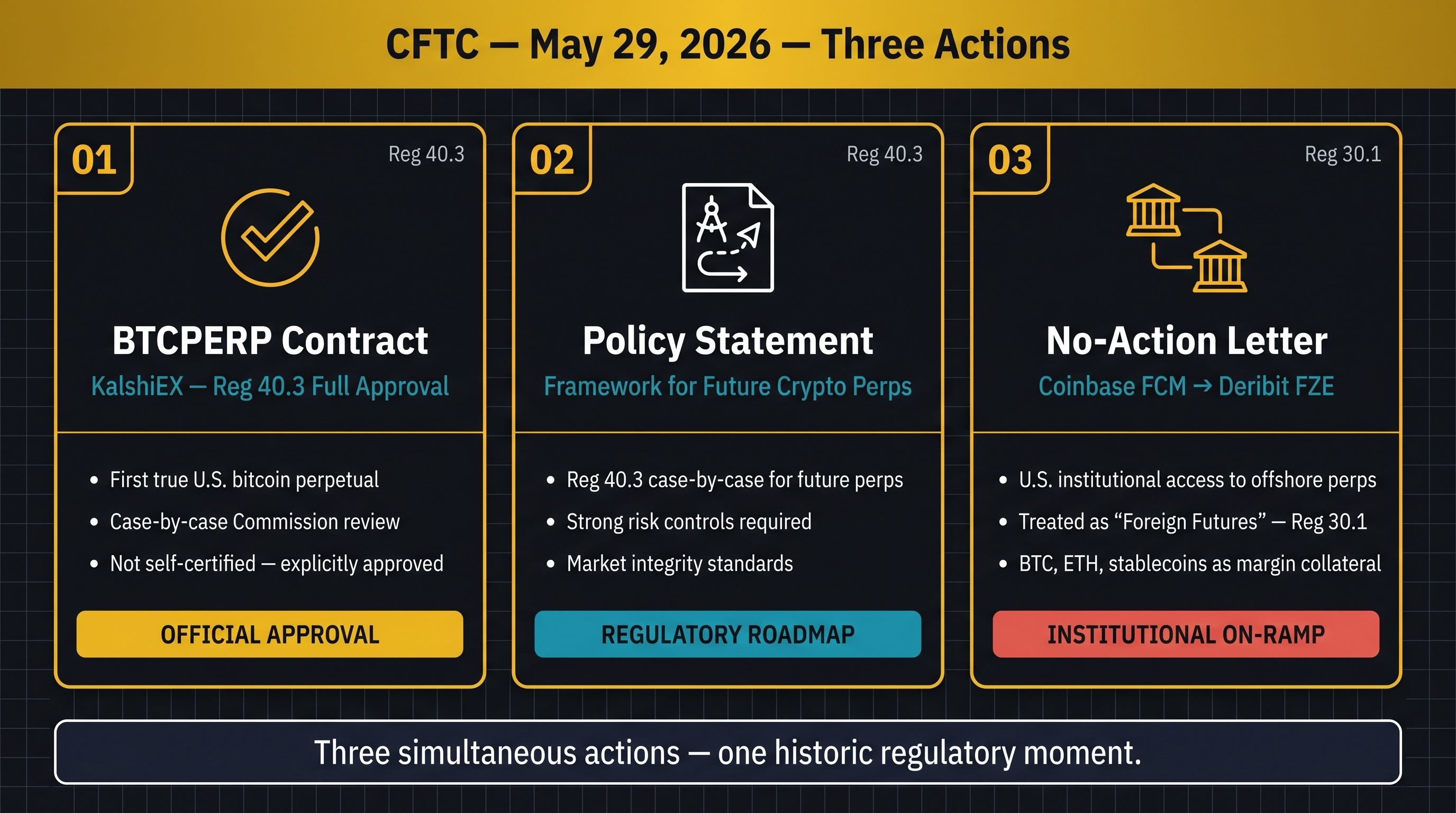
The U.S. Commodity Futures Trading Commission (CFTC) formally approved the BTCPERP contract submitted by KalshiEX, LLC — the first true bitcoin perpetual futures contract approved on a CFTC-registered exchange. At the same time, it issued a policy statement on how future crypto perp contracts will be reviewed, and staff issued a no-action letter allowing Coinbase to route U.S. institutional clients into Deribit's offshore perp markets under a compliant "foreign futures" framework.
Translation: crypto perpetual futures are now officially part of the U.S. regulatory playbook. And for traders everywhere — including the hundreds of millions already using Binance Futures — the implications are bigger than most people realize.
What Did the CFTC Actually Approve?
Let's break down the three-part action from May 29:
1. Kalshi's BTCPERP Contract — The First Official U.S. Perpetual
KalshiEX received a full Commission approval order under CFTC Regulation 40.3 for its BTCPERP contract — a perpetual futures contract referencing the spot price of bitcoin.
This is a meaningful distinction. Previous U.S. crypto derivatives contracts were typically approved via "self-certification," a lighter-touch process where exchanges submit a product and it goes live unless the CFTC objects. BTCPERP went through the full, case-by-case approval process — meaning the Commission reviewed market design, risk controls, pricing mechanics, and compliance standards and explicitly said yes.
That's the regulatory equivalent of moving a product from "tolerated" to "officially legitimate."
2. A Policy Statement That Sets the Rules of the Road
The CFTC also published a formal policy statement explaining how it will evaluate future perpetual contracts submitted by exchanges.
Key points from the policy:
Future perp contracts should generally be submitted for Reg 40.3 approval (case-by-case review), rather than self-certified.
Perpetuals are recognized as valid futures structures, but not automatically suitable for all underlying assets.
Exchanges wanting to list perps will need to demonstrate strong risk controls, fair mark pricing, customer protections, and market integrity standards.
Legal commentators note this gives exchanges a clear roadmap while preserving CFTC discretion — this is guidance plus product-specific orders, not a final rulemaking, so there's still some flexibility and uncertainty ahead.
3. The Coinbase–Deribit No-Action Letter — Institutional Perps, Regulated
The third piece is arguably the most immediately impactful for institutional traders. CFTC staff issued a no-action letter allowing Coinbase's registered futures commission merchant (FCM) arm to offer U.S. institutional clients access to crypto perpetuals and options listed on Deribit FZE, treating them as "foreign futures" under CFTC Regulation 30.1.
Under this framework:
U.S. institutions can gain compliant exposure to deep offshore perp liquidity via a regulated intermediary.
Bitcoin, ether, and payment stablecoins can be posted as margin collateral, including to foreign brokers with asset-reuse rights, under specific conditions.
There's a regulated front-end connecting to offshore books — a model that could expand to other venues over time.
This is not the same as unrestricted retail access to Deribit or other offshore venues. But it does open a significant, compliant pipe for institutional money to flow into perp markets.
Why This Is a Bigger Deal Than It Sounds
Crypto perps have been the dominant instrument for leveraged trading for years — across Binance, OKX, Bybit, Deribit, and dozens of others. But almost all of that volume has been offshore, away from U.S. regulatory oversight.
U.S. traders either couldn't access these products directly, used VPNs and workarounds, or traded the far less liquid and less flexible CME futures contracts as the nearest compliant alternative.
By approving a full perp contract and publishing a policy framework, the CFTC is doing something regulators rarely do: explicitly acknowledging that a product that emerged and scaled outside the formal system is legitimate, and building rules around it rather than banning it.
This matters for three reasons:
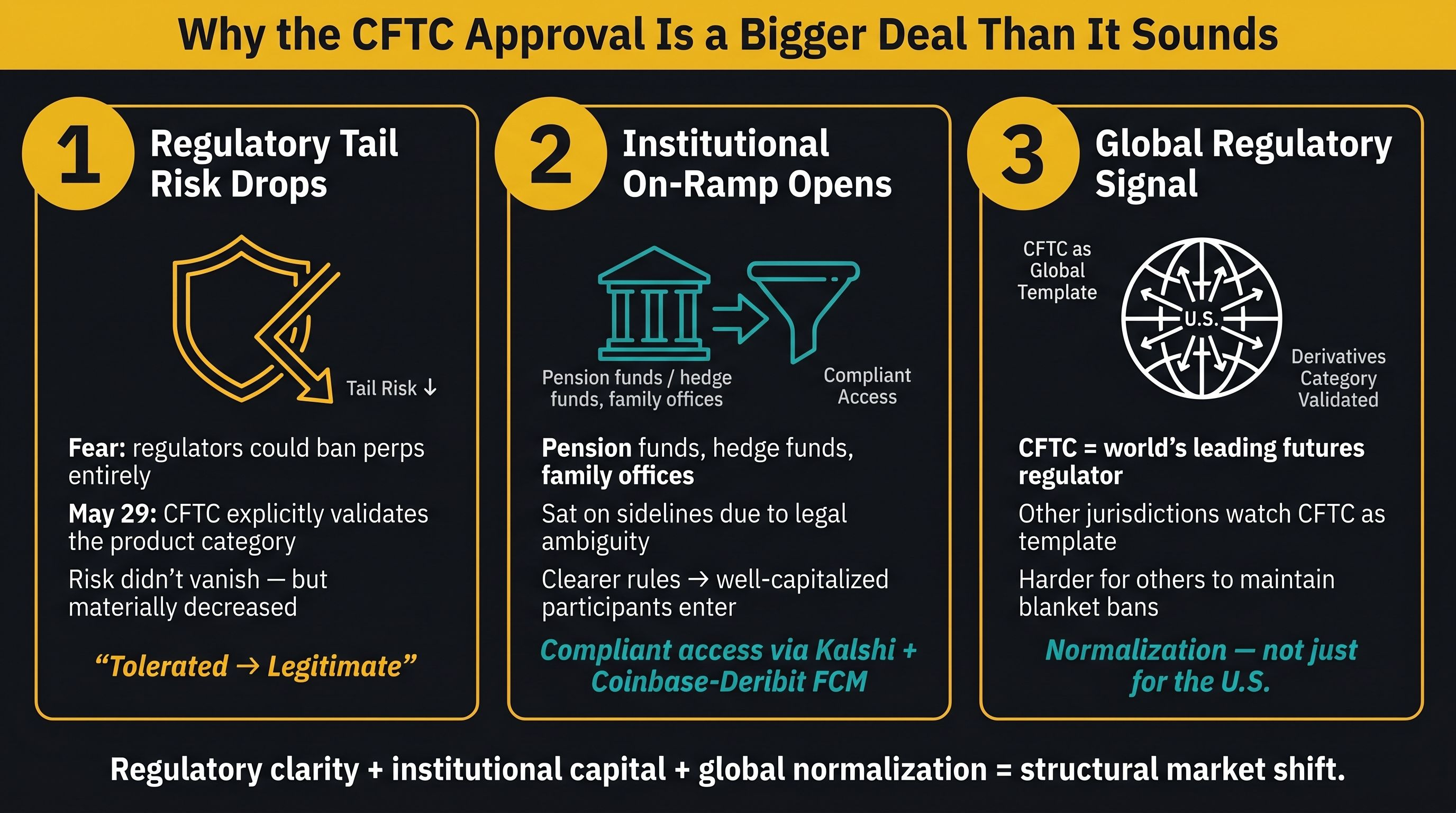
Regulatory tail risk drops. One of the perennial fears among perp traders has been that regulators could classify the entire product category as illegal or force its shutdown. That risk didn't vanish on May 29, but it materially decreased.
Institutional capital gets a compliant on-ramp. Pension funds, hedge funds, family offices — many of these players have been sitting on the sidelines of perp markets precisely because of legal ambiguity. Clearer rules mean more sophisticated, well-capitalized participants entering the market.
It signals global regulatory normalization. The CFTC's position matters beyond the U.S. because regulators elsewhere often look to the CFTC as a template for derivatives. If the world's leading futures regulator approves bitcoin perps, it becomes significantly harder for other jurisdictions to maintain a blanket ban.
How Perpetual Futures Work — A Quick Refresher
If you're newer to perps or writing for a broader audience, here's the one-paragraph version:
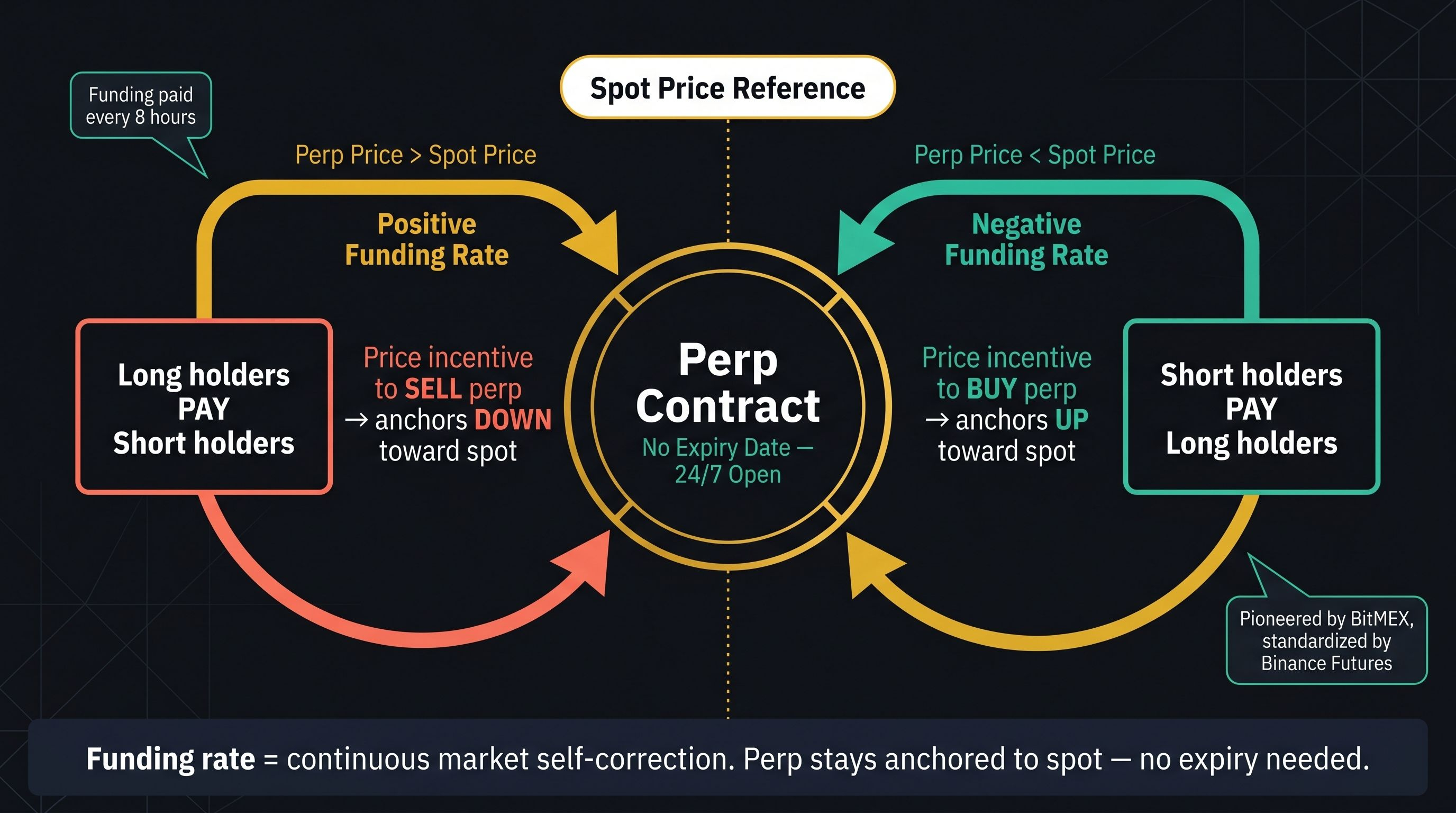
A perpetual futures contract tracks the price of an underlying asset (say, BTC) with no expiration date. Instead of settling on a fixed date like a traditional futures contract, it stays open indefinitely. To keep the contract price anchored to the spot market, it uses a funding rate mechanism: if perps trade above spot, long-position holders pay shorts; if perps trade below spot, shorts pay longs. This creates a continuous incentive for the market to keep the perp price close to the real asset price.
The result is an instrument that feels like leveraged spot trading but operates within a derivatives framework — which is precisely why it became the go-to tool for crypto traders who want leverage, precision, and round-the-clock access.
The CFTC is now endorsing this exact design as a valid futures structure — just with added regulatory guardrails.
Where Binance Fits — And Why It Already Had a Head Start
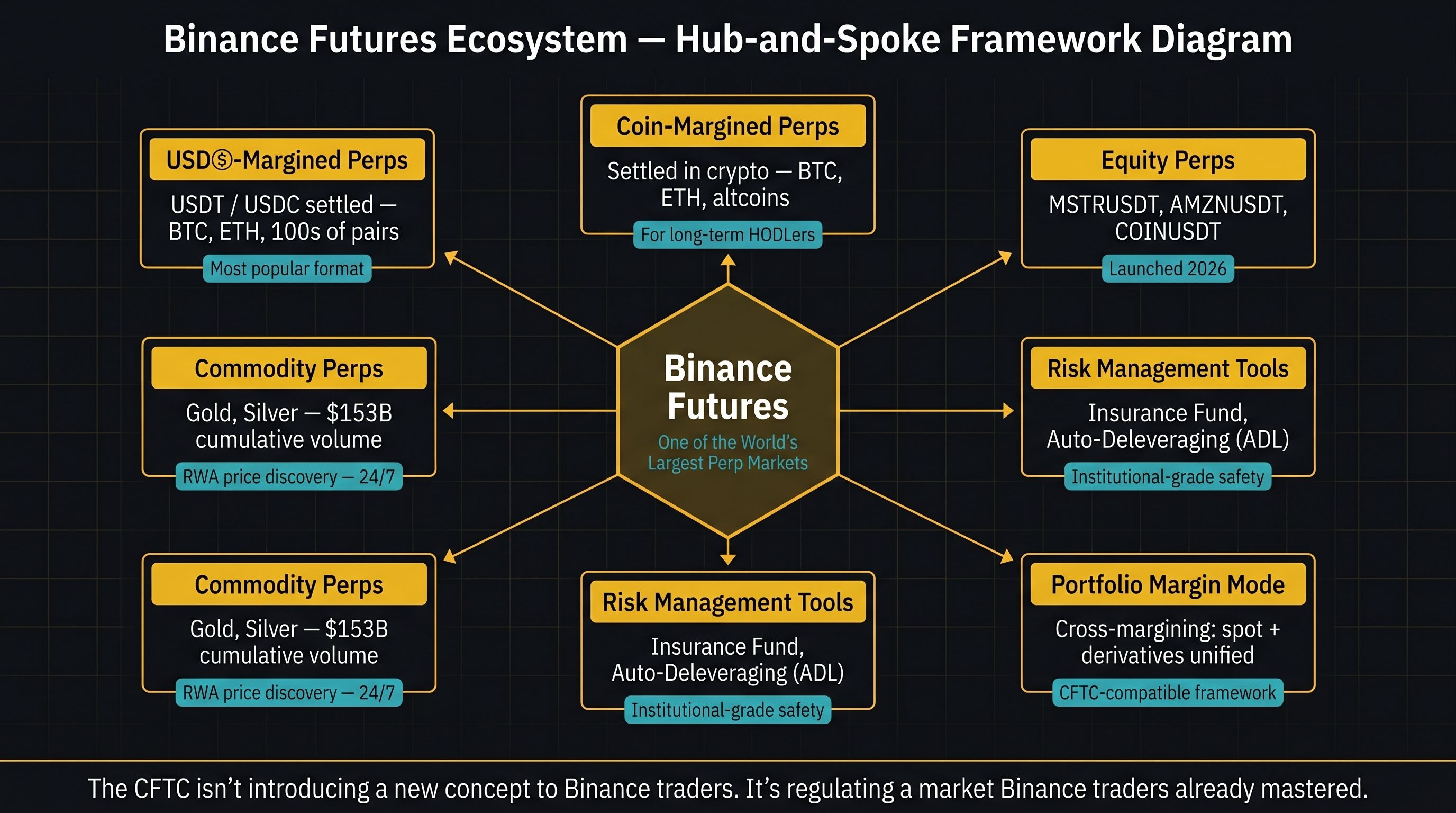
Here's the context your audience needs: while U.S. regulators were still debating whether bitcoin perps were legal, Binance was already running one of the world's largest and most liquid perp markets across hundreds of trading pairs.
Binance Futures offers USDⓈ-Margined (USDT/USDC) and coin-margined perpetual contracts across not just BTC and ETH, but also altcoins, equity-linked instruments, and real-world asset-linked products. Earlier in 2026, Binance launched equity perpetuals like MSTRUSDT, AMZNUSDT, and COINUSDT, as well as gold and silver commodity perps. Research has highlighted Binance's commodity perps clearing over $153 billion in cumulative volume as a structural shift in 24/7 real-world asset price discovery.
The regulatory mechanics that the CFTC is now asking U.S. exchanges to implement — mark-price caps, funding rate controls, insurance funds, cross-margining, liquidation engines — are mechanics Binance has been running and refining for years.
Put simply: the CFTC isn't introducing a new concept to Binance traders. It's regulating a market structure that Binance traders already mastered.
For traders using Binance Futures, there are a few specific features worth understanding in this context:
Binance Academy has extensive educational content on perpetual contracts, funding rates, and risk management — useful both for onboarding newer readers and for SEO anchor links.
Binance Futures' Insurance Fund and Auto-Deleveraging (ADL) system are exactly the risk-management mechanisms regulators are looking for in perp market design.
Portfolio Margin Mode on Binance enables cross-margining across both spot and derivatives — the kind of integrated risk framework that institutional-grade perp trading requires.
What Practically Changes for You as a Trader
If You're a Non-U.S. Binance User
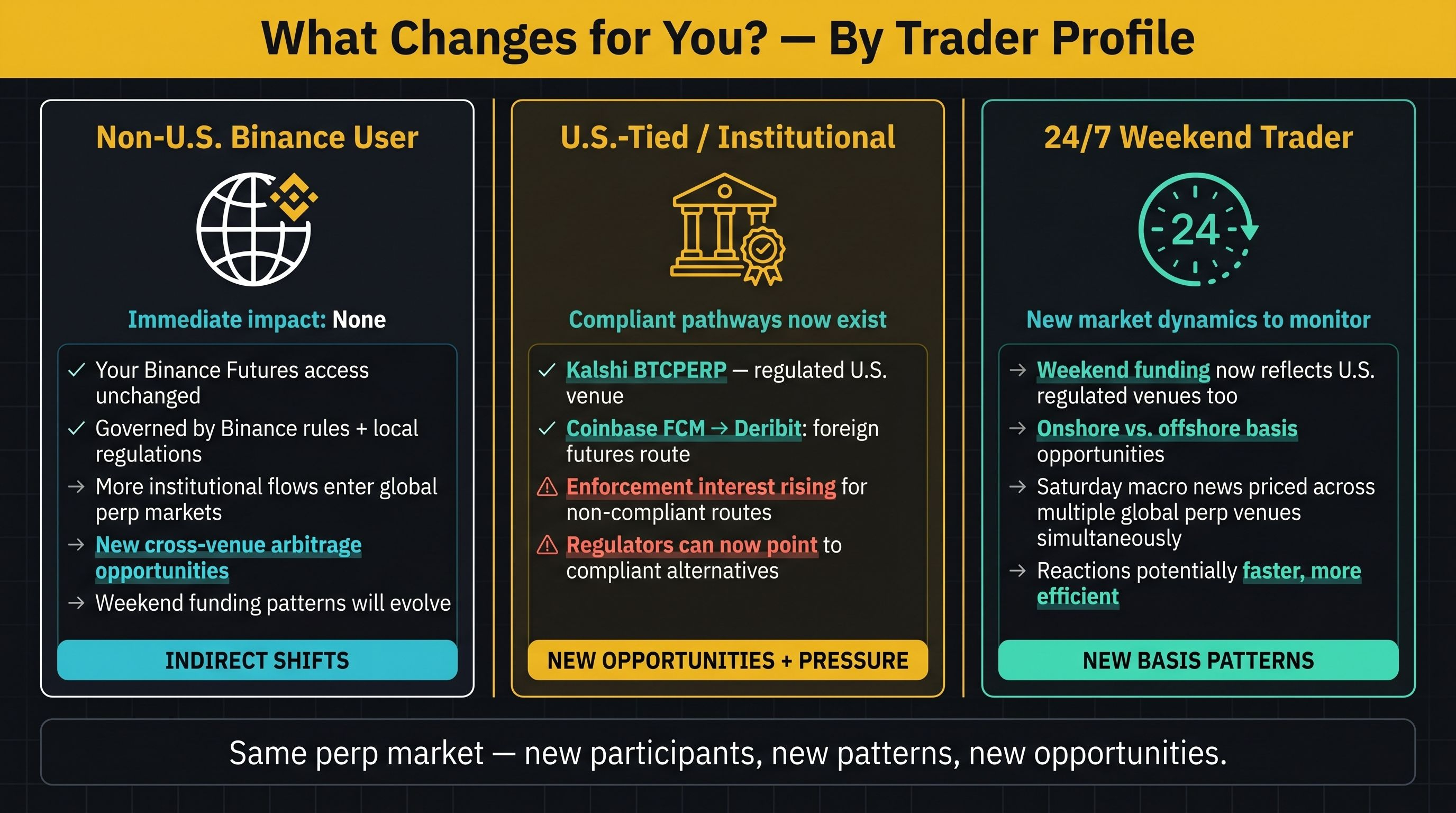
Nothing changes in your immediate trading experience. Your access to Binance Futures, leverage tiers, and available contracts is governed by Binance's rules and your local regulations — not the CFTC.
But the strategic backdrop shifts in ways that matter:
More institutional flows entering perp markets. As U.S. institutions gain compliant access — via Kalshi or the Coinbase–Deribit structure — more systematic, hedging, and volatility-targeting strategies will participate in global perp liquidity. This can affect funding cycles, open interest trends, and price discovery dynamics on Binance itself.
Tighter cross-venue arbitrage opportunities. Traders who understand both Binance perps and U.S. perp venues (Kalshi, CME, etc.) will have new basis trades and funding-rate arbitrage setups that didn't cleanly exist before.
Reduced regulatory stigma. For content creators, analysts, and educators in this space: covering perps is no longer covering a regulatory gray-zone product. The CFTC just validated the category.
If You Have U.S. Ties or Trade With Institutional Constraints
The emergence of onshore alternatives and the foreign-futures framework creates both opportunity and urgency:
Opportunity: There are now regulated, legally clear pathways to perp exposure in the U.S. via Kalshi or through FCMs accessing Deribit. This is important for traders whose legal structure requires regulated counterparties.
Pressure: As the CFTC builds a workable framework, enforcement interest in unregulated access routes is likely to increase — especially when regulators can now point to compliant alternatives they approved.
For the Weekend and 24/7 Trader
One of Binance's core advantages has always been continuous markets — trading when CME is closed, capturing weekend gaps, reacting to Sunday news before traditional markets open.
As U.S. perp venues grow, they'll run 24/7 schedules too. This creates new patterns to monitor:
Weekend funding rates will increasingly reflect not just offshore books (Binance, Bybit, etc.) but also regulated U.S. venues and the institutional flows routed through them.
Basis between onshore perps and offshore perps may widen or tighten based on U.S. market microstructure, creating intraday opportunities for basis traders.
Significant macro news hitting on a Saturday — the kind of move Binance traders have long understood — will now be priced through multiple global regulated perp venues simultaneously, potentially making reactions faster and more efficient.
The Bigger Picture: TriFi, the Super-App Era, and What Comes Next
Zoom out, and the CFTC's perp approval fits into a much larger narrative that Binance's product roadmap already reflects.
Earlier in 2026, the CFTC also opened the door for listed spot cryptocurrency products on CFTC-registered futures exchanges — another major milestone. The Trump administration has explicitly positioned the U.S. as a "crypto capital," and the regulatory signal across agencies has been one of integration rather than exclusion.
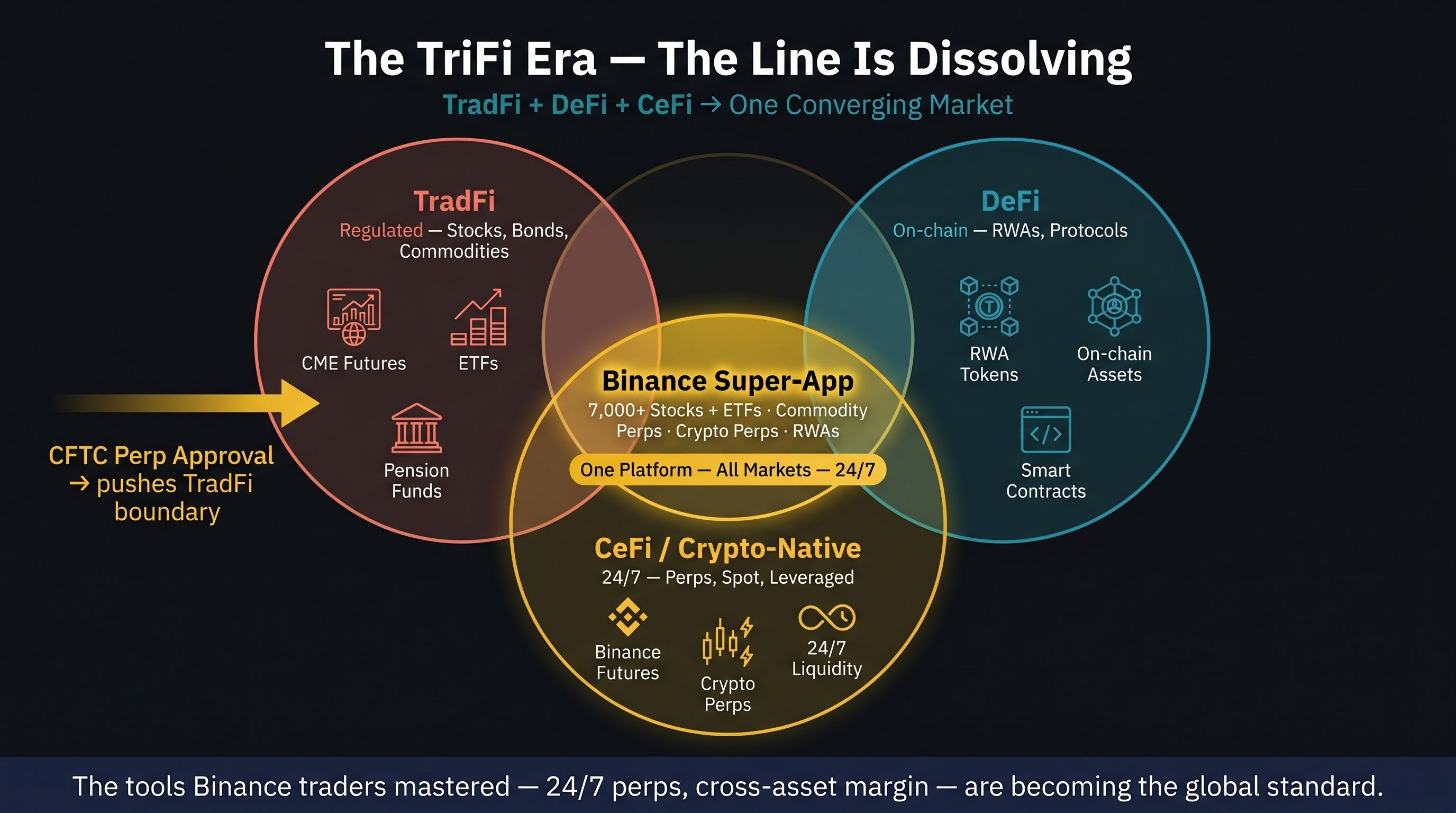
At the same time, Binance has been expanding rapidly into what can be called the TriFi era — the convergence of traditional finance (TradFi), decentralized finance (DeFi), and crypto-native finance (CeFi). The platform now offers:
Commodity perpetuals (gold, silver) and equity perps (US stocks) directly on Binance Futures
Over 7,000 U.S. stocks and ETFs accessible via Binance Stocks, alongside existing crypto products
24/7 real-world asset price discovery on a single platform
The CFTC's move and Binance's product expansion are two sides of the same trend: the line between offshore crypto derivatives and regulated TradFi infrastructure is dissolving. Regulators are formalizing the product structures crypto exchanges pioneered; crypto exchanges are absorbing the asset classes that TradFi always owned.
For your readers, the most practical implication is this: the tools and strategies they've developed on Binance — perp trading, 24/7 exposure, cross-asset margining — are becoming the standard, not the exception. And as institutional capital gains compliant on-ramps into that world, the liquidity, volatility, and opportunity profile of perp markets is likely to grow, not shrink.
✅ Key Takeaways
The CFTC formally approved the first true bitcoin perpetual futures contract (BTCPERP by Kalshi) on May 29, 2026, ending years of regulatory ambiguity around crypto perps in the U.S.
A policy statement now gives exchanges a clear roadmap for listing crypto perps: Reg 40.3 case-by-case approval, with strict risk-management requirements.
A no-action letter allows Coinbase to route U.S. institutional clients into Deribit's offshore crypto perp markets under the "foreign futures" framework — a major institutional on-ramp.
Binance traders aren't playing catch-up. Binance already runs one of the world's largest perp ecosystems with hundreds of contracts, 24/7 liquidity, and institutional-grade risk management tools.
Expect structural changes to perp market dynamics: more institutional flows, tighter cross-venue basis opportunities, evolving weekend funding patterns.
The bigger trend is TriFi convergence: regulated perps onshore + crypto super-apps like Binance adding stocks, commodities, and RWAs = a fundamentally different market structure by 2027.
❓ FAQ
Q: What exactly did the CFTC approve on May 29, 2026?
The CFTC issued three actions: (1) formal approval of KalshiEX's BTCPERP perpetual bitcoin futures contract, (2) a policy statement outlining how future crypto perps will be reviewed, and (3) a no-action letter enabling Coinbase to offer institutional clients compliant access to Deribit's offshore perp markets.
Q: Can U.S. retail traders now access crypto perps legally?
Not freely. Retail access remains limited to CFTC-registered venues like Kalshi. The Coinbase–Deribit structure is designed for institutional clients, not retail. The CFTC has not broadly opened offshore crypto perps to U.S. retail traders.
Q: Does this affect Binance traders outside the U.S.?
Directly, no — Binance Futures access is governed by Binance's own rules and local regulations. Indirectly, yes: more institutional capital entering perp markets globally will affect funding rates, open interest dynamics, and cross-venue basis.
Q: What is a funding rate and why does it matter for perp traders?
A funding rate is a periodic payment between long and short holders that keeps a perpetual contract's price anchored to the underlying spot price. When perps trade above spot, longs pay shorts (positive funding); below spot, shorts pay longs (negative funding). It's one of the most important cost and signal factors in perp trading strategy.
Q: What does "foreign futures" classification mean?
Under CFTC Regulation 30.1, certain non-U.S. futures products can be accessed by U.S. persons through registered U.S. intermediaries (FCMs) as "foreign futures." The Coinbase–Deribit structure uses this classification to offer institutional clients access to Deribit's crypto perps with regulatory oversight via Coinbase's FCM.
Q: How is a perpetual futures contract different from a traditional futures contract?
A traditional futures contract has a fixed expiry date and settles on that date. A perpetual futures contract has no expiry — it stays open indefinitely, with funding rate payments ensuring the price stays close to spot. Perps are the dominant leveraged trading instrument in crypto because of their flexibility and 24/7 availability.
Q: Is Binance affected by CFTC regulations?
Binance operates under its own regulatory licenses across multiple jurisdictions. Binance.com has historically restricted access for U.S. persons and is not a CFTC-registered exchange. The May 29 CFTC actions do not change Binance's existing access policies.
#CryptoPerps #CFTC #BinanceFutures #BTCPerp #CryptoRegulation #PerpetualFutures #CryptoDerivatives #Bitcoin