
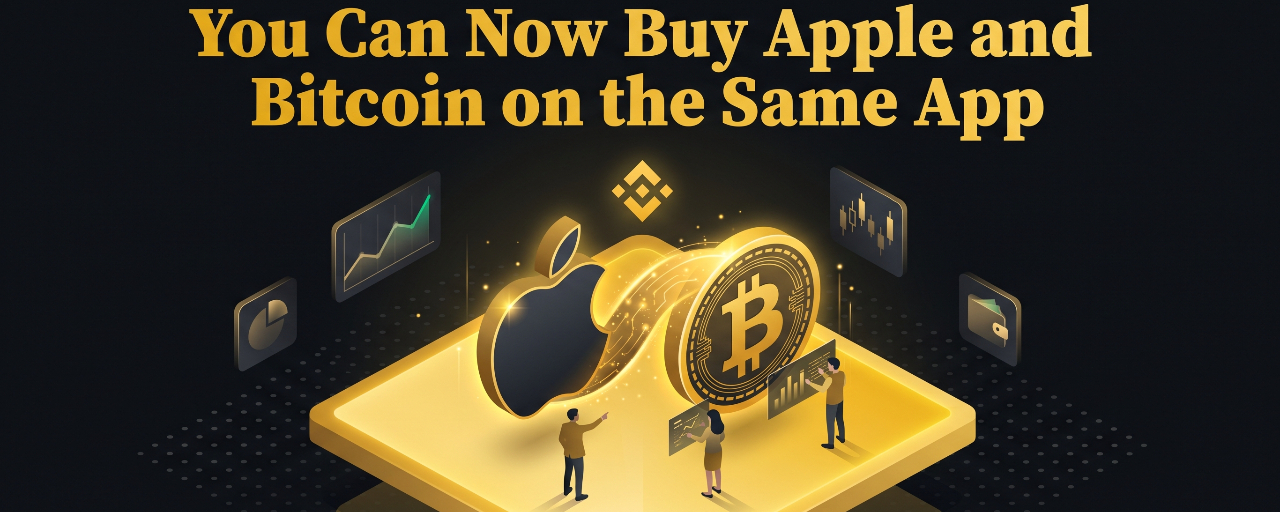
You Can Now Buy Apple and Bitcoin on the Same App — Here's What That Changes
The line between crypto and traditional investing just got a lot blurrier — and this time, it's not a pitch deck. It's live.
Open your Binance app. Tap Spot. Buy BTC.
Now tap again. Buy Apple.
That's not a concept. That's not a prototype. As of June 2026, eligible Binance users can trade over 7,000 U.S.-listed stocks and ETFs — including Apple, NVIDIA, Tesla, and the S&P 500 — from the exact same account they use for crypto. Zero commission. Starting from $5. Funded with stablecoins.
This is arguably the single biggest product story in crypto-meets-finance this year. And if you're serious about understanding where money is headed, you need to understand what just happened.
What Binance Actually Launched
Let's get specific before we get philosophical, because the details matter.
Binance has added access to 7,000+ U.S.-listed stocks and ETFs for eligible non-U.S. users, directly inside the core Binance interface. No separate app. No different login. No new KYC (if you're already verified). Just a new tab sitting alongside your existing crypto portfolio.
Here's what the product actually includes:
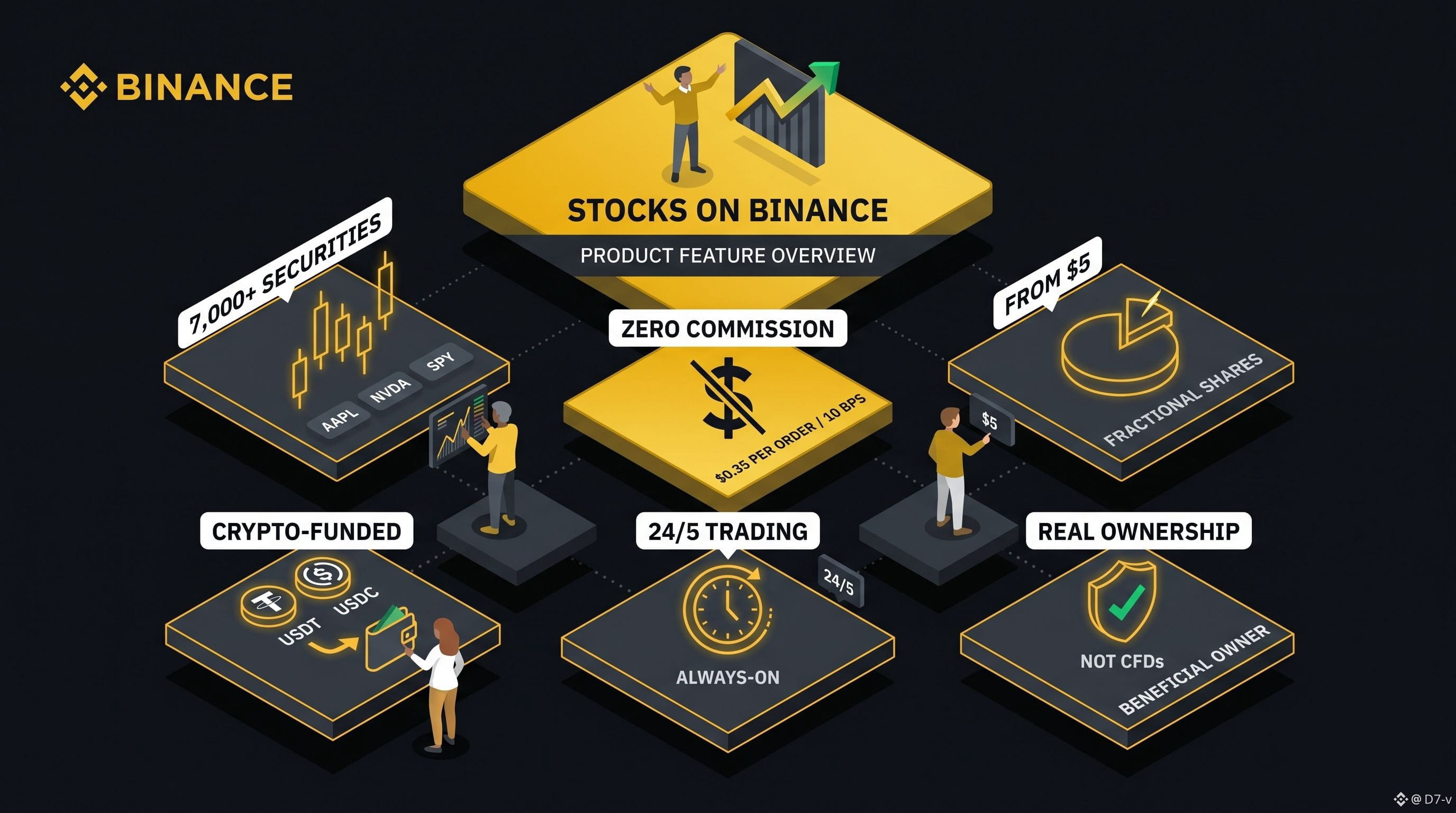
7,000+ securities — covering U.S. equities like Apple (AAPL), NVIDIA (NVDA), and Amazon (AMZN), plus major ETFs like SPY, QQQ, and IVV
Zero commission trading, with a small platform fee of $0.35 per order or 10 basis points for larger trades — structurally cheaper than many traditional brokers
Fractional shares from $5, meaning you don't need $180+ to own a piece of NVDA
Crypto-funded positions — you pay with USDT, USDC, BNB, or other supported assets; stock sale proceeds settle in stablecoins
24/5 trading hours on select stocks — bridging the UX gap between always-on crypto and traditional market hours
Real beneficial ownership — not CFDs, not synthetic exposure. A U.S.-regulated clearing partner (Alpaca Securities / Nest Trading) holds the actual shares on your behalf
That last point is worth repeating. You're not betting on price movement. You own the stock. Dividends, corporate actions, and ownership rights come with that — all surfaced through Binance's interface.
Why This Is Bigger Than a Feature Update
Product updates happen every week in crypto. This one is different because of what it represents, not just what it does.
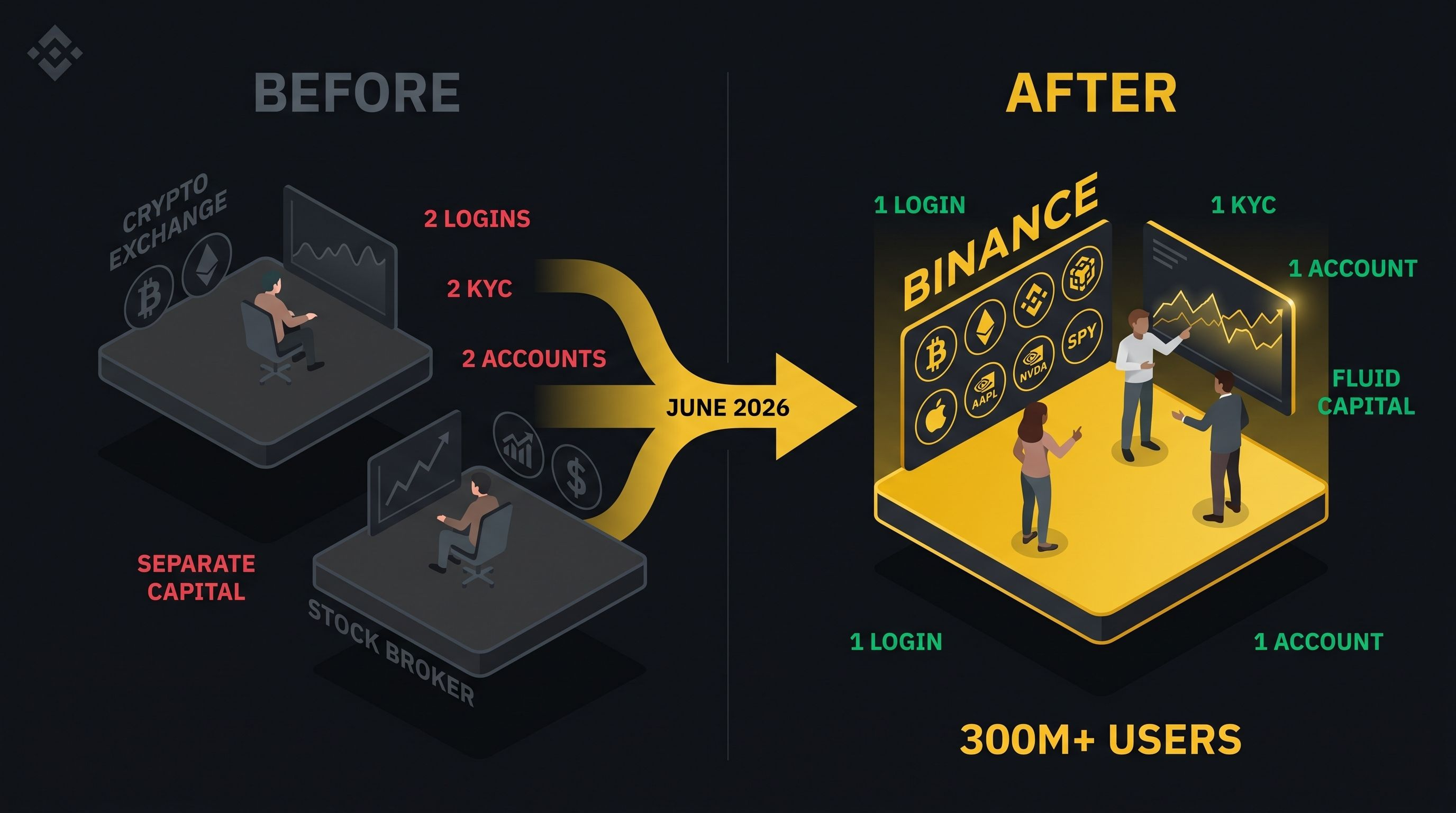
For years, crypto and traditional finance operated as two parallel universes. If you wanted BTC exposure, you used Binance, Coinbase, or a DEX. If you wanted Apple or the S&P 500, you opened Fidelity, Interactive Brokers, or Robinhood. Two logins. Two KYCs. Two interfaces. Two mental models. Often, two separate pots of capital that never really talked to each other.
That separation wasn't just inconvenient — it created a genuine friction cost that made diversification feel like a project rather than a habit. For crypto-native investors in emerging markets especially, getting access to U.S. equities through a traditional broker often meant navigating a multi-week onboarding process, currency conversion, minimum deposit requirements, and yet another platform to monitor.
Binance just collapsed that into a single tap for 300+ million verified users.
That's not a feature. That's a structural shift in how people will build portfolios going forward.
What Changes for Crypto-Native Investors
If you've lived primarily in crypto, here's what this changes in practical terms:
Portfolio construction becomes one-screen
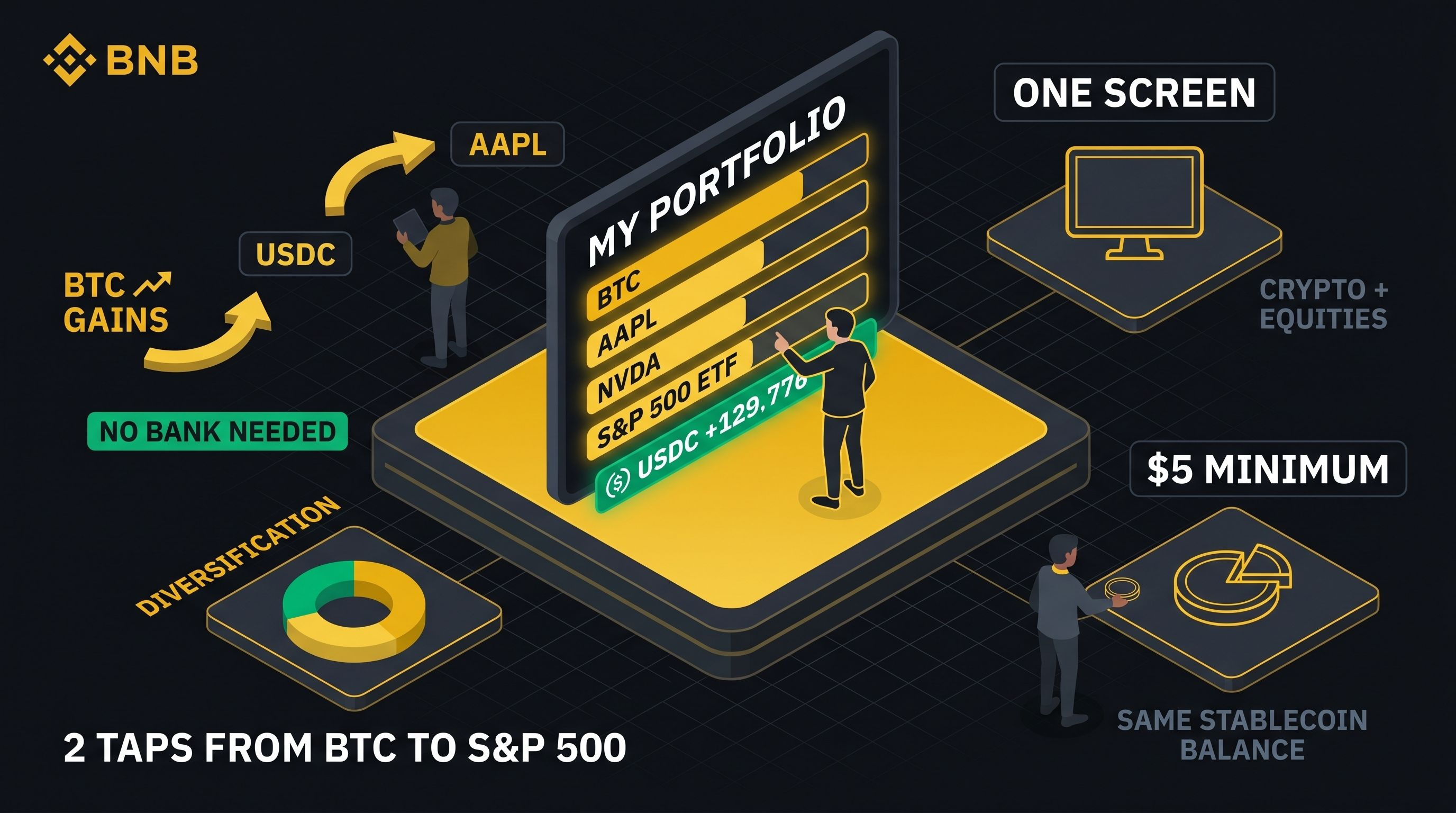
Instead of wiring funds to a broker, waiting for settlement, and managing a separate account, you can now rotate a portion of your BTC gains or stablecoin stack directly into U.S. equities — in a couple of taps, on the same screen where you check your crypto P&L.
Diversification stops being "a separate project"
For many crypto users, equities have been that thing they know they should own, but it's "another app, another process, another day." When it lives inside Binance, the barrier evaporates. The S&P 500 is now two taps from your BTC balance.
Capital becomes more fluid
Profits from a strong altcoin trade can be moved into NVDA or a broad-market ETF without going back through a bank account in the middle. Crypto profits, equity exposure — one continuous flow.
The mental model of "portfolio" expands
Crypto-native investors have historically thought in terms of BTC dominance, altcoin allocation, and DeFi yield. Now that vocabulary naturally extends to P/E ratios, sector ETFs, and dividend yield — all in the same interface, all denominated in the same stablecoin balance.
The Super App Vision: From Buzzword to Reality
"Financial super app" has been a phrase thrown around by fintech and crypto companies for years. WeChat-for-money. Grab-for-finance. Everything in one place.
The problem? Most "super apps" added a thin feature layer to a single core function. A crypto exchange that added P2P wasn't a super app. A neobank that added crypto trading wasn't a super app. They were products with bolt-ons.
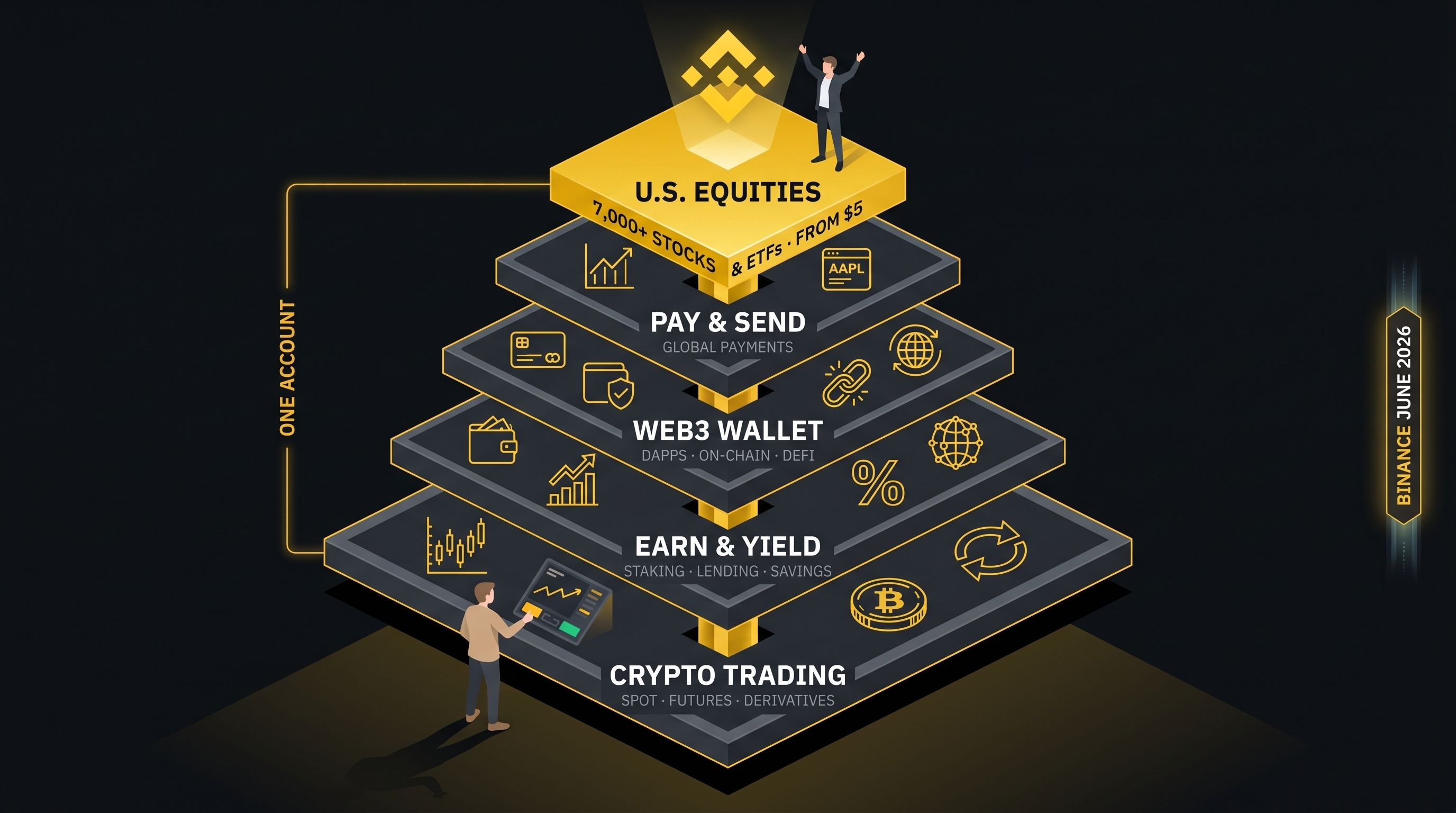
A real financial super app means one unified account where you can:
Hold and trade crypto (spot, futures, derivatives)
Earn yield on idle assets
Access Web3 and on-chain environments
Pay, send, and receive money globally
And now — own the world's most liquid equity market, starting from $5
That's Binance in June 2026.
The significance isn't just breadth. It's the composability. Your BTC profits, your Apple shares, your USDC yield, and your Web3 Wallet are all connected. One account. One risk surface. One interface to manage all of it.
For the first time, "I manage all my money in one place" can mean something genuinely comprehensive — not just "I keep all my crypto in one place."
bStocks: When Apple Shares Go On-Chain
Here's where this gets interesting for anyone already deep in DeFi and Web3.
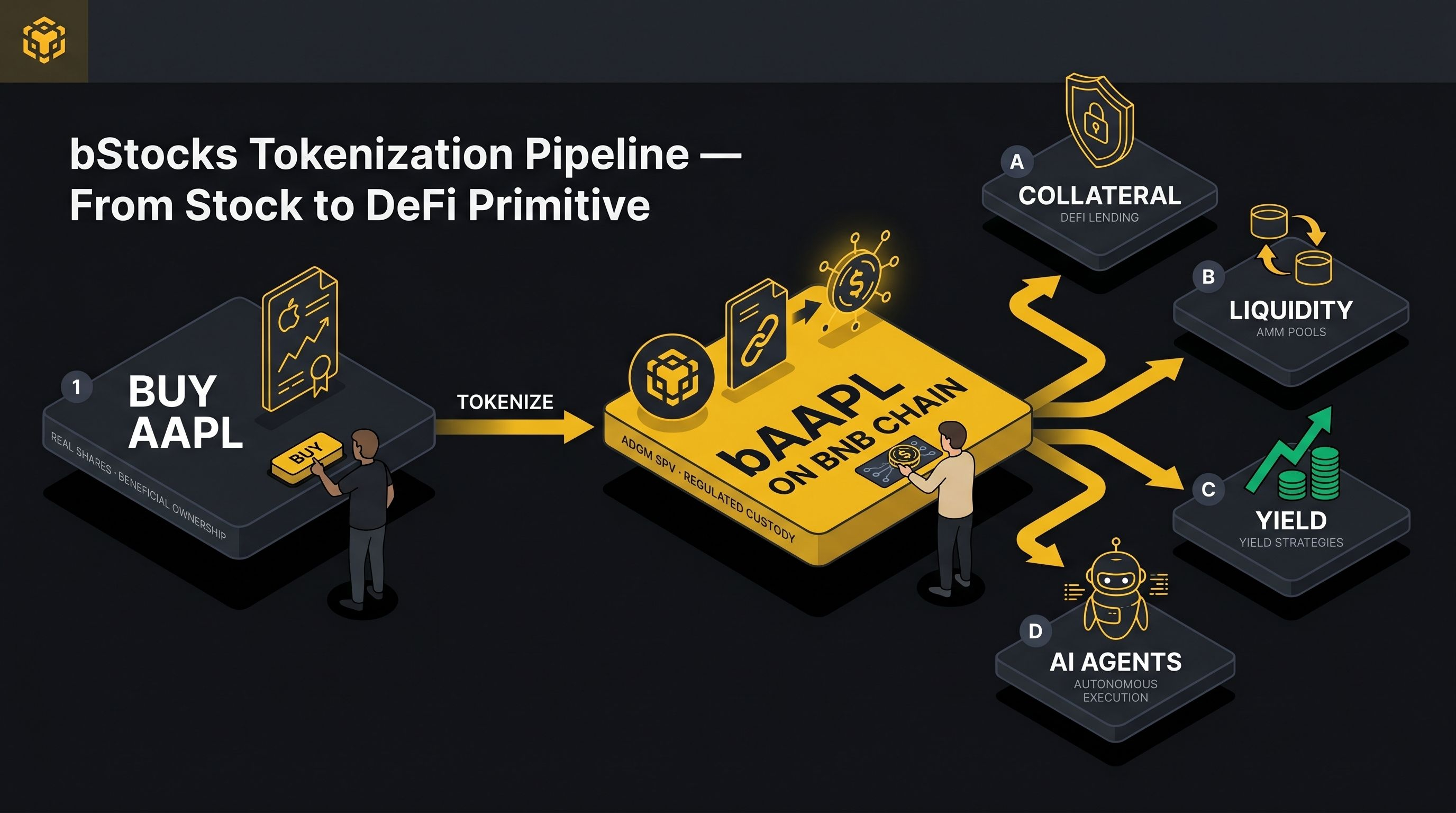
Alongside the traditional stock trading rollout, Binance has announced bStocks — tokenized representations of U.S. stocks, issued through a special-purpose vehicle in Abu Dhabi's ADGM (Abu Dhabi Global Market), set to launch on BNB Chain.
The mechanics:
You buy real shares of Apple or NVIDIA through Binance's stock interface
You convert eligible shares into bStock tokens (e.g., bAAPL, bNVDA)
Those tokens live on BNB Chain as on-chain assets
Why does this matter? Because once your Apple shares are tokenized on BNB Chain, they stop being a passive brokerage position and start being a programmable financial asset.
They can become:
Collateral in decentralized lending protocols
Liquidity in AMM pools pairing equities with stablecoins
Composable inputs for yield strategies that combine equity exposure with DeFi mechanics
Building blocks for AI agents executing cross-asset strategies autonomously
In other words: bStocks bridge the gap between your Apple shares and the DeFi ecosystem. A stock you own becomes a primitive you can compose with.
This has been a white whale for DeFi since the beginning — real-world asset (RWA) exposure that is actually liquid, actually on-chain, and actually composable with existing DeFi infrastructure. Binance's bStocks, backed by regulated custody and sitting on a mature blockchain with deep DEX and lending liquidity, is one of the most serious attempts yet to make that real at scale.
The TriFi Era: Crypto + TradFi + Tokenization
If you've been following the thesis that the next phase of finance is about the convergence of three historically separate rails — crypto, traditional finance, and AI-powered automation — then this launch is arguably the most important real-world proof point yet.
Call it TriFi. Call it Web4 finance. Call it whatever you want. The shape is the same:
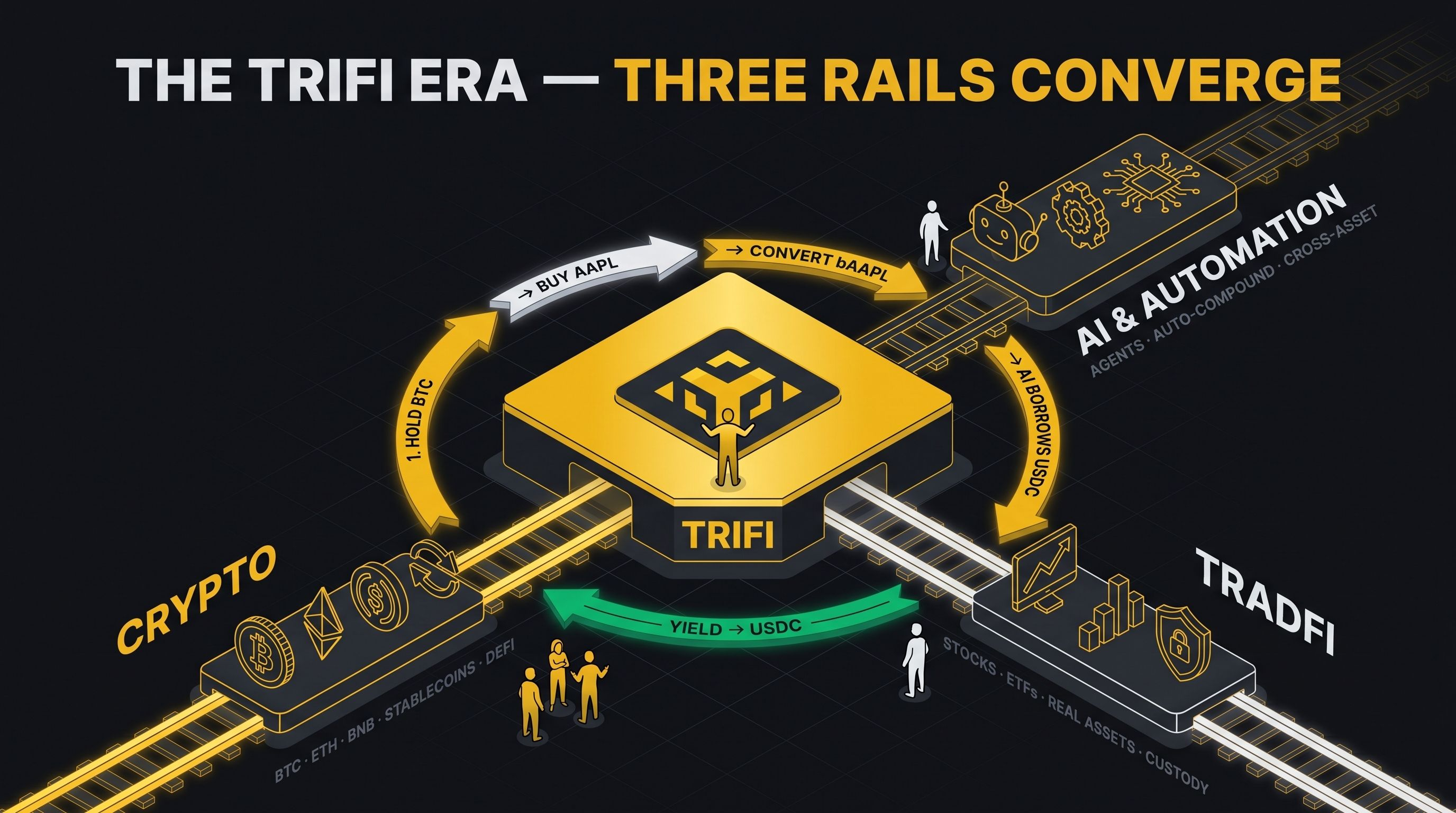
Rail 1 — Crypto: BTC, ETH, BNB, stablecoins, DeFi protocols, on-chain identity
Rail 2 — Traditional Finance: U.S. stocks, ETFs, real-world assets, regulated custody
Rail 3 — AI & Automation: Agent-driven portfolio management, auto-compounding, cross-asset execution
Stocks on Binance connects Rail 1 and Rail 2 in a single interface for the first time at this scale. bStocks on BNB Chain starts making that connection programmable. AI agents and tools like Binance's ecosystem of trading bots and on-chain tools start operating across both rails simultaneously.
The loop looks like this:
You hold BTC on Binance. You rotate profits into Apple stock (no brokerage needed). Apple shares get converted to bAAPL on BNB Chain. An AI agent uses bAAPL as collateral to borrow stablecoins and redeploy into a yield strategy — automatically. Profits flow back in USDC.
That loop — from crypto to traditional equity to tokenized DeFi collateral to AI-automated yield — is the TriFi Era in miniature. And as of June 2026, every piece of that loop exists.
What to Watch (and What to Be Careful About)
This is real, live infrastructure — but it comes with real, live limitations. Here's what to understand before you deploy capital:
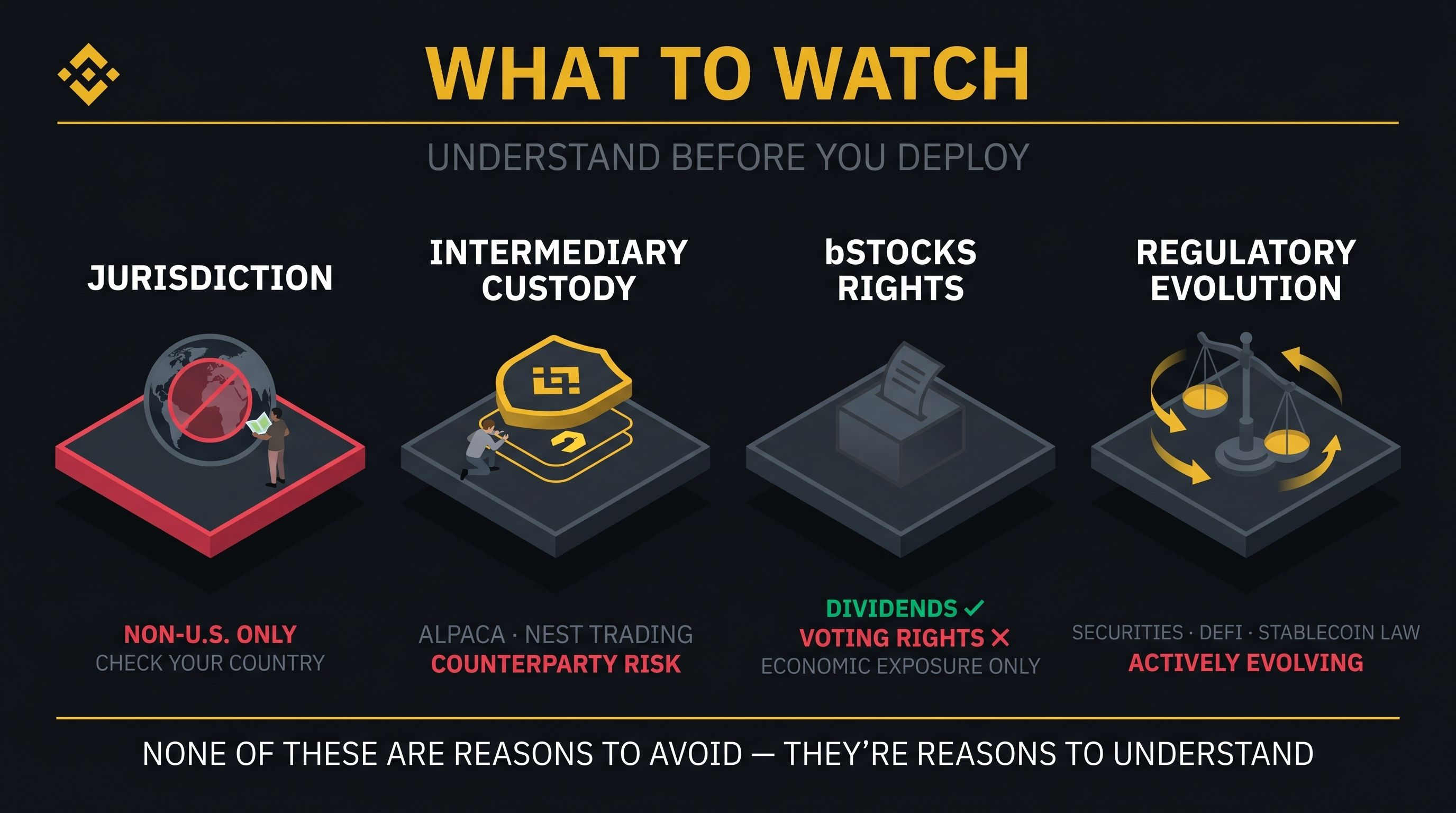
Jurisdiction restrictions
Stocks on Binance are for eligible non-U.S. users only. U.S. residents remain excluded. Availability varies by country, so check your jurisdiction before assuming access.
The intermediary layer
While you are the beneficial owner, custody is handled by regulated partners including Alpaca Securities and Nest Trading. This adds a traditional infrastructure layer under the Binance UI — and with it, counterparty risk that is distinct from normal crypto exposure.
bStocks ≠ full shareholder rights (yet)
Early-stage tokenized stocks typically do not grant full voting rights. You get economic exposure and dividend flow, but governance rights may be limited — similar to most tokenized equity products currently in the market.
Regulatory landscape is still forming
Tokenized stocks and crypto-native equity trading sit at the intersection of securities law, DeFi regulation, and stablecoin rules — all areas where global regulation is actively evolving. What's available today may change based on regulatory developments in key jurisdictions.
None of these are reasons to avoid the product. They're reasons to understand it properly — which is always the right starting point.
Key Takeaways
Binance now offers 7,000+ U.S. stocks and ETFs to eligible non-U.S. users, funded with crypto, starting from $5 with zero commission
This is real beneficial ownership, not CFDs — backed by regulated U.S. clearing infrastructure
Upcoming bStocks will let users convert shares into tokenized assets on BNB Chain, making equities composable within DeFi
This is the clearest real-world proof point of the financial super app thesis — one account spanning crypto, equities, payments, and Web3
The convergence of crypto rails, traditional finance, and on-chain programmability represents a genuine structural shift in how portfolios can be built and managed
Limitations exist — jurisdiction rules, intermediary custody, and evolving regulation mean users need to do their homework before diving in
FAQ
Q: Can U.S. residents buy stocks on Binance?
No. The U.S. stocks and ETFs feature is currently available only to eligible non-U.S. users. Binance.com is not available to U.S. residents under current regulations.
Q: Are these real stocks or derivatives?
They are real stocks with real beneficial ownership, held in custody by a regulated U.S. clearing broker. You receive dividends and are the beneficial owner of the shares — not a CFD or synthetic position.
Q: What cryptocurrencies can I use to buy stocks on Binance?
Users can fund stock purchases with USDT, USDC, BNB, and other supported crypto assets. Sale proceeds settle in stablecoins (primarily USDC).
Q: What are bStocks?
bStocks are tokenized representations of U.S. stocks issued through a regulated SPV in Abu Dhabi's ADGM, designed to live on BNB Chain as programmable on-chain assets. They allow users to use their stock exposure in DeFi contexts.
Q: What is the minimum investment for stocks on Binance?
Fractional shares start from just $5, making it accessible for users who want exposure to high-priced stocks like NVDA without buying a full share.
Q: Are there fees for trading stocks on Binance?
Trading is zero commission, with a small platform fee of $0.35 per order or 10 basis points for larger trades. This is generally competitive with most online brokers.
Q: What is the "TriFi Era"?
TriFi refers to the convergence of crypto, traditional finance (TradFi), and AI-driven automation into a single, programmable financial layer — where stocks, crypto, stablecoins, and DeFi protocols operate together in one connected ecosystem.
Q: How does this connect to DeFi?
Through bStocks on BNB Chain, tokenized equity can be used as collateral, liquidity, or composable inputs in DeFi protocols — bridging the gap between Wall Street assets and on-chain financial infrastructure.