
For years, investing meant living in two separate worlds. In one world, you had your brokerage account — limited to market hours, slow settlement, and a dashboard that went quiet on weekends. In the other, you had crypto — volatile, 24/7, and entirely disconnected from equities.
That wall is coming down. And Binance just swung the first major sledgehammer.
With the launch of bStocks — tokenized U.S. equities living natively on BNB Chain — Binance has made its most significant move yet toward becoming a multi-asset financial superapp. This isn't a side feature. It's a strategic declaration: one platform, one account, one unified financial life.
Let's break down what bStocks actually are, why they matter, and what they signal about the future of money.
What Are bStocks? (And What They're Not)
Before the hype takes over, let's get the basics right.
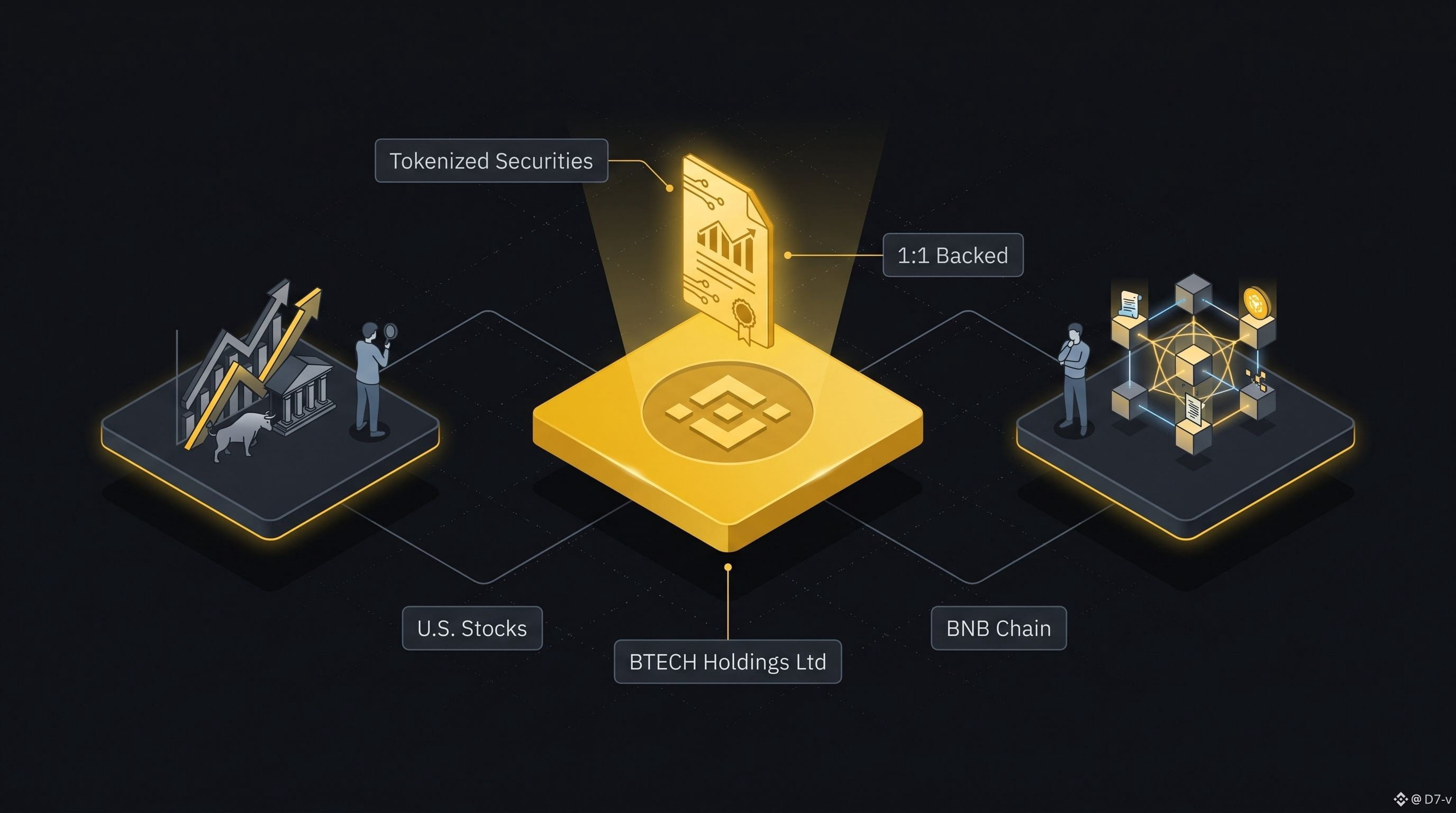
bStocks are tokenized securities — digital tokens that mirror the economic performance of U.S.-listed stocks and ETFs. Think Nvidia, Tesla, Circle, Apple — now represented as blockchain-native tokens on BNB Chain, backed 1:1 by the corresponding underlying share held in custody.
Each bStock is issued by BTECH Holdings Ltd, a special-purpose vehicle registered under the Abu Dhabi Global Market (FSRA) framework, where bStocks are officially admitted as regulated tokenized securities. That regulatory wrapper is a big deal — it means these aren't synthetic knock-offs. They're compliant, structured instruments with legal backing.
But here's the critical nuance: bStocks do not give you shareholder rights. No voting rights, no direct ownership of the underlying share, no affiliation with the issuing company. What you do get is contractual exposure to price movements and dividend income streams — similar to how a CFD or structured certificate works, but with the added property of being a programmable on-chain token.
Think of it this way: a bStock of Nvidia isn't the same as owning Nvidia stock in a Fidelity account. It's owning a blockchain-native certificate that tracks Nvidia's performance — and can be moved, held in self-custody, or eventually plugged into DeFi protocols.
24/7 Trading: The Always-On Advantage
Traditional stock markets run roughly 9:30 AM to 4:00 PM ET, Monday through Friday. If something happens on a Saturday — a major announcement, a geopolitical shock, an earnings surprise — you're stuck watching the price on the news, unable to act.
Crypto traders have never had that problem. And with bStocks, equity traders won't either.
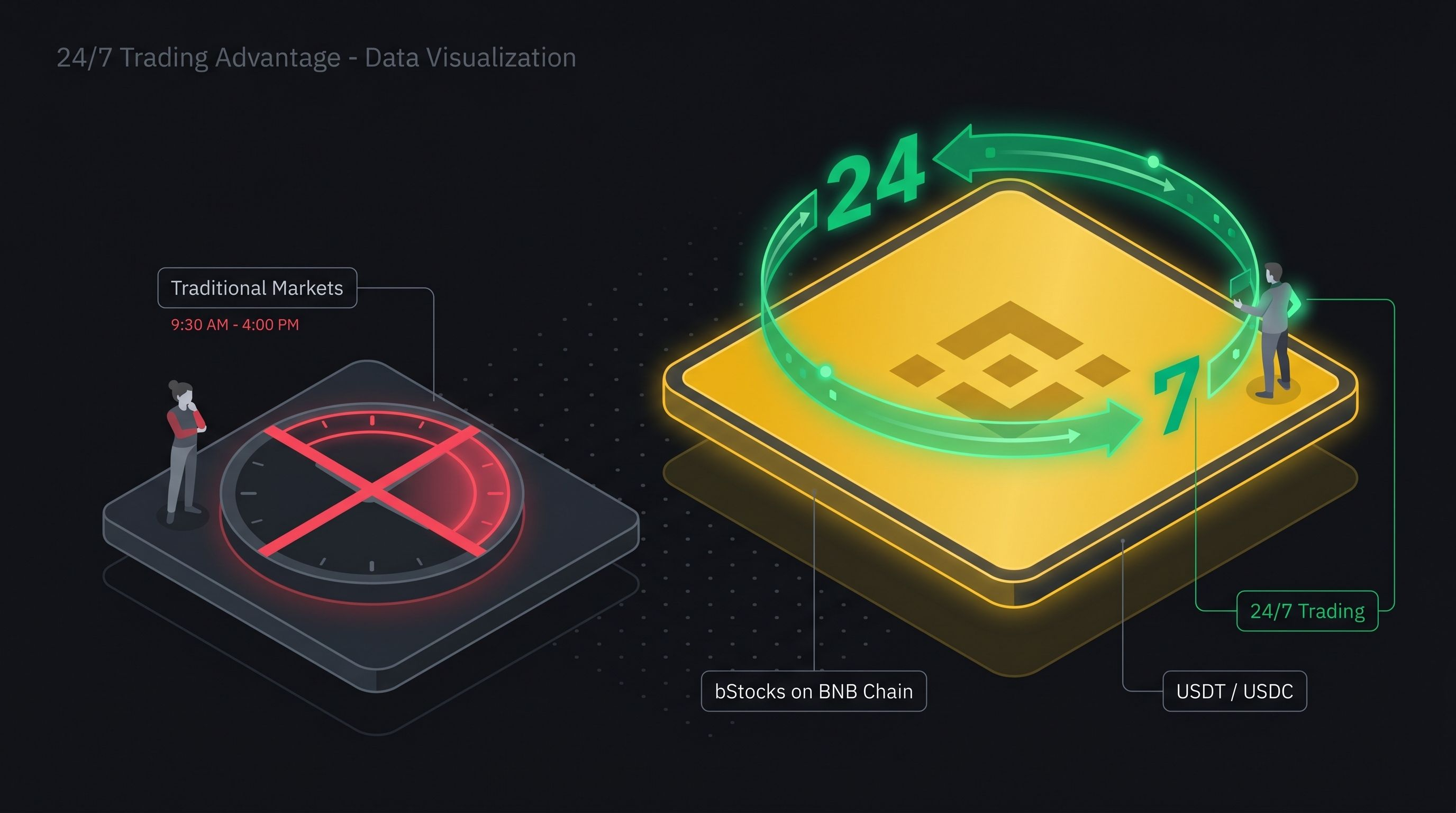
Binance's stock offering already supports 24/5 trading for its standard U.S. stocks and ETFs — but once positions are tokenized into bStocks, trading becomes truly 24/7, including weekends. The token layer eliminates the constraint of traditional exchange hours.
Combined with the fact that users can fund these positions directly with USDT, USDC, BNB, or other crypto assets, the entire workflow changes. You don't need a separate bank account. You don't need a brokerage login. You don't need to wait for market open. Your stablecoin balance can become Apple exposure in seconds.
For traders who already operate in a 24/7 crypto mindset, this is a natural extension. For traditional investors watching crypto, it's a compelling glimpse of what always-on markets look like in practice.
The TradFi-to-DeFi Bridge You Didn't See Coming
Here's where bStocks get genuinely interesting from a structural standpoint.
Once a user tokenizes their stock position into a bStock, that token lives on BNB Chain — and it behaves like any other blockchain asset. That means it can be:
Withdrawn to self-custody — Trust Wallet, Binance Wallet, compatible hardware wallets
Transferred peer-to-peer on-chain without intermediaries
Potentially deployed in DeFi — lending protocols, liquidity pools, collateralized borrowing (subject to protocol support and regulatory rules)
This is the native bridge that the industry has been talking about in theory for years. The promise of RWA (Real-World Asset) tokenization was always this: take trillion-dollar legacy asset classes and put them on programmable rails so they can interact with DeFi the same way stablecoins and liquid staking tokens do.
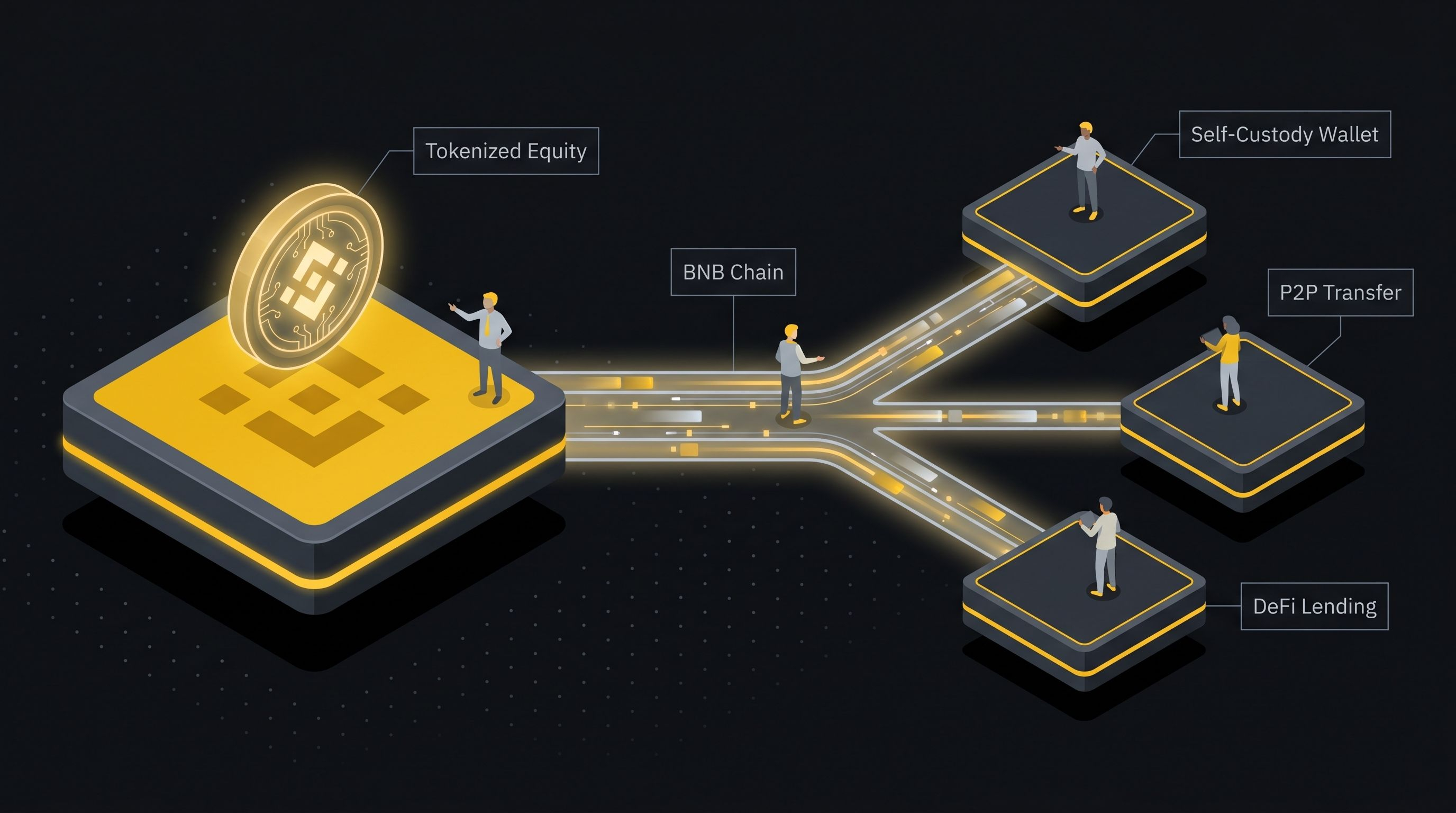
bStocks make that concrete. A user could, in principle, hold tokenized Nvidia exposure as collateral in a lending protocol, borrow stablecoins against it, deploy those stablecoins in a yield strategy — all without ever touching a traditional brokerage or bank.
We're still in early days, and DeFi integration for regulated tokenized equities will require careful legal and technical scaffolding. But the architecture is now in place.
Binance's Superapp Strategy Explained
Let's zoom out and look at the chess board.
Binance has been vocal about its ambition to become a multi-asset financial superapp — and the bStocks launch is the clearest proof point yet that this isn't just marketing language. Consider what a single Binance account now gives eligible non-U.S. users access to:
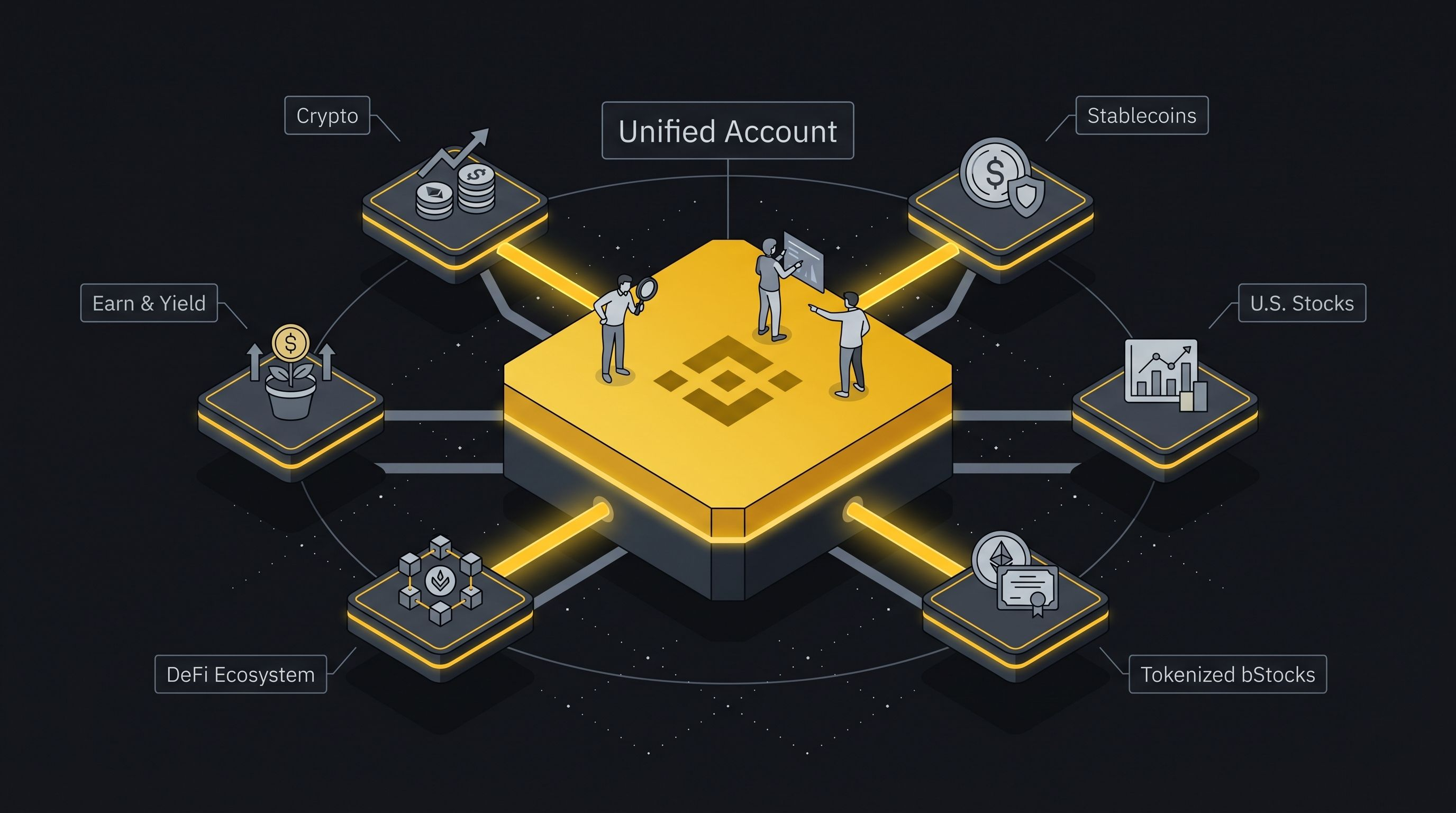
Asset Class Feature Crypto (Spot & Futures) 350+ trading pairs, leverage, options Stablecoins USDT, USDC, FDUSD for payments and yield U.S. Stocks & ETFs 7,000+ equities, zero commission, $5 minimum Tokenized bStocks On-chain, self-custody, 24/7, DeFi-composable DeFi (via Binance Wallet) BNB Chain ecosystem access Earn & Yield Staking, flexible savings, launchpool
That's a comprehensive financial stack. The kind that would have previously required a brokerage account, a crypto exchange account, a DeFi wallet, and a savings platform — all separate, all siloed, all with their own funding rails.
The superapp vision isn't about having every feature. It's about eliminating the friction between asset classes so that capital can flow naturally between crypto, equities, and DeFi within a single ecosystem. Binance is explicitly building toward unified balances, crypto-based funding for all asset types, and on-chain composability — all in one account.
What This Means for Retail and Crypto-Native Investors
If you're a crypto-native investor, bStocks changes your mental model for portfolio management.
Previously, rotating from BTC to a diversified equity position required going through multiple platforms: exchange → bank → brokerage, with KYC at every step and days of settlement delays. Now, that rotation is a single trade within one interface, settled in near-real time, fundable with stablecoins.
If you're a retail investor coming from traditional finance, the proposition is equally compelling. Fractional investing starts from just $5, zero commissions apply, and the platform you're already using for crypto is the same one where you can buy Tesla or an S&P 500 ETF.
For emerging market investors in particular — in Southeast Asia, Africa, Latin America — where access to U.S. equity markets has historically been limited by banking infrastructure, bStocks and Binance's global reach could be genuinely transformative. Crypto-funded access to U.S. equities, with no dollar bank account required, is a powerful unlock.
Risks and Caveats You Should Know
In the spirit of intellectual honesty — because no good crypto article glosses over the risks — here's what you need to understand before going all-in on bStocks.
1. You don't own the underlying stock.
bStocks are certificates, not direct equity ownership. Your rights and payoffs depend on the issuer (BTECH Holdings Ltd), the custodian, and the regulatory framework — not just the market price.
2. Access is jurisdictionally restricted.
bStocks are issued under an FSRA-approved prospectus and are only available to eligible users in permitted jurisdictions. U.S. residents are excluded. Availability can change with regulatory shifts.
3. Platform and counterparty risk exist.
Even with 1:1 backing, you are exposed to Binance's operational continuity and the custodian holding the underlying shares. This is different from holding equities in a SIPC-protected U.S. brokerage.
4. DeFi integration is not yet live at scale.
The architecture supports it, but meaningful DeFi composability for regulated tokenized equities is still in early development. Don't expect to plug bStocks into Aave on day one.
Informed investing means knowing both the upside and the caveats. bStocks are genuinely innovative — and the risk profile is meaningfully different from a traditional brokerage account.
The Bigger Picture: RWA Tokenization Is Going Mainstream
bStocks don't exist in a vacuum. They're part of a sweeping global trend.
Tokenized stock trading volume reportedly hit roughly $15 billion in Q1 2026 alone — surpassing the total volume for the entire second half of 2025. That's not a niche experiment anymore. Institutions, regulators, and platforms worldwide are recognizing that putting real-world assets on-chain is not a question of whether but when and how.
Binance's move puts it at the center of that transition. By combining a global user base, an established crypto exchange, BNB Chain's DeFi ecosystem, and now regulated tokenized equities, Binance has assembled a stack that few competitors can replicate quickly.
For the broader market, this signals that the TradFi-DeFi convergence is no longer a whitepaper thesis. It's a product you can use today. The definition of a "crypto platform" is expanding — and the definition of a "brokerage" is being quietly disrupted.
Key Takeaways
bStocks are regulated tokenized securities — 1:1 backed by underlying U.S. equities, issued under FSRA (Abu Dhabi) regulatory framework
They do not confer shareholder rights — they provide contractual exposure to price and dividend income
Trading is 24/5 for standard stocks, 24/7 for tokenized bStocks on BNB Chain
Users can fund positions with stablecoins and crypto, eliminating the need for a dollar bank account
bStocks support self-custody and are designed for future DeFi composability — the core RWA thesis in action
Binance is executing a clear superapp strategy — one account for crypto, equities, stablecoins, and DeFi
Access is restricted — not available to U.S. residents or users in excluded jurisdictions
RWA tokenization is accelerating — $15B+ in Q1 2026 tokenized stock volume signals mainstream momentum
Platform risk exists — bStocks are not the same as holding equities in a traditional regulated brokerage
❓ FAQ Section
Q: What are bStocks on Binance?
bStocks are tokenized certificates representing U.S.-listed stocks and ETFs, issued by BTECH Holdings Ltd under FSRA regulation in Abu Dhabi. They trade on BNB Chain and can be held in self-custody wallets.
Q: Do bStocks give me ownership of the real stock?
No. bStocks provide contractual exposure to the price performance and dividends of the underlying stock, but do not confer shareholder voting rights or direct ownership.
Q: Can I trade stocks 24/7 on Binance?
Standard U.S. stocks and ETFs on Binance trade 24/5. When converted to tokenized bStocks on BNB Chain, trading is available 24/7, including weekends.
Q: What cryptocurrencies can I use to buy stocks on Binance?
Eligible users can fund stock purchases using stablecoins like USDT and USDC, as well as selected crypto assets including BNB.
Q: Are bStocks available to U.S. users?
No. bStocks and Binance's U.S. stock trading features are available only to eligible non-U.S. users in permitted jurisdictions. U.S. residents should check Binance.US for applicable products.
Q: Can I use bStocks in DeFi protocols?
bStocks are designed to be DeFi-composable as BNB Chain tokens, but live integration with specific DeFi protocols depends on protocol support and applicable regulations. Full DeFi composability is a roadmap item, not yet universally live.
Q: How is Binance's superapp different from a traditional brokerage?
A traditional brokerage offers equities in isolation. Binance's superapp combines crypto trading, stablecoin rails, 7,000+ U.S. stocks, tokenized equities, and DeFi access in a single account funded with crypto — without requiring a separate bank account or brokerage login.
Q: What is the minimum investment for Binance stocks?
Eligible users can start investing in U.S. stocks and ETFs with as little as approximately $5, with fractional share support and zero commission fees.