
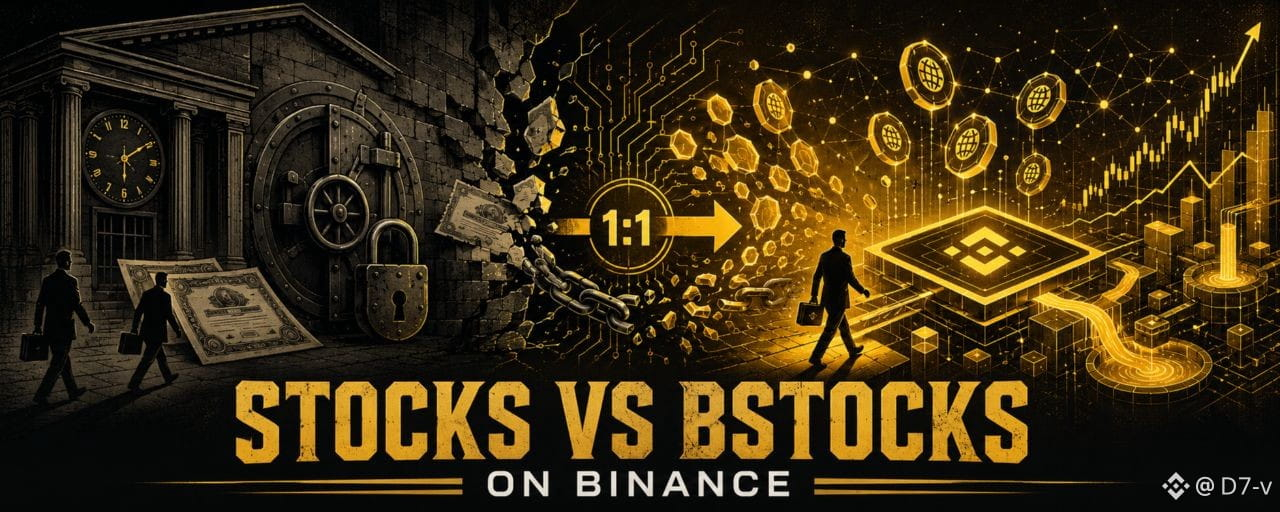
The line between traditional finance and crypto just got a lot thinner. Binance — the world's largest crypto exchange — now lets you trade U.S. stocks and ETFs without ever leaving your crypto account. But here's where it gets interesting: there are two ways to do it, and they're built for very different types of users.
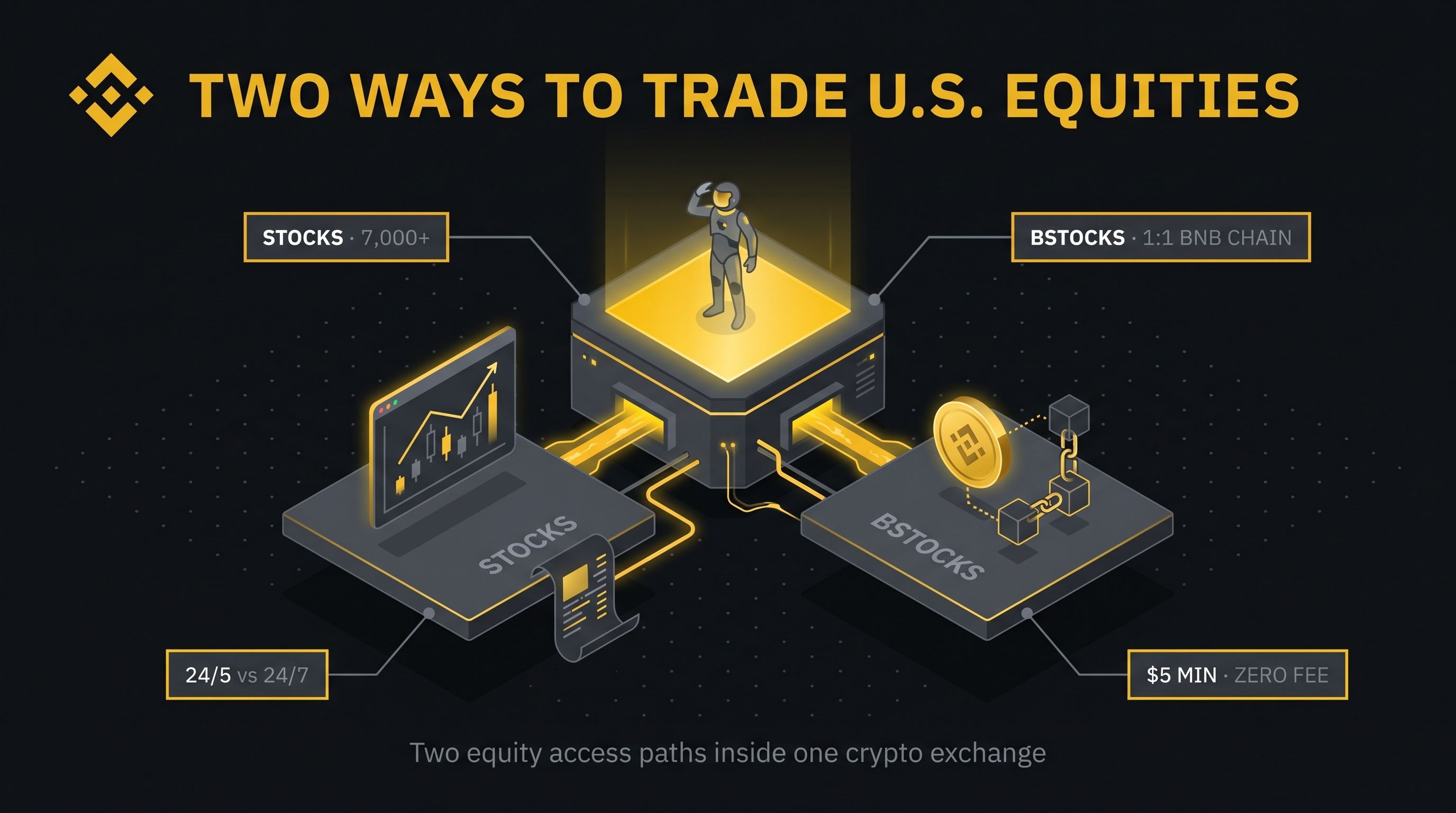
Binance Stocks gives you real brokerage-style exposure to 7,000+ U.S.-listed equities. Binance bStocks takes those same assets and puts them on a blockchain — tradeable 24/7 and composable with DeFi. Understanding the difference isn't just a technical exercise. It shapes how you trade, how you manage dividends, where your assets live, and whether you can use them in on-chain strategies.
Let's break it all down.
What Are Binance Stocks?
Binance Stocks is a traditional equities product built inside the Binance app. You can buy fractional shares of 7,000+ U.S.-listed stocks and ETFs — companies like Apple, Nvidia, Tesla, and beyond — starting from just $5, with zero commission fees.
Under the hood, orders are routed through Nest Trading Limited and executed, cleared, and custodied by Alpaca Securities LLC, a regulated U.S. broker-dealer. Binance acts as the front-end interface; Alpaca holds the actual securities on your behalf as the beneficial owner.
You fund trades using USDC, USDT, BNB, or other supported cryptocurrencies, which are automatically converted to USDC for the transaction. When you sell, proceeds land back in USDC in your Binance account. Trading runs 24 hours a day, five days a week (24/5), covering regular market hours plus pre- and post-market sessions.
This is the simplest, most familiar route if you're used to TradFi investing — it just happens to live inside a crypto exchange.
What Are Binance bStocks?
bStocks are tokenized securities — digital tokens that are backed 1:1 by real underlying shares held by a regulated custodian, then issued on the BNB Chain blockchain. They track the total economic performance of their underlying stock and trade like crypto spot pairs on Binance, around the clock, every day of the week.
Launched in June 2026, bStocks debuted with a curated selection of high-profile U.S. equities including Nvidia (bNVDA), Tesla (bTSLA), Micron (bMU), Circle (bCIRC), and SanDisk, with more planned.
The core concept: if you already hold Binance Stocks, you can convert them into bStocks at a 1:1 ratio at no conversion fee. From that point on, your equity exposure lives on-chain — you can self-custody the tokens in a compatible wallet, hold them on Binance, or eventually use them within DeFi protocols as a real-world asset (RWA).
bStocks are legally classified as tokenized securities or certificates — not direct shares — issued through an SPV structure under regulators such as the Financial Services Regulatory Authority (FSRA) in Abu Dhabi Global Market (ADGM). That means you don't get shareholder voting rights, but you do get full economic participation.
Stocks vs bStocks: The Key Differences
Dimension Binance Stocks Binance bStocks What you hold Beneficial ownership of actual U.S. stocks/ETFs On-chain tokenized securities backed 1:1 by real shares Legal nature Traditional securities via regulated broker (Alpaca) Tokenized certificates under ADGM/FSRA framework Trading hours 24/5 (including pre/post-market) 24/7 including weekends Settlement Traditional securities infrastructure via Alpaca On-chain settlement on BNB Chain Custody Custodied by Alpaca Securities LLC Token held on Binance or self-custody wallets Dividends Cash credits to Binance account (via broker) Auto-reinvested; tracked as total return Voting rights No direct voting rights (beneficial ownership via broker) No voting rights DeFi use Not designed for on-chain use Composable RWA — lending, collateral, liquidity pools Asset universe 7,000+ U.S. stocks and ETFs Curated selection (expanding), e.g., NVDA, TSLA, CIRC Fees Zero commission; spreads/platform fees may apply No tokenization fee; standard Binance spot trading fees
Ownership and Legal Structure: More Similar Than You Think
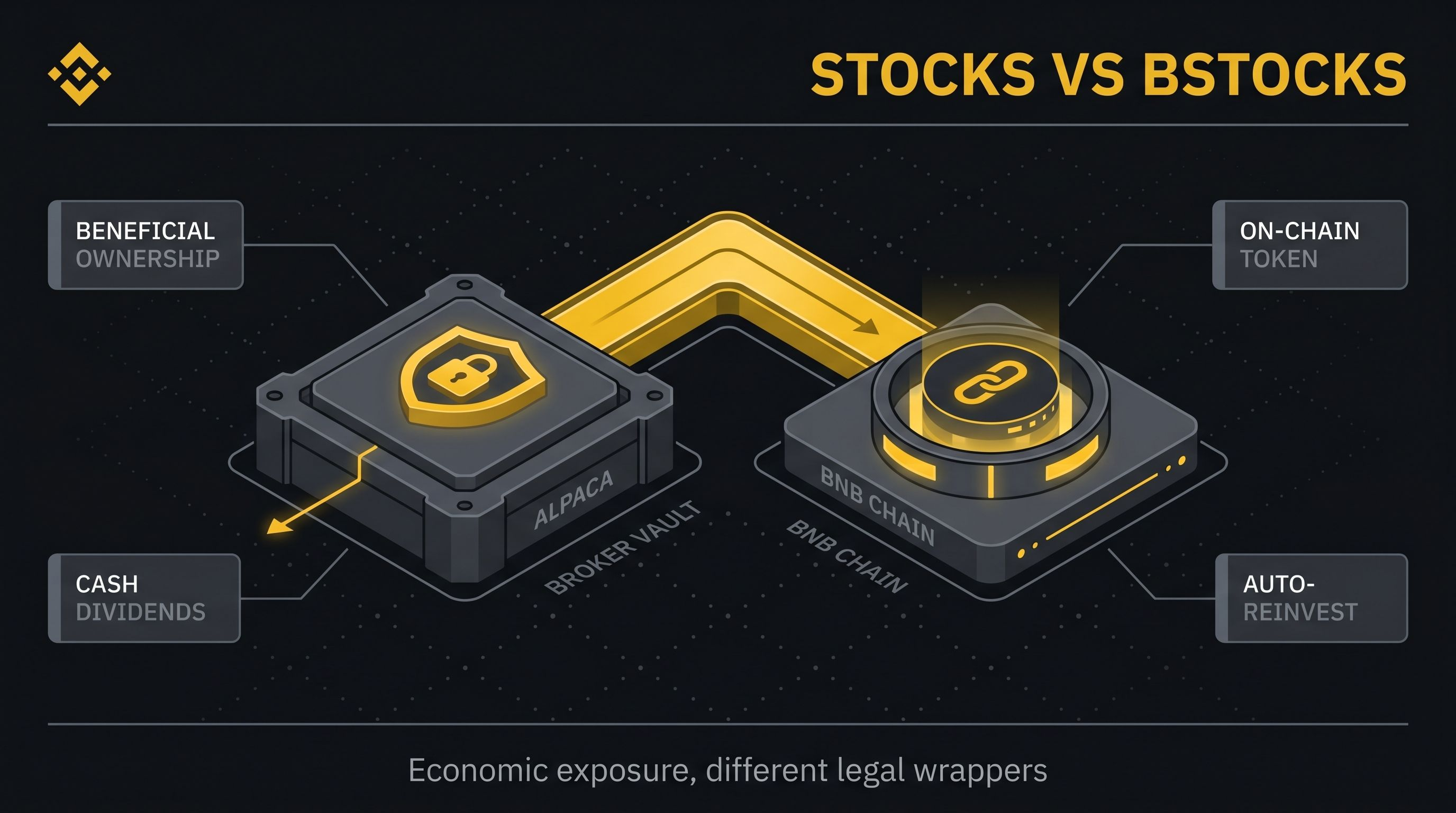
Neither product gives you the voting rights of a shareholder sitting on the company register. With Stocks, you're the beneficial owner, meaning you own the economic interest through a broker (Alpaca) who holds the securities in your name on a custodial basis — the same model used by most retail brokerage apps globally.
With bStocks, the issuer (an SPV or issuing entity) holds the underlying shares, and you hold a token representing your pro-rata claim on those assets. You still capture all price movements and total returns, but the legal wrapper is a tokenized security or certificate under the ADGM framework rather than a traditional brokerage account. Think of it like a tokenized ETF structure, but for individual stocks.
For most retail users, this distinction doesn't change the day-to-day experience much. But for institutional users or those with tax or legal obligations tied to share ownership, it's worth understanding.
Trading Hours and Settlement: The 24/7 Advantage
This is where bStocks genuinely diverges from anything TradFi offers. Traditional markets close on weekends. U.S. stock markets are open roughly 9:30 AM–4:00 PM ET on weekdays, with limited extended-hours access. Even Binance Stocks — which offers generous 24/5 trading — follows this five-day-a-week cycle.
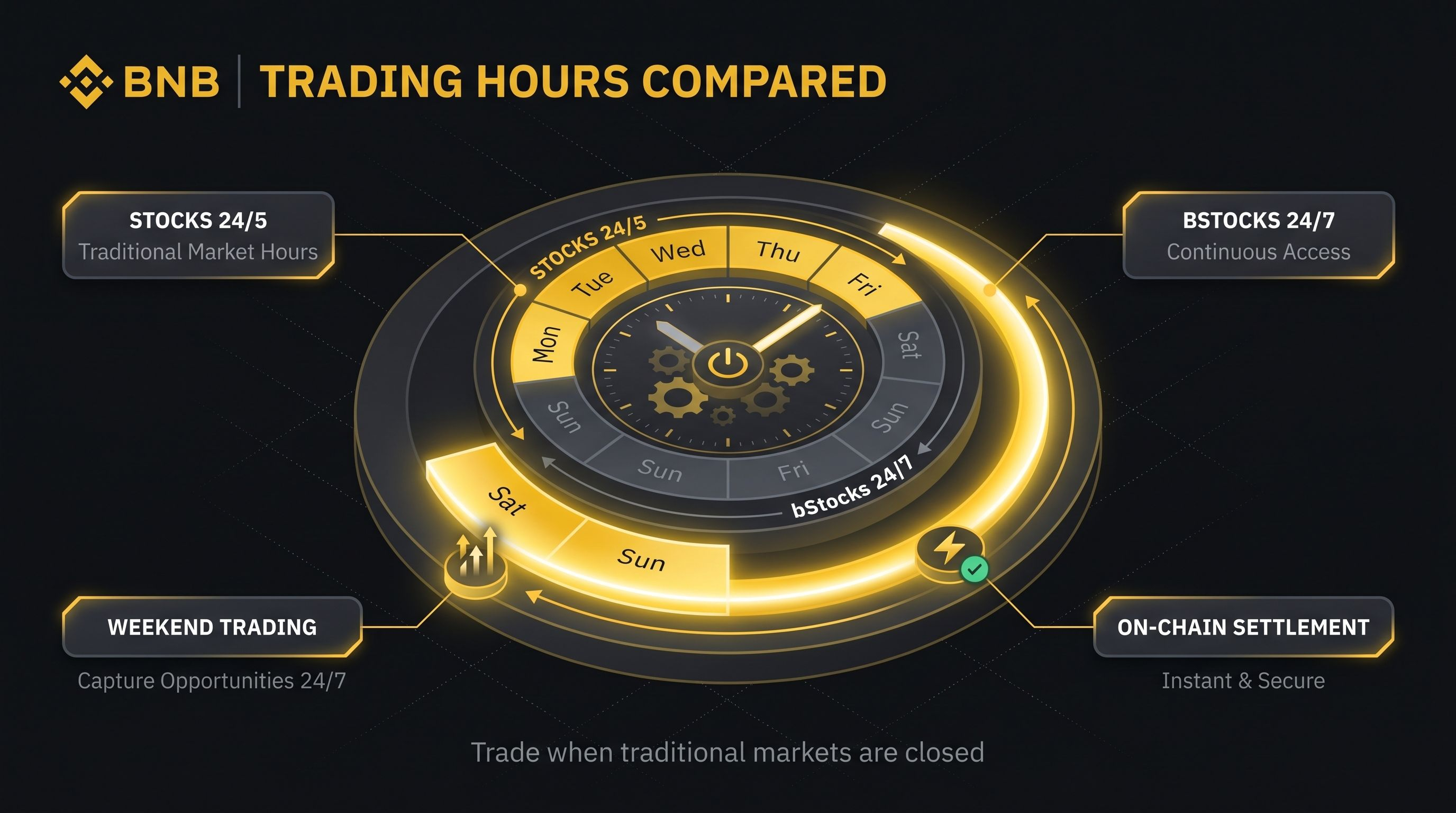
bStocks trade 24/7, including Saturday and Sunday. When markets are closed and macro news breaks — a Fed announcement, a geopolitical event, a major corporate headline — bStock prices can still move and be traded on Binance's spot market, because price discovery happens on-chain rather than waiting for market open.
Settlement for bStock trades is handled on BNB Chain, meaning token transfers are near-instant and verifiable on-chain. When you redeem bStocks back into Stocks, that conversion processes during regular market hours since it involves the underlying securities infrastructure.
Custody: Who Actually Holds Your Assets?
With Binance Stocks, custody stays entirely in the brokerage stack. Alpaca Securities LLC is your custodian; Binance is your interface. You cannot withdraw shares to an external brokerage. To exit, you sell back to USDC within Binance.
With bStocks, the underlying shares are still held by a custodial entity, but the tokens themselves are on-chain. This opens a fundamentally different custody model:
Hold bStocks on Binance — the simplest option; works like spot crypto.
Withdraw to a self-custody wallet — as support rolls out for compatible wallets on BNB Chain, you can hold your equity exposure in your own wallet with your own private keys, with no broker holding them for you.
For crypto-native users who operate under the "not your keys, not your coins" philosophy, self-custody bStocks represent a genuinely new paradigm: equity exposure that no custodian can freeze, restrict, or lose.
Dividends and Corporate Actions: A Key Difference to Understand
If you hold Binance Stocks and the underlying company pays a cash dividend, that dividend is credited to your Binance account in cash or stablecoin — exactly how dividends work at any traditional brokerage. Stock splits, consolidations, and other corporate actions are also processed by the broker, updating your position accordingly.
bStocks work differently. Rather than distributing cash dividends to token holders, dividends are automatically reinvested into the underlying security. This means bStocks function as total-return trackers — over time, the token's value incorporates both price appreciation and reinvested dividends, which compounds silently rather than landing in your account as cash.
This matters for your strategy. If you rely on dividend income as cash flow, Stocks are more suitable. If you're focused on total wealth accumulation and prefer compounding, bStocks' auto-reinvestment structure works in your favor.
DeFi Composability: bStocks' Hidden Power
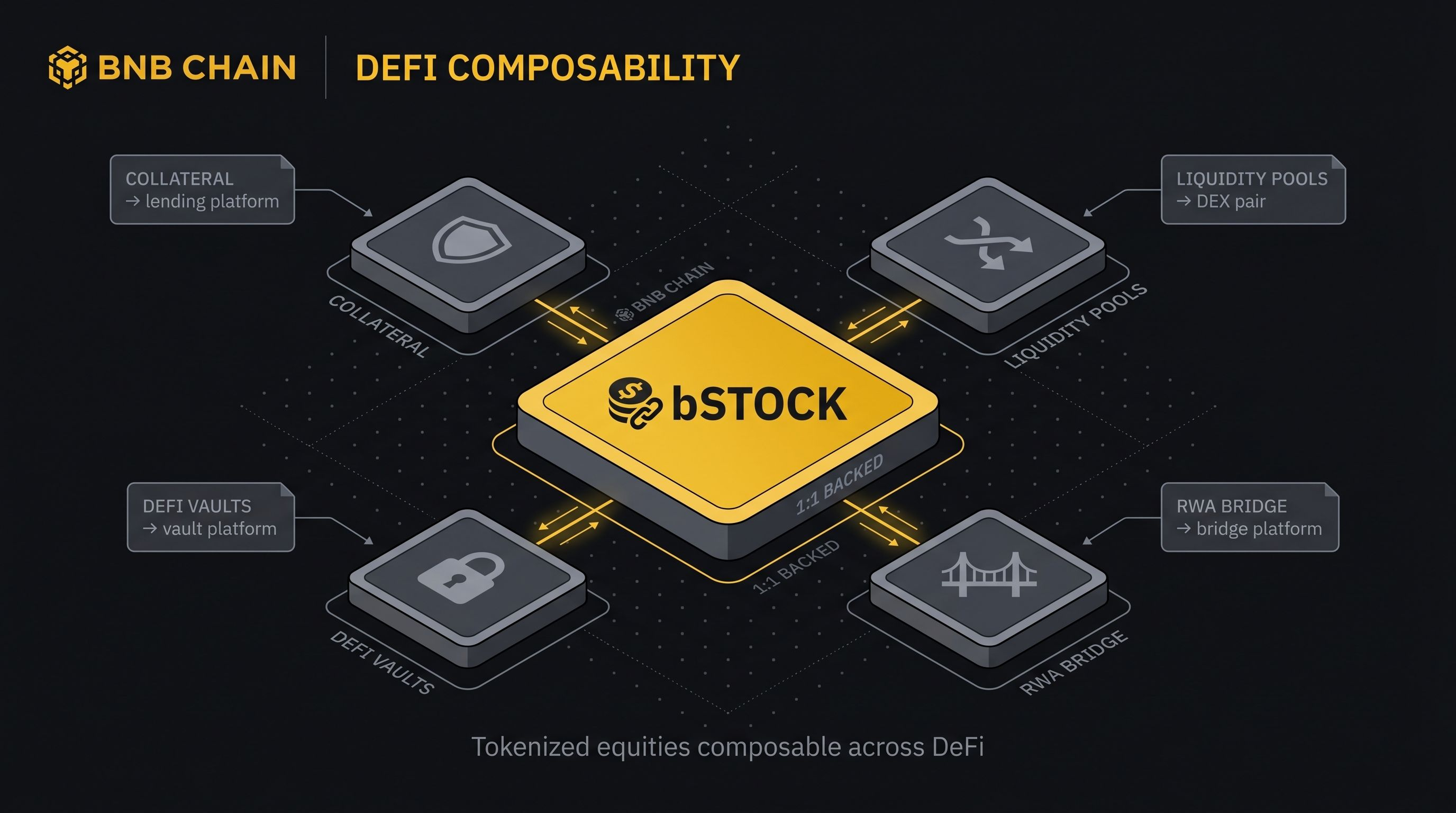
This is the headline feature that sets bStocks apart from anything the traditional world offers. Because bStocks are on-chain tokens on BNB Chain, they are designed to be composable — meaning DeFi protocols can integrate them just like any other token.
What does that look like in practice?
Use bStocks as collateral on lending platforms to borrow stablecoins without selling your equity exposure
Provide liquidity in bStock/USDC pairs on DEXs and earn trading fees
Integrate bStocks into structured products — DeFi vaults, yield strategies, or basket tokens
Bridge RWA exposure directly into on-chain portfolios that already hold crypto assets
As the RWA sector matures, tokenized equities like bStocks could become a core collateral primitive across DeFi — similar to how WBTC brought Bitcoin into Ethereum's ecosystem. It's early, but the infrastructure is being built.
Who Should Choose Binance Stocks?
Binance Stocks is the right choice if:
You want simple, familiar exposure to U.S. equities through a brokerage-style setup you already understand
You want access to the broadest possible universe of U.S.-listed stocks and ETFs (7,000+) including niche sectors, small caps, and ETFs
You prefer cash dividends credited directly rather than auto-reinvestment
Your strategy is standard equity investing — buy, hold, sell — within extended but TradFi-aligned market hours
You're not looking to plug your equity positions into DeFi or manage token custody
Who Should Choose Binance bStocks?
bStocks is the right choice if:
You're crypto-native and want equity exposure that lives on-chain alongside your crypto portfolio
You value 24/7 trading — being able to react to news on a Saturday morning or Sunday night matters to your strategy
You want the option to self-custody your equity exposure in a compatible wallet, keeping your shares under your own keys
You plan to use tokenized equities in DeFi strategies — lending, liquidity, collateral, structured products
You're building or investing in the RWA thesis and want direct exposure to how tokenized equities work in practice
Key Takeaways
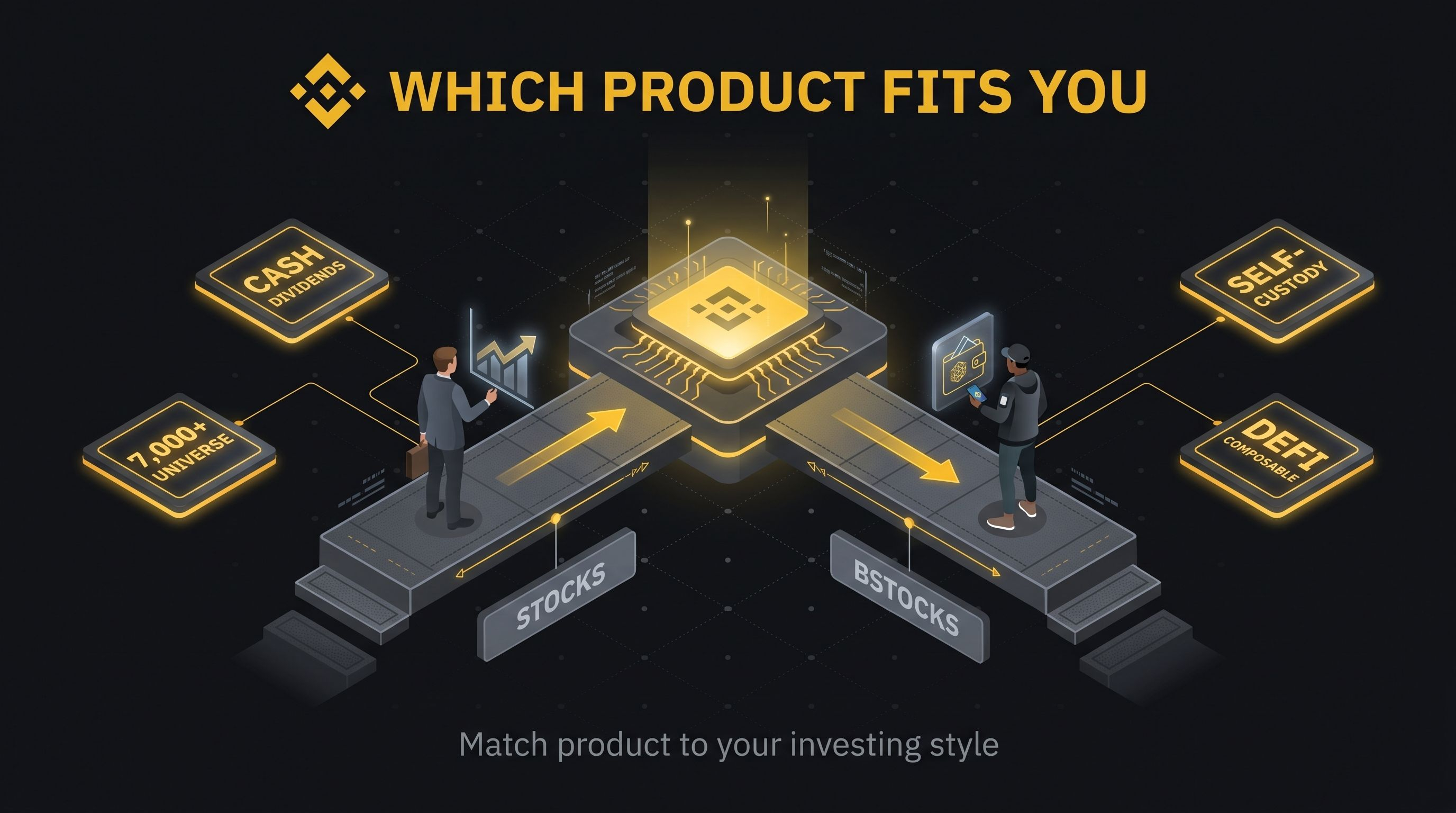
Binance Stocks gives you traditional brokerage exposure to 7,000+ U.S. equities through Alpaca Securities, with 24/5 trading, cash dividends, and zero commissions — accessed entirely inside the Binance app.
Binance bStocks are 1:1-backed tokenized securities on BNB Chain, offering 24/7 trading, on-chain settlement, self-custody potential, and DeFi composability — for a curated but growing set of U.S. names.
The biggest practical differences are: trading hours (24/5 vs 24/7), custody model (broker-held vs on-chain token), dividends (cash payout vs auto-reinvested), and DeFi use (none vs composable RWA).
Neither product gives you direct shareholder voting rights — both are economic exposure products through an intermediary structure.
bStocks represent the infrastructure layer of the RWA movement — equities on-chain that can interact with the full DeFi stack.
Always verify regional eligibility — both products are generally aimed at non-U.S. users and availability varies by jurisdiction.
❓ FAQ
Q1: Can I convert my Binance Stocks into bStocks at any time?
Yes. Eligible users can convert Stocks into bStocks at a 1:1 ratio with no conversion fee. Conversions back to Stocks are processed during regular market hours since they involve the underlying securities.
Q2: Do bStocks pay dividends?
Not directly. Dividends from underlying stocks are automatically reinvested, making bStocks total-return trackers rather than income instruments. Your bStock position reflects both price growth and reinvested dividends over time.
Q3: Are bStocks real shares?
No. bStocks are tokenized securities (certificates) backed 1:1 by real shares held by a custodian. You hold a token representing economic exposure — not a direct legal claim on the underlying shares. Voting rights are not included.
Q4: Can I use bStocks in DeFi?
This is the design intent. bStocks are built on BNB Chain as programmable RWAs, meaning DeFi protocols can integrate them as collateral, liquidity assets, or components in structured products. Specific protocol integrations are rolling out over time.
Q5: What happens to bStocks if Binance has a problem?
The underlying shares are held by a regulated custodian separately from Binance. If you've withdrawn bStock tokens to a self-custody wallet, those tokens remain yours on-chain regardless of Binance's operational status. This is one of the key risk-management arguments for self-custody.
Q6: Are Binance Stocks and bStocks available in all countries?
No. Both products are subject to regional restrictions and are generally aimed at non-U.S. users. Availability varies based on local regulations. Always check Binance's eligibility criteria for your jurisdiction before trading.
Q7: What are the fees for bStocks?
There is no fee to tokenize (convert Stocks to bStocks) or to convert back. When you trade bStocks on Binance's spot market, standard Binance spot trading fees apply. No separate brokerage commissions.
Q8: Can I self-custody bStocks in my own wallet?
Yes, as self-custody support rolls out on BNB Chain. bStocks are on-chain tokens, meaning they can be withdrawn to compatible self-custody wallets — giving you equity exposure that you hold independently of any custodian.