
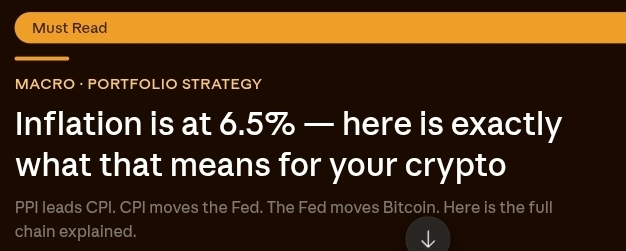
Most people see a number like 6.5% PPI and move on. But if you hold crypto, that number just changed the rules of your game — and understanding why could save your portfolio.
Producer Price Index measures inflation at the wholesale level — the prices businesses pay before they pass them on to consumers. When PPI runs hot, CPI follows weeks later. When CPI runs hot, the Fed tightens. When the Fed tightens, risk assets like Bitcoin fall.
Digital assets have increasingly traded as macro-sensitive risk assets since 2022. Bitcoin's correlation with the Nasdaq 100 has hovered between 0.5 and 0.7 throughout Q1 2026 — meaning equity-market reactions to inflation data directly spill into crypto. This is not a crypto-specific phenomenon. It is a macro repricing event that hits every asset class competing for the same pool of speculative capital. OpenPR
Core PPI doubled month over month. Trade services jumped 2.7% in a single month — the largest on record. Higher oil prices near $90.8 per barrel added another source of pressure, raising transport and production costs. Investing.com
So what does this mean practically for your portfolio?
In the short term — the next 2 to 4 weeks — inflation staying above 6% means rate cut hopes stay dead. Bitcoin struggles to break $65,000. Altcoins bleed slowly. Stablecoins earn yield.
In the medium term — 3 to 6 months — if inflation peaks here and starts falling, the narrative flips fast. Bitcoin typically moves before the rate cut itself as markets price in the expectation.
In the long term — the case for Bitcoin as an inflation hedge has never been stronger on paper. 6.5% producer inflation is exactly the environment Bitcoin was designed for. The timing of when that narrative takes hold is the only debate.
Protect your capital in the short term. Stay positioned for the medium term. Because when this inflation cycle peaks — and it will — the next Bitcoin move will not wait for you to get ready.
DYOR. Not financi$al advice$BTC
