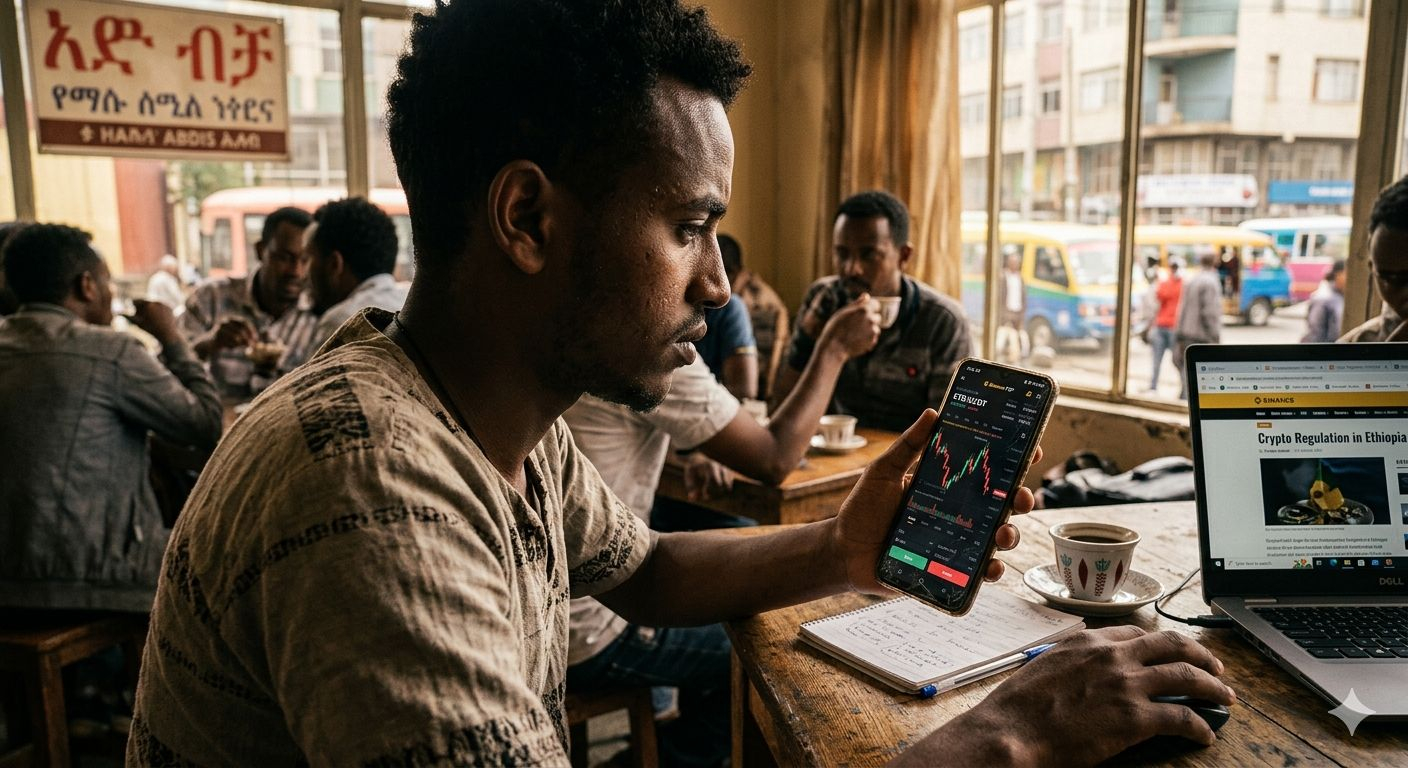
Cryptocurrency trading can be particularly difficult in developing countries such as Ethiopia for several reasons:
Limited Access to Banking Services
Many international crypto exchanges require bank cards, wire transfers, or payment systems that may not be widely available.
Restrictions on foreign currency access make it harder to fund trading accounts.
Regulatory Uncertainty
Governments may not have clear laws governing cryptocurrency.
Traders face uncertainty about taxation, legality, and future regulations.
Foreign Exchange Controls
Countries with strict currency controls often limit access to U.S. dollars and other major currencies used in crypto markets.
This creates barriers when depositing or withdrawing funds.
Internet and Infrastructure Challenges
Reliable internet access is essential for trading.
Power outages or unstable connections can lead to missed opportunities and losses.
High Volatility and Risk
Crypto markets can move dramatically within minutes.
In countries where incomes are relatively low, losses can have a much greater impact on household finances.
Fraud and Scams
Limited consumer protection makes traders vulnerable to fake investment platforms, Ponzi schemes, and fraudulent "wallet" applications.
Many people enter the market without sufficient knowledge and become targets for scammers.
Educational Barriers
Crypto trading requires understanding blockchain technology, market analysis, risk management, and security practices.
Access to quality financial education may be limited.
Withdrawal Difficulties
Even when traders make profits, converting crypto into local currency can be challenging if local exchanges and payment channels are unavailable.
For Ethiopians specifically, foreign exchange restrictions, limited access to international payment systems, and an evolving regulatory environment are among the biggest obstacles. Crypto trading is harder in developing countries not because people lack talent, but because the financial system is stacked against them.
But
A trader in the United States can easily connect a bank account, deposit dollars, use regulated exchanges, and withdraw profits.
A trader in Ethiopia often faces: Another challenge is capital size. Many successful traders in wealthy countries can afford to lose money while learning. Someone trading with a few hundred dollars in a developing economy often cannot afford large mistakes, making the learning curve much more painful.
Ironically, crypto was designed to remove barriers, but the people who could benefit most from it often face the greatest obstacles accessing it safely and legally.
Instead
Learning risk management.
Understanding blockchain fundamentals.
Avoiding "guaranteed profit" schemes.
Using only well-established exchanges and wallets.
Never investing money needed for living expenses.
Most crypto traders lose money. The people who last are usually those who treat it as a skill that takes years to develop rather than a quick path to wealth.