


Key Highlights
Zcash (ZEC) is trading at $513.53 — up +21.31% in 24 hours — with a market cap of approximately $8.58 billion — recovering sharply from the 4-year hidden Orchard bug collapse that sent ZEC down 35%+ just days ago.
Zcash founder Zooko Wilcox has reassured the community that legitimate Orchard shielded pool funds remain fully recoverable — and that the vulnerability was never exploited — calming fears that had dominated sentiment since the disclosure.
Anthropic's Claude (Mythos model) conducted a post-patch security audit and found no additional critical vulnerabilities — adding a credible independent verification layer to Zooko's assurances.
A Bump and Run Reversal (BARR) pattern is forming on the 4-hour chart — with the 50 MA recently reclaimed at ~$432 — and a confirmed breakout above the lead-in phase trendline targeting the $750+ zone.
Zcash is staging one of its most significant single-day recoveries in recent history — and the catalyst is not a technical breakout or a macro tailwind. It is something more fundamental: the founder of the protocol standing up and telling the community, clearly and directly, that their funds are safe.
As we covered in our ZEC 4-year bug collapse article — the disclosure of a critical vulnerability in Zcash’s Orchard shielded pool sent ZEC down 35%+ — driven primarily by the impossibility of independently verifying whether counterfeit ZEC had been minted during the 4-year window the bug existed. The market priced the uncertainty as a worst-case scenario.
Today’s +21.31% recovery is the market reassessing that worst-case pricing — as Zooko’s direct communication and a Claude AI post-patch audit provide the closest thing to supply integrity assurance that Zcash’s privacy architecture currently allows.
ZEC at a Glance — June 13, 2026
 Zcash (ZEC) Price 15 June 2026/Source: Coinmarketcap
Zooko’s Statement — “Legitimate Funds Remain Recoverable”
The primary driver of today’s recovery is direct communication from Zcash founder Zooko Wilcox — who addressed the community’s concerns about the Orchard pool vulnerability with the clearest reassurance he could provide given the protocol’s privacy architecture.
Zooko’s key messages:
The vulnerability was never exploited — The Zcash team believes no attacker used the bug to create counterfeit ZEC before the emergency patch was deployed. While the privacy design of the Orchard pool means this cannot be independently verified on-chain — the team’s forensic assessment found no evidence of exploitation during the 4-year window.
Shielded funds remain recoverable — Users who hold legitimate funds in the Orchard shielded pool can recover them. Zooko specifically reassured the community that choosing to leave funds in shielded wallets remains a reasonable and safe choice — directly countering the panic-driven narrative that funds needed to be moved immediately.
Moving funds carries its own risks — In a nuanced point that many panicked community members had not considered — Zooko highlighted that moving assets out of shielded wallets is not risk-free:
Privacy tradeoffs — Moving from shielded to transparent addresses reveals transaction history that the shielded pool was specifically designed to protect
Custodian risks — Moving to a different custody solution introduces its own security considerations
Operational mistakes — The act of moving large amounts of cryptocurrency carries execution risk regardless of the asset
This framing — that staying put may actually be safer than panicking into movement — has been central to the sentiment reversal driving today’s rally.
The Claude AI Audit — Independent Verification
Adding a significant layer of credibility to Zooko’s reassurances — the post-patch security review was conducted by Anthropic’s Claude (Mythos model) — and it found no additional critical vulnerabilities in the Zcash codebase following the emergency patch.
The irony here is notable: the same Claude AI model family that discovered the original Orchard vulnerability — as we covered in our ZEC collapse article, security researcher Taylor Hornby used Claude Opus 4.8 to find and build the proof-of-concept exploit — has now conducted the post-patch audit and found the codebase clean.
This creates a meaningful credibility loop: the AI model that found the bug has reviewed the fix and found no further issues. For a community that was worried about unknown unknowns in the Orchard code — a post-patch audit finding no additional critical vulnerabilities is exactly the reassurance needed to shift sentiment from panic to measured confidence.
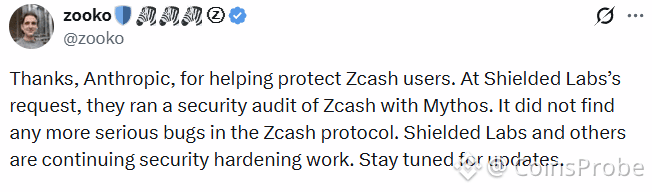 Zcash Claude Audit Statement/Source: @zooko (X)
Technical Analysis: BARR Pattern Signals Major Recovery
On the 4-hour chart, ZEC is displaying a Bump and Run Reversal (BARR) pattern — a bullish reversal setup.Key levels on the chart:
Bump Phase low: $256.12
50 MA (key support): ~$432.18 (recently reclaimed)
Lead-in Phase trendline: Currently being tested
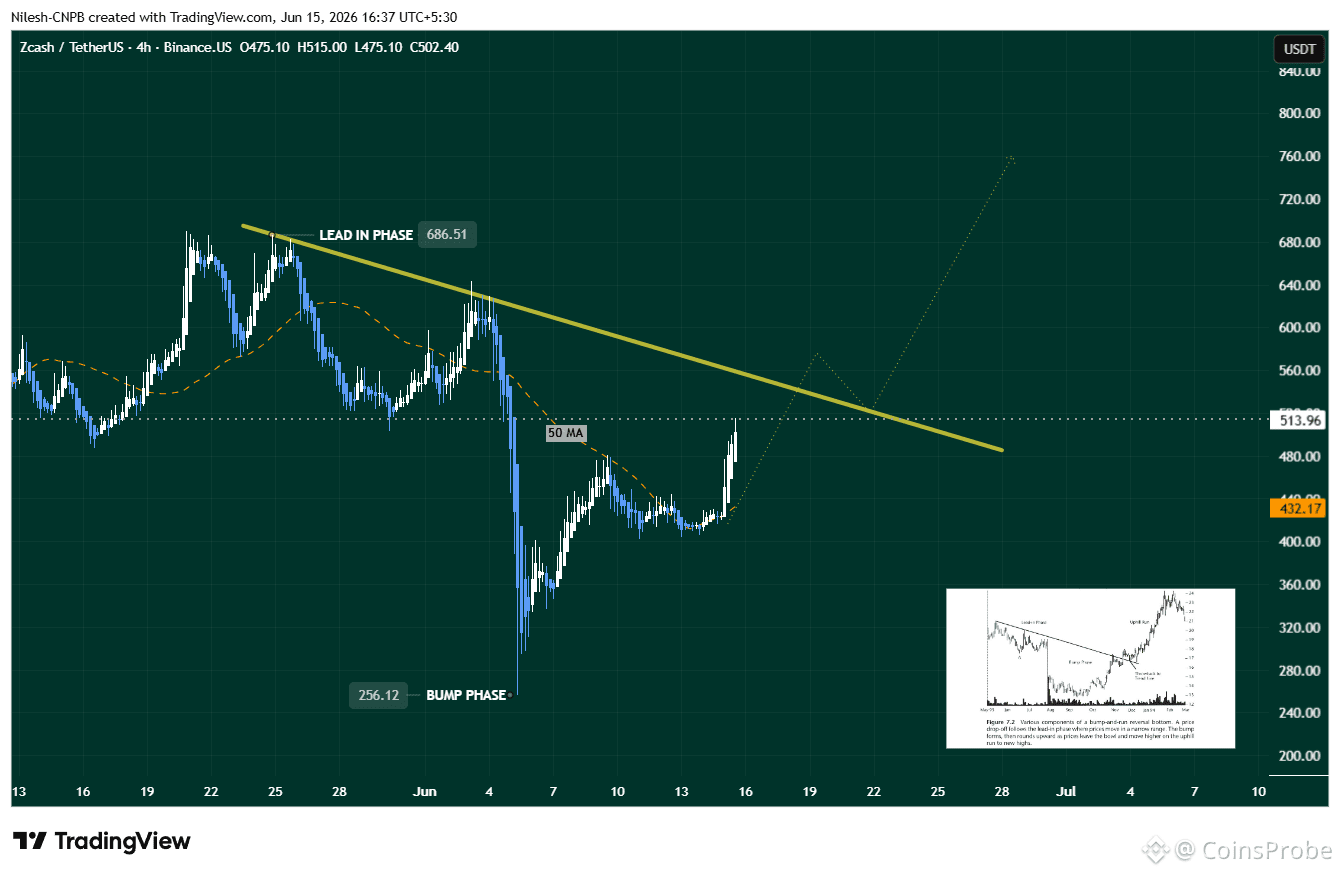 Zcash (ZEC) 4H Chart – Coinsprobe/Source: Tradingview
Where ZEC Is Now:
ZEC has completed the Bump Phase low at $256.12 and is now in the Run Phase — staging a strong recovery back toward the lead-in phase trendline. The 50 MA at approximately $432.18 has been recently reclaimed — a significant technical milestone that confirms the recovery has substance rather than being a dead-cat bounce.
At $513.53 — ZEC is now testing the lead-in phase trendline directly.
What Comes Next — Two Scenarios
Bullish Scenario — BARR Confirmation to $750+
A successful breakout and retest of the lead-in phase trendline — combined with a sustained hold above the 50 MA at $432 — would confirm the BARR reversal pattern and activate the $750+ measured move target.
The $750 zone represents a recovery toward pre-bug-disclosure price levels — where ZEC was trading before the 35%+ collapse triggered by the vulnerability announcement. A return to $750 would represent approximately +46% upside from current levels — and would confirm that the market has fully priced out the supply integrity uncertainty that caused the original crash.
The catalyst alignment is constructive: Zooko’s reassurance plus the Claude AI audit plus the BARR technical confirmation — if all three hold simultaneously — creates a multi-dimensional bull case that is difficult to dismiss.
Bearish Caution — 50 MA Failure
If ZEC fails to sustain above the lead-in phase trendline and slides back below the 50 MA at $432 — the bullish BARR structure weakens significantly. A close below $432 would suggest the recovery is stalling and a retest of lower supports — potentially toward the $350–$380 zone — becomes the primary risk.
The fundamental risk that could trigger this: any new information suggesting the Orchard vulnerability may have been exploited before the patch — or any additional security discoveries that the Claude audit may have missed. The supply integrity uncertainty that drove the original crash has not been eliminated — it has been reduced. That distinction matters for risk management.
Bottom Line
Zcash’s +21.31% recovery is a direct response to two things the market needed after the Orchard bug disclosure: the founder’s direct reassurance that funds are safe and a credible independent audit finding no further vulnerabilities. Zooko’s message — that staying in shielded wallets is reasonable, that exploitation has not been detected, and that moving funds carries its own risks — addressed the specific fears that had driven the panic selling.
The Claude AI post-patch audit adds the independent verification layer that makes the reassurance more credible than a founder statement alone. The BARR technical pattern provides the structural framework for recovery — with the 50 MA reclaimed and the lead-in trendline now being tested.
Watch $513–$520 for the trendline breakout confirmation. Watch $432 as the 50 MA floor that must hold. And watch whether Shielded Labs’ proposed network upgrade for public supply verification — which would eliminate the core supply integrity uncertainty permanently — advances on a timeline that could provide the next fundamental catalyst toward $750.
Disclaimer: The views and analysis presented in this article are for informational purposes only and reflect the author’s perspective, not financial advice. Technical patterns and indicators discussed are subject to market volatility and may or may not yield the anticipated results. Investors are advised to exercise caution, conduct independent research, and make decisions aligned with their individual risk tolerance.