🌊
The Strait of Hormuz is experiencing a highly volatile shift in maritime traffic following a period of unprecedented disruption. Following the historical blockade earlier this year, the shipping industry is closely monitoring the waterway as commercial activity attempts to resume amidst complex geopolitical negotiations.
Here is a breakdown of the current situation on the ground:
📈 The Recent Surge in Transits
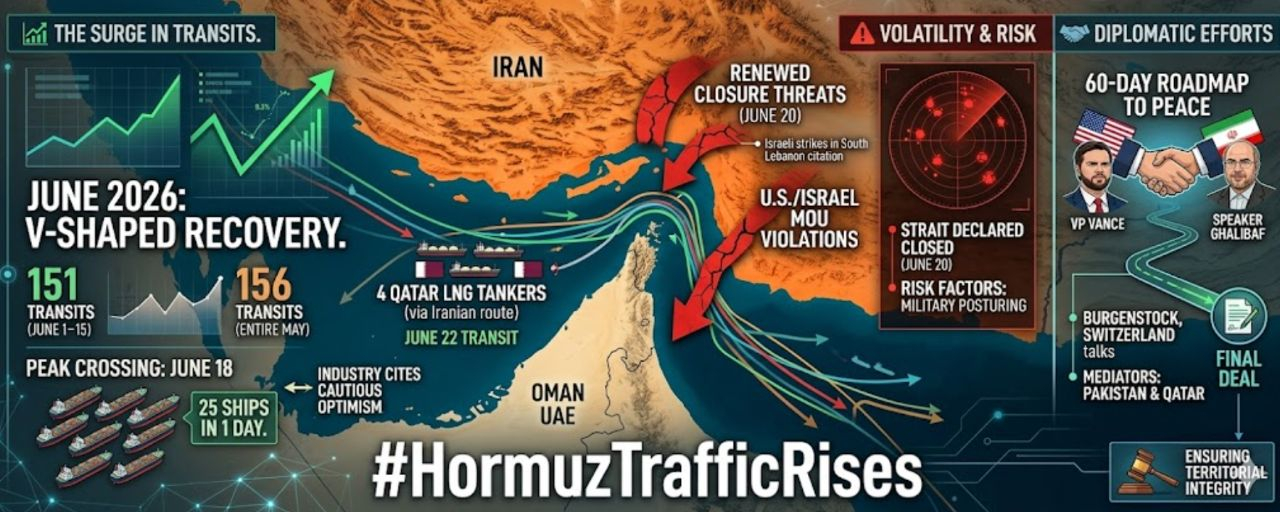
The Islamabad MoU: A preliminary agreement known as the "Islamabad MoU" signed between the U.S. and Iran initially sparked cautious optimism in the freight and maritime sectors. This agreement led to an immediate uptick in ocean transits.
By the Numbers: In the first 15 days of June, 151 vessels transited the strait, which nearly matched the total of 156 transits recorded for the entire month of May.
Peak Daily Crossings: On June 18, 2026, 25 commercial vessels crossed the Strait, marking the highest single-day count since mid-April.
⚠️ Immediate Volatility & Continued Risks
Renewed Closure Threats: Despite the initial surge, tensions flared up again on June 20 when Iran declared the Strait closed to maritime traffic. Iran's central command cited U.S. and Israeli violations of the recent Memorandum of Understanding, specifically pointing to continued Israeli strikes in South Lebanon.
Traffic Persists: Even with the newly announced closure and the associated risks, critical global energy shipments are pushing through the chokepoint. As of Monday, June 22, four liquefied natural gas (LNG) tankers controlled by Qatar entered the strait via the Iranian route.
🤝 Ongoing Diplomatic Efforts
Swiss Negotiations: Teams led by U.S. Vice President JD Vance and Iran's Mohammad Bagher Ghalibaf are currently engaged in technical talks at the Burgenstock resort in Switzerland.
The 60-Day Roadmap: Mediators from Pakistan and Qatar announced that negotiators have reached a "roadmap towards reaching a final deal within 60 days" to officially end the conflict and ensure the territorial integrity of the region.
The Bottom Line: While the hashtag #HormuzTrafficRises highlights a much-needed return of commercial activity, the situation remains highly fluid. The long-term security of the world's most critical energy chokepoint ultimately hinges on the success of the ongoing 60-day diplomatic roadmap.
#OilPriceFalls #CryptoNewss #BREAKING #SouthKoreaProposesBroaderCryptoTravelRule