

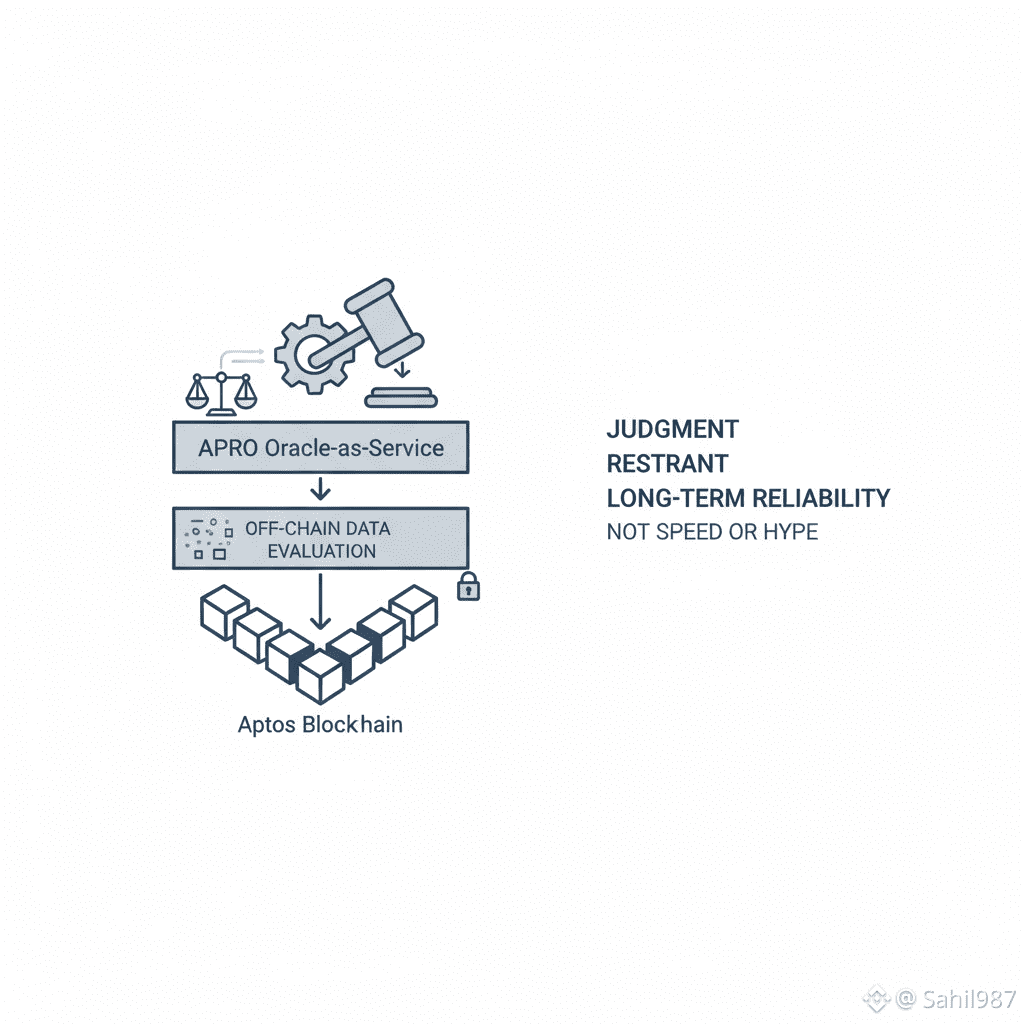
 I didn’t expect an oracle launch to make me think about judgment. Data, yes. Verification, maybe. Speed and decentralization, certainly. But judgment isn’t a word we usually associate with infrastructure. And yet that’s what came to mind as I looked more closely at APRO bringing its Oracle-as-a-Service live on Aptos. The announcement itself was restrained, almost deliberately so. There was no attempt to frame it as a turning point for the entire industry. Instead, it felt like something being put in place because it was overdue. That subtlety mattered. It suggested that APRO wasn’t trying to win attention, but to reduce friction and in infrastructure, that’s often the more honest goal.
For a long time, the oracle conversation has been dominated by delivery. How fast can data move? How many sources can be aggregated? How decentralized is the feed? These are reasonable questions, but they don’t explain why oracle-related incidents continue to surface in mature systems. In production, most failures don’t come from incorrect data. They come from correct data being applied too eagerly. Automation reacts to transient noise. Contracts execute when context hasn’t settled. Systems behave “as designed” while producing outcomes that feel wrong to users and operators alike. APRO’s design philosophy seems to start from that lived reality. Instead of treating delivery as success, it treats delivery as responsibility. The distinction between Data Push and Data Pull reflects this shift. Push is reserved for signals where delay clearly increases harm prices, liquidation thresholds, time-sensitive market data. Pull governs information whose influence should be conditional real-world assets, structured datasets, application state. That boundary doesn’t limit capability; it limits unnecessary reaction.
This approach becomes especially meaningful on Aptos. As a high-throughput chain built for parallel execution, Aptos responds quickly by design. That speed is an advantage only if inputs are disciplined. Otherwise, it magnifies instability. APRO’s two-layer architecture acknowledges this trade-off. Off-chain, data is aggregated, filtered, and evaluated where uncertainty still belongs. Sources disagree. APIs degrade gradually. Markets fluctuate in ways that don’t always justify action. APRO doesn’t rush to collapse that complexity into instant certainty. AI-assisted verification is used less as a truth oracle and more as a pattern detector looking for correlation drift, latency anomalies, and synchronization effects that often precede problematic behavior. Only after this evaluation does data cross into the on-chain layer, where APRO deliberately narrows its role to verification, finality, and immutability. The result isn’t slower execution. It’s execution with clearer intent.
What grounds this philosophy is the Oracle-as-a-Service model itself. Most teams underestimate how much oracle logic they end up owning. Integration doesn’t end when a feed goes live. It continues through tuning parameters, handling edge cases, passing audits, and explaining outcomes when users ask why something happened. APRO’s OaaS approach moves much of that responsibility into shared infrastructure. Builders on Aptos don’t need to decide how aggressive updates should be or how much noise is acceptable. Those decisions are embedded into the service. Over time, this reduces operational overhead and cognitive load. Teams spend less time stabilizing inputs and more time improving products. That shift doesn’t generate headlines, but it compounds quietly.
From experience, this is often where systems either mature or become brittle. I’ve seen protocols with strong ideas struggle because supporting infrastructure slowly became the bottleneck. Oracles were technically correct, yet operationally exhausting. Teams built layers of defensive logic just to feel safe. What stands out about APRO’s approach is that it appears shaped by those outcomes rather than by theory alone. It doesn’t promise to eliminate risk. It promises to contain it. It recognizes that automation needs boundaries and that not every update deserves a reaction. That kind of restraint is easy to overlook early on and very difficult to retrofit later.
The broader industry context makes this shift feel timely. Blockchain infrastructure has spent years oscillating between extremes decentralization without usability, speed without safety. Oracles sit directly in the middle of this tension, connecting external reality to irreversible systems. APRO’s deployment on Aptos suggests a more balanced phase. Scalability is respected, but not worshipped. Automation is embraced, but bounded. The oracle layer is treated less as a firehose of data and more as a judgment layer that decides when data should matter. That framing aligns better with where real value is being built today: in applications that must operate predictably for years, not just through the next market cycle.
Early adoption signals reinforce this reading. Builders describe APRO less as a feature and more as infrastructure they don’t have to think about anymore. That’s usually the strongest endorsement infrastructure can receive. APRO’s support for multiple data types crypto markets, real-world assets, verifiable randomness also matters. The same behavioral rules apply regardless of context. Consistency across use cases is difficult to achieve and easy to underestimate, but it’s essential for long-term trust.
None of this means the system is without open questions. Off-chain processing introduces trust boundaries that must be monitored. AI-assisted verification must remain interpretable as complexity grows. Supporting dozens of chains requires operational discipline that doesn’t fully automate itself. These are real trade-offs, and APRO doesn’t pretend otherwise. What matters is that these uncertainties are acknowledged and designed around. Infrastructure that claims perfection rarely survives real usage. Infrastructure that plans for imperfection often does.
In the end, APRO’s Oracle-as-a-Service going live on Aptos doesn’t feel like a milestone meant to be celebrated once and forgotten. It feels like a recalibration of expectations. Oracles are no longer just messengers of truth. They are places where judgment is exercised before irreversible execution occurs. By embedding pacing, restraint, and context into the oracle layer itself, APRO shifts responsibility away from individual applications and back into shared infrastructure. That’s not dramatic. But it’s durable. And if blockchain is moving from experimentation toward longevity, durability is exactly what the next phase requires.