

@Walrus 🦭/acc Public blockchains solved trust in computation, but they never solved trust in data. Storage has lived on the margins of Web3, either off-chain, fragile, or economically misaligned with application demand. Walrus enters this gap at a moment when Sui is proving that high-throughput, object-centric execution can support systems that are closer to real infrastructure than financial experiments. What makes Walrus notable is not only that it offers decentralized storage, but that it treats storage, privacy, and financial activity as one economic surface.
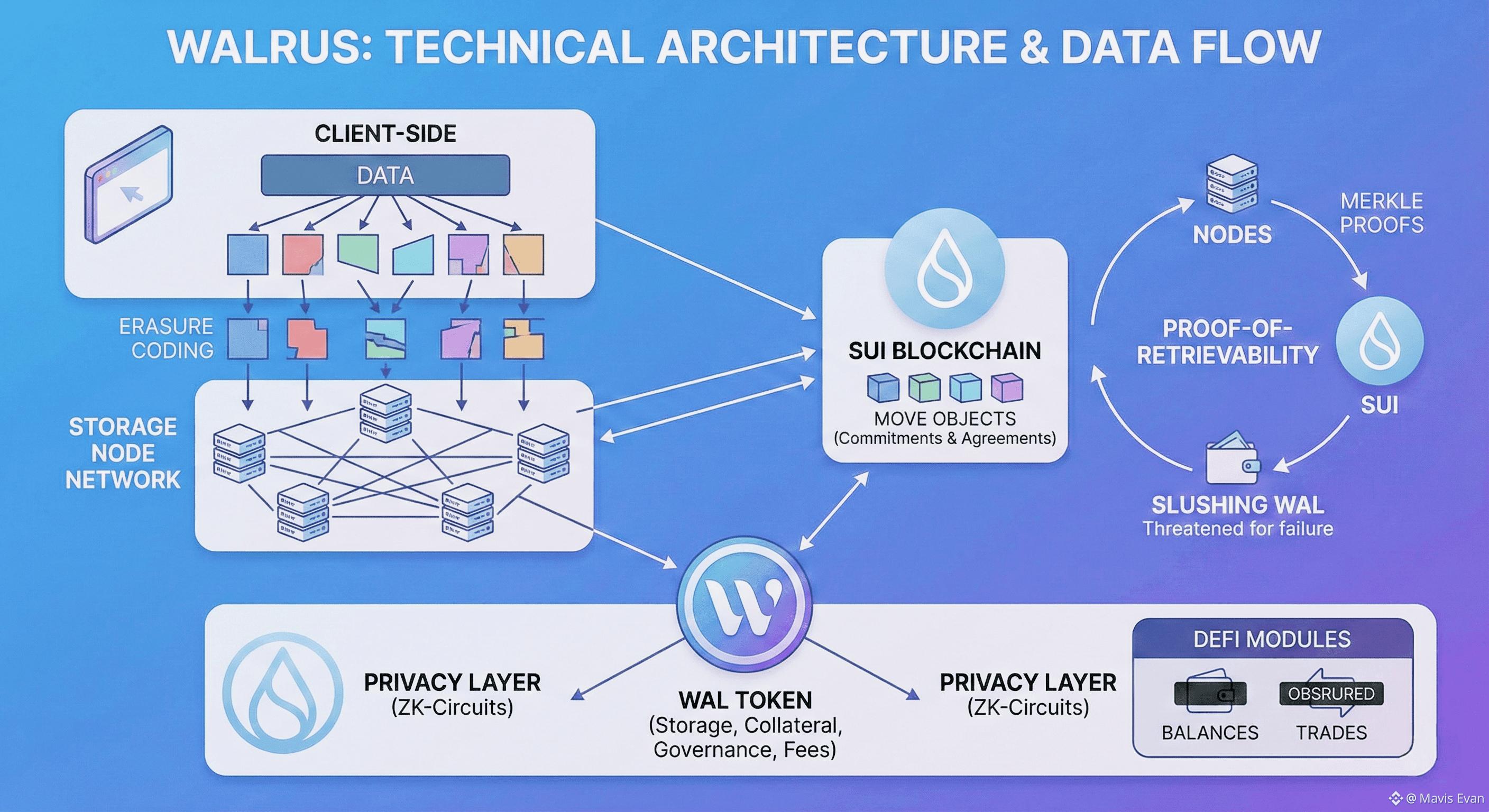
Walrus is built as a layered system that anchors heavy data workflows to Sui without dragging data itself onto the base chain. Files are processed client-side using erasure coding, producing multiple fragments where only a subset is required for full recovery. These fragments are encrypted and distributed across independent nodes. On Sui, the protocol stores cryptographic commitments and service agreements as Move objects, creating verifiable contracts that define which node is responsible for which fragment and under what economic terms.
Node compliance is enforced through proof-of-retrievability challenges. Each storage node periodically submits compact Merkle proofs to Sui, demonstrating that it still holds the assigned data. Failure results in slashing of staked WAL, making dishonest storage economically irrational. This creates a feedback loop where availability is not trusted but continuously verified.
Above the storage engine sits a privacy layer that uses zero-knowledge circuits to obscure balances and trade sizes inside the protocol’s own DeFi modules. Users can provide liquidity, borrow against collateral, or rebalance positions without exposing portfolio composition on-chain. This is a sharp break from the transparency model of most high-throughput chains.
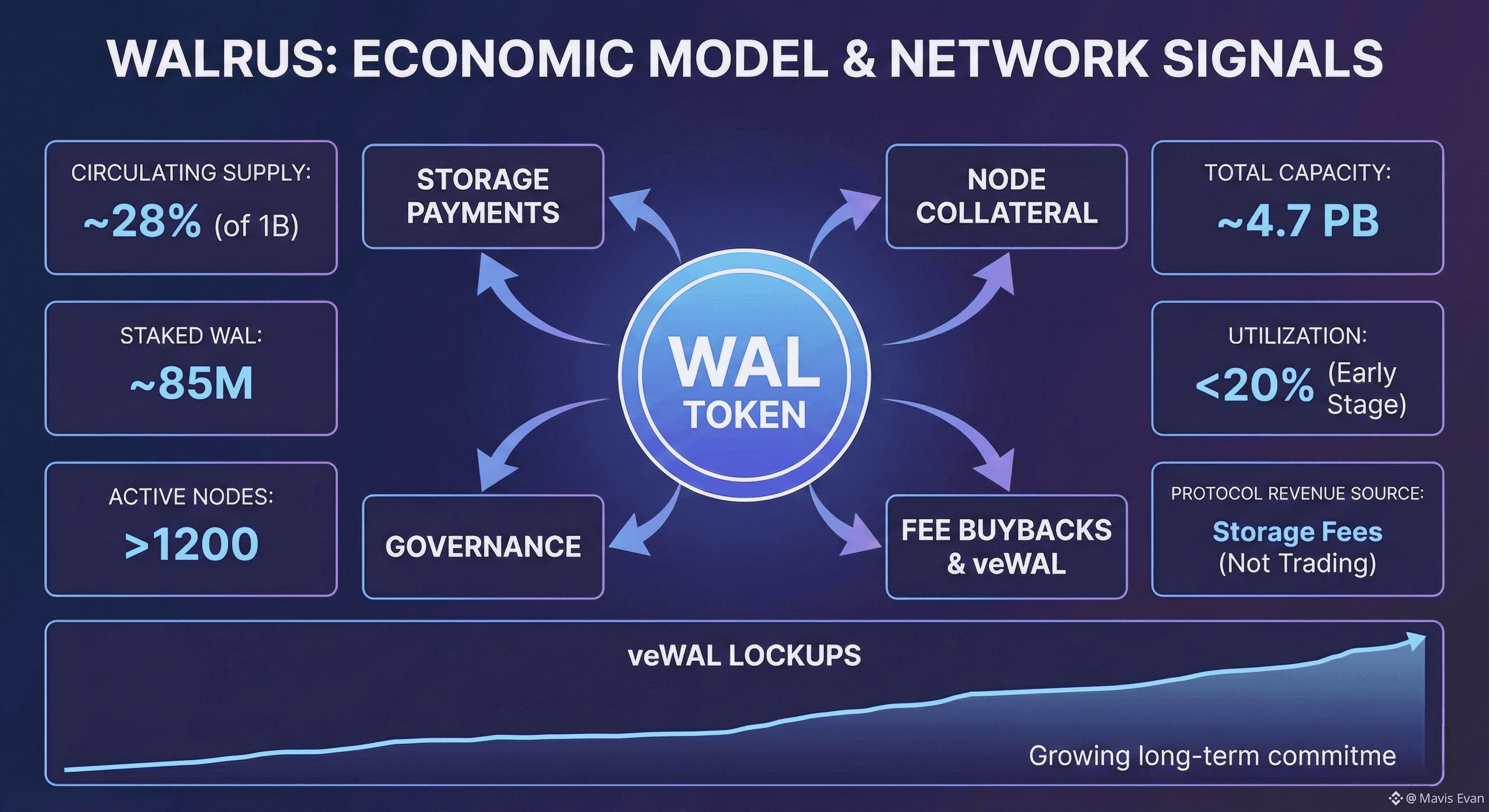
The WAL token binds these layers together. It is required to pay for storage, to collateralize nodes, to govern the protocol, and to absorb value from network fees through a buyback mechanism distributed to vote-escrowed lockers.
By March 2024 the circulating supply of WAL had reached roughly 28 percent of its fixed one billion cap, with emissions dominated by community rewards and early vesting tranches. Around 85 million WAL was staked across more than twelve hundred active storage nodes, supporting an estimated 4.7 petabytes of total capacity. Actual utilization remained below twenty percent, a typical early-stage signal that infrastructure is being built ahead of demand.
Fee flows show that storage payments, not trading activity, are the largest source of protocol revenue. This is structurally different from most DeFi systems on Sui, where transaction fees dominate. WAL lockups into veWAL have been trending upward since the governance model was introduced, indicating that a growing share of the supply is being removed from liquid circulation in exchange for long-term fee rights.
For developers, Walrus changes the economics of building data-heavy applications on Sui. High-resolution NFTs, gaming assets, or archival datasets no longer require stitching together external storage providers with fragile incentive models. The SDK exposes storage and private finance primitives directly, which reduces integration complexity and opens design space for applications that treat data persistence as a native feature rather than a workaround.
For investors, WAL behaves less like a speculative asset and more like a hybrid between infrastructure equity and productive collateral. The buyback and veWAL framework redirects real protocol fees toward long-term holders, creating a clearer linkage between usage and token value than is common in early-stage ecosystems.
For the Sui network itself, Walrus acts as a capacity amplifier. It offloads heavy data while increasing on-chain activity through proofs, governance, and settlement, pushing Sui’s object model into real operational stress rather than synthetic benchmarks.
The protocol’s greatest strength is also its most obvious vulnerability. Combining erasure coding, cryptographic proofs, zero-knowledge circuits, and custom Move contracts creates a large attack surface. A flaw in any layer could undermine economic guarantees or expose private flows.
The vote-escrow model, while powerful, introduces strategic risk. Concentration of veWAL among a small set of lockers could skew emission incentives toward narrow interests, discouraging new participants. Regulatory exposure is another open question. Privacy-preserving financial tools attract scrutiny, particularly as Walrus positions itself for enterprise use.
Finally, Walrus remains tightly coupled to Sui. A slowdown in Sui developer growth or user adoption would directly constrain Walrus demand, regardless of its internal execution quality.
The upcoming cross-chain storage gateway is likely to be a defining milestone. If users on other networks can purchase storage without touching Sui, Walrus transitions from a Sui application into a multi-chain service layer. The longer-term introduction of a dedicated zk rollup for private interactions would materially reduce costs and could make confidential DeFi viable at scale.
Node growth suggests supply is not the bottleneck. Demand will be driven by whether Walrus can attract applications that treat data persistence as core logic rather than auxiliary infrastructure.
Walrus is not trying to outcompete traditional storage networks on volume alone, nor is it trying to become another generic Sui DeFi venue. Its ambition is narrower and deeper: to redefine how blockchains think about data by embedding privacy, persistence, and economic incentives into a single operational loop. If that convergence holds, WAL will not be valued primarily as a token, but as a claim on a new category ofn-chain infrastructure that treats data as a first-class asset rather than an external dependency.