

@Dusk Network enters 2026 with a positioning few layer-1s have attempted. It is not trying to optimize retail DeFi or meme-driven liquidity. Its design goal is narrower and harder: make regulated finance work on a public blockchain without breaking privacy rules or legal frameworks. This problem is no longer theoretical. Banks and exchanges have moved past the question of whether assets will be tokenized. The real challenge is how to do it while preserving confidentiality, selective disclosure, and enforceable compliance logic.
Most tokenization pilots over the past two years have stalled on this exact issue. Wrapping securities on a generic EVM chain solves settlement speed, but it exposes sensitive data and pushes compliance off-chain. That model does not scale into real capital markets. Dusk reverses the approach by embedding regulatory primitives directly into the protocol layer.
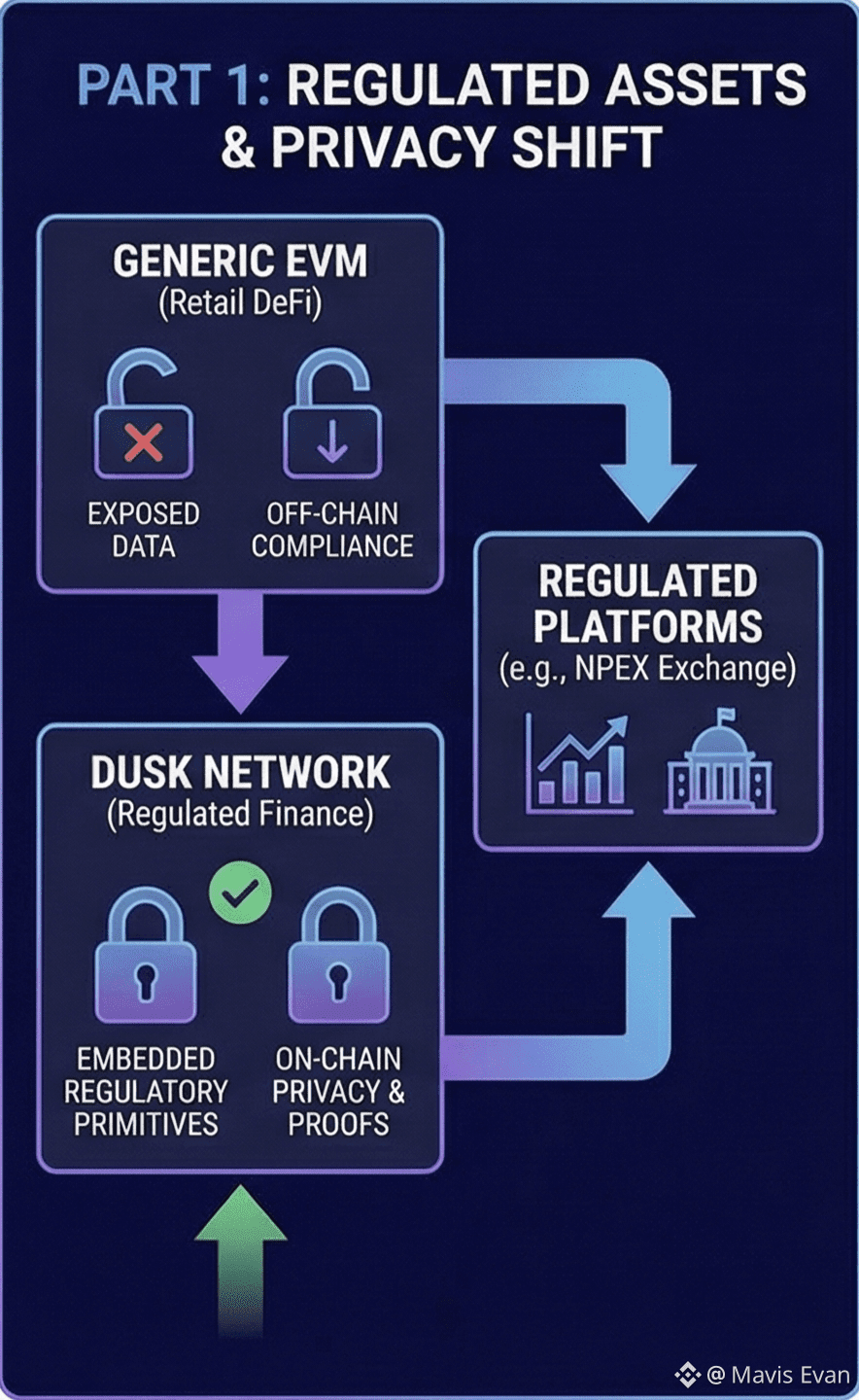
The partnership with NPEX, a regulated Dutch stock exchange, illustrates this strategy more clearly than any marketing claim. It signals that Dusk is targeting licensed platforms rather than retail users. Instead of chasing total value locked, it is building infrastructure that regulators can audit and institutions can integrate.
At the technical level, Dusk combines zero-knowledge friendly design with a custom consensus mechanism called DuskDS. Rather than exposing validator behavior publicly as in classical proof of stake, DuskDS uses cryptographic randomness to rotate small validator committees. This limits the ability of external observers to infer block producer identity or transaction ordering, which matters when large financial instruments are being settled.
Privacy on Dusk is not limited to hiding balances. The protocol introduces confidential smart contracts, where business logic executes on encrypted inputs and only publishes proofs of correctness. A bond issuance can therefore prove that regulatory conditions were met without leaking investor identities or trade terms. These proofs are native to the chain, not an add-on layer.
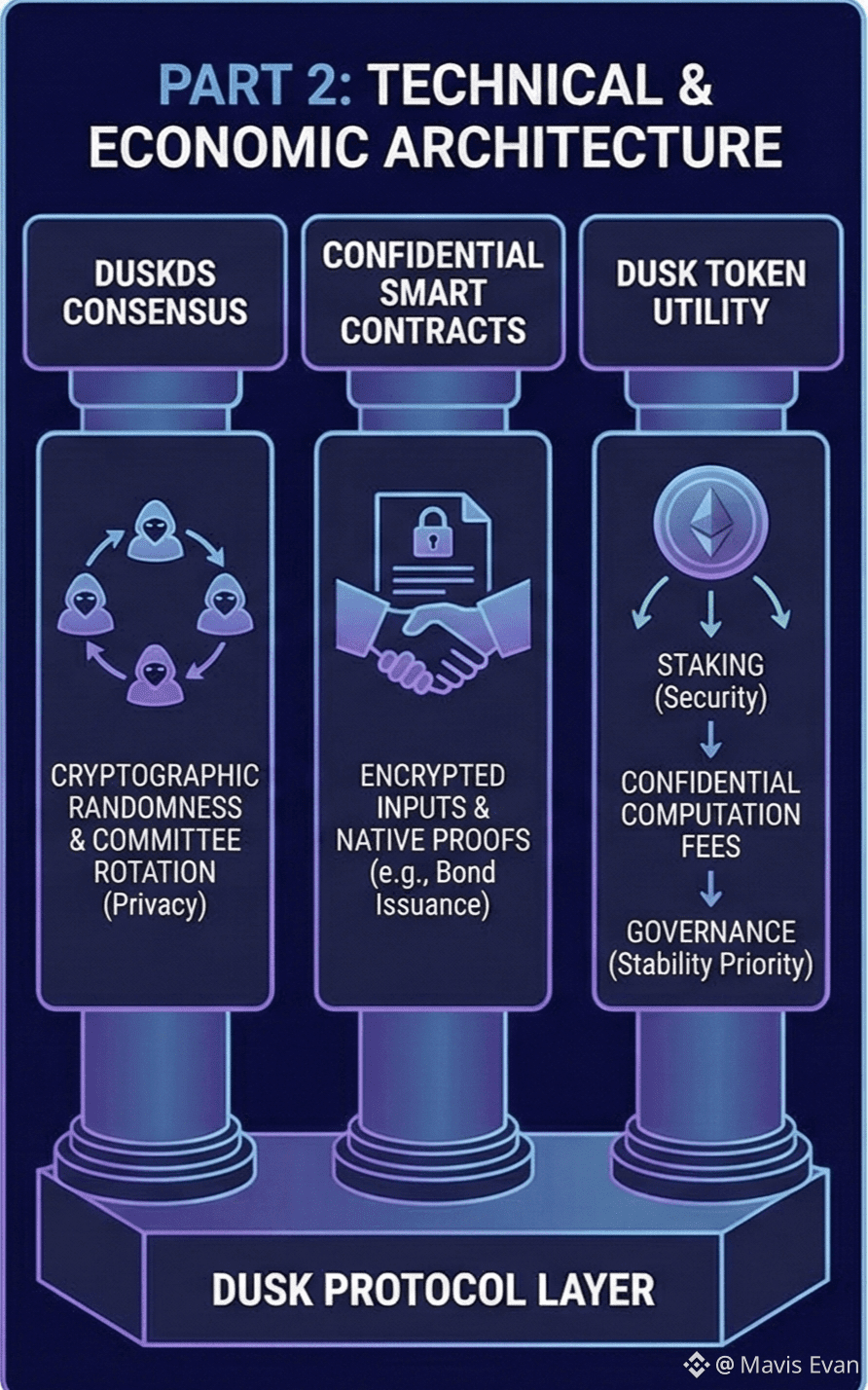
DUSK token utility is shaped by this environment. It secures the network through staking, pays for confidential computation, and anchors governance. Fee mechanics prioritize stability over auction-style volatility, reflecting the needs of institutions that require predictable settlement costs.
On-chain data suggests a network still early but maturing. Wallet growth has accelerated since the DuskDS upgrade, validator count has stabilized, and the share of circulating DUSK locked in staking has risen. Transaction volume remains modest, yet the average transaction size is increasing, a sign that higher-value operations are replacing test activity. Fee dispersion remains narrow, confirming that predictable execution costs are becoming a reality.
The upcoming DuskEVM release is the next inflection point. Ethereum compatibility lowers the barrier for builders but introduces a technical tension. The EVM was never designed for encrypted computation. Preserving privacy guarantees inside a Solidity environment will test the protocol’s architecture more than any previous upgrade.
Market impact should be judged carefully. Dusk is not competing for retail liquidity pools. Its addressable market is smaller but deeper. If even part of the projected regulated securities pipeline reaches mainnet, economic throughput per transaction could exceed that of many larger chains.
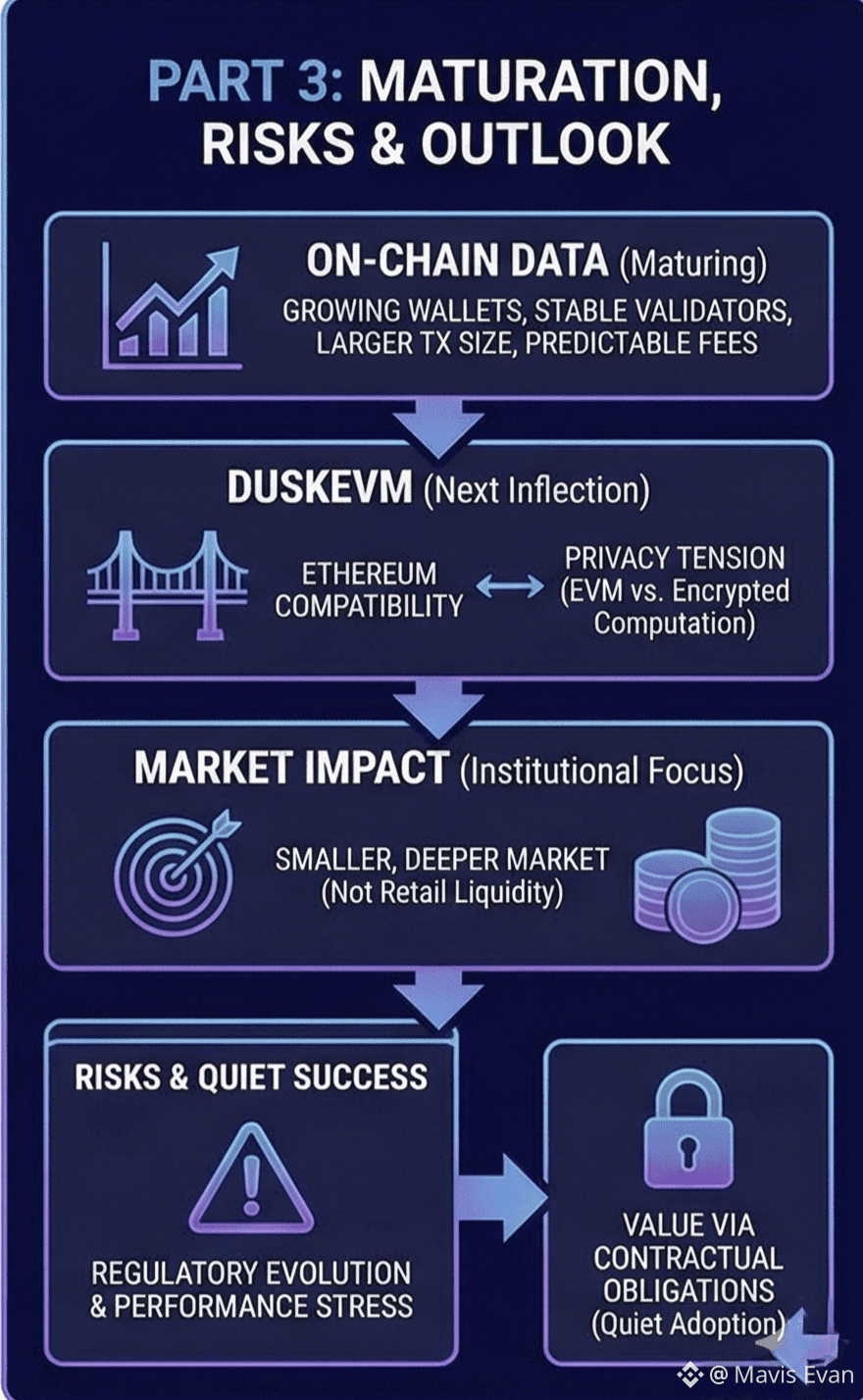
Risks are real. Regulation evolves faster than code, and backward-compatible upgrades are legally mandatory when real securities are involved. Confidential computation is also resource-intensive, and a sudden demand spike could stress network performance.
Dusk is unlikely to dominate public mindshare. Its success will be quieter, measured in whether bond issuers, equity platforms, and compliance teams choose it as their settlement layer. If that happens, its value will compound through contractual obligations rather than hype cycles.
