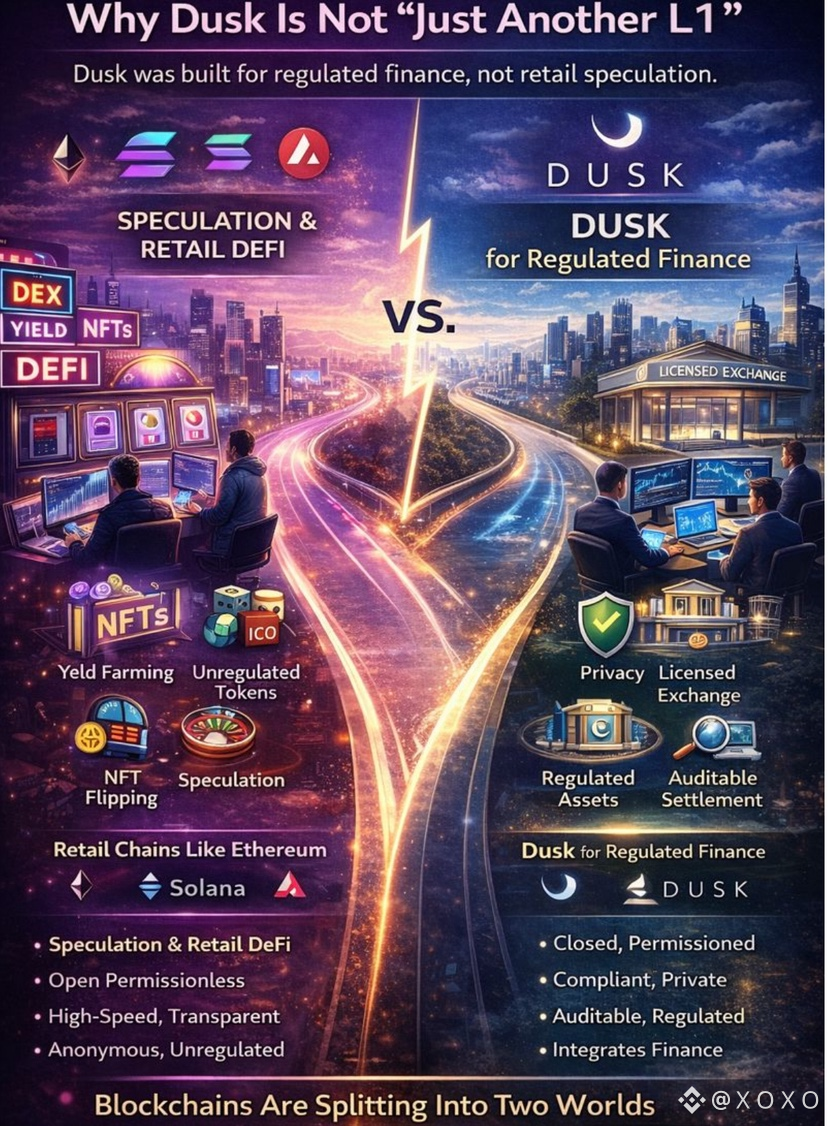
When most people hear the words Layer 1, they immediately think about speed, fees, or how many transactions a chain can push through per second. That way of thinking comes from the retail DeFi era, where blockchains were competing for traders, yield farmers, and NFT mints. But that era is slowly closing, and a very different type of blockchain is starting to matter more.
@Dusk was never built to win the meme war. It was built to solve a problem that public blockchains still fail at in 2026, which is how to run real financial markets onchain without breaking the rules those markets are legally required to follow.
Traditional finance does not just care about settlement. It cares about identity, auditability, privacy, reporting, investor protection, and regulatory oversight. These are not optional features. They are the basic conditions that allow trillions of euros to move every day. Public blockchains, especially Ethereum-style transparent ledgers, were never designed for this reality. They expose every balance, every trade, every position, and every counterparty to the world. That works for retail speculation. It does not work for banks, brokers, asset managers, or regulated exchanges.
This is where Dusk begins to look fundamentally different.
Dusk is not trying to be a faster Ethereum. It is trying to be the first blockchain that regulators, exchanges, and financial institutions can actually use without redesigning how they operate. That means privacy that does not break compliance. It means transparency that does not violate confidentiality. And it means infrastructure that understands legal requirements as part of the protocol itself.
Most chains add compliance later. Dusk embedded it from the start.
The way Dusk is structured already reveals its intent. Instead of pushing everything onto a single execution layer, Dusk uses a modular architecture where its base layer focuses on security, finality, and privacy, while DuskEVM provides an Ethereum-compatible environment on top. That separation is not cosmetic. It is what allows regulated assets to settle on a private, auditable ledger while still giving developers the freedom of Solidity and EVM tooling.
In other words, Dusk is not trying to attract degens. It is trying to attract capital markets.
This becomes even clearer when you look at what is launching on Dusk instead of just what Dusk is. DuskTrade, built with NPEX, is not a synthetic trading app or a token swap. It is a regulated marketplace connected to a licensed European exchange, bringing more than three hundred million euros in tokenized securities onchain. That is not crypto pretending to be finance. That is finance actually moving onto crypto infrastructure.
You cannot do that on a transparent chain without violating data protection laws, front-running protections, or confidentiality requirements. You cannot do that on a permissionless DeFi protocol without losing investor safeguards. And you cannot do that on a centralized exchange without losing the benefits of onchain settlement.
Dusk sits in the middle of all three worlds.
Its privacy system, Hedger, is designed so transactions can be hidden from the public while still being provable to auditors and regulators. That single design choice solves one of the biggest contradictions in crypto. How do you keep trades private but still legal. How do you protect users without hiding crime. How do you allow institutions to operate without exposing their strategies to the entire internet.
Most blockchains never even tried to answer those questions.
Because of that, comparing Dusk to Solana, Avalanche, or Ethereum misses the point. Those chains optimize for open markets and retail participation. Dusk optimizes for closed-loop financial systems that still need to interoperate with public infrastructure. It is not a casino chain. It is a settlement network for regulated assets.
This is why its partnerships look different. It works with exchanges that have MTF, Broker, and ECSP licenses. It integrates with oracle providers like Chainlink to verify real-world data. It builds compliance tooling into its execution layer. These are not things retail chains focus on because retail chains do not have to answer to regulators.
@Dusk does.
And that is exactly why it is not just another L1.
What is quietly happening is that crypto is splitting into two worlds. One is high-speed speculation and consumer DeFi. The other is institutional, regulated, and asset-backed finance. Dusk is positioning itself to be the backbone of the second world.
That world is not loud yet. But it is much larger, much richer, and much more permanent.
And when it arrives at scale, it will not run on transparent blockchains that leak every trade. It will run on infrastructure that understands privacy, law, and finance at the protocol level.
That is what Dusk is actually building.