
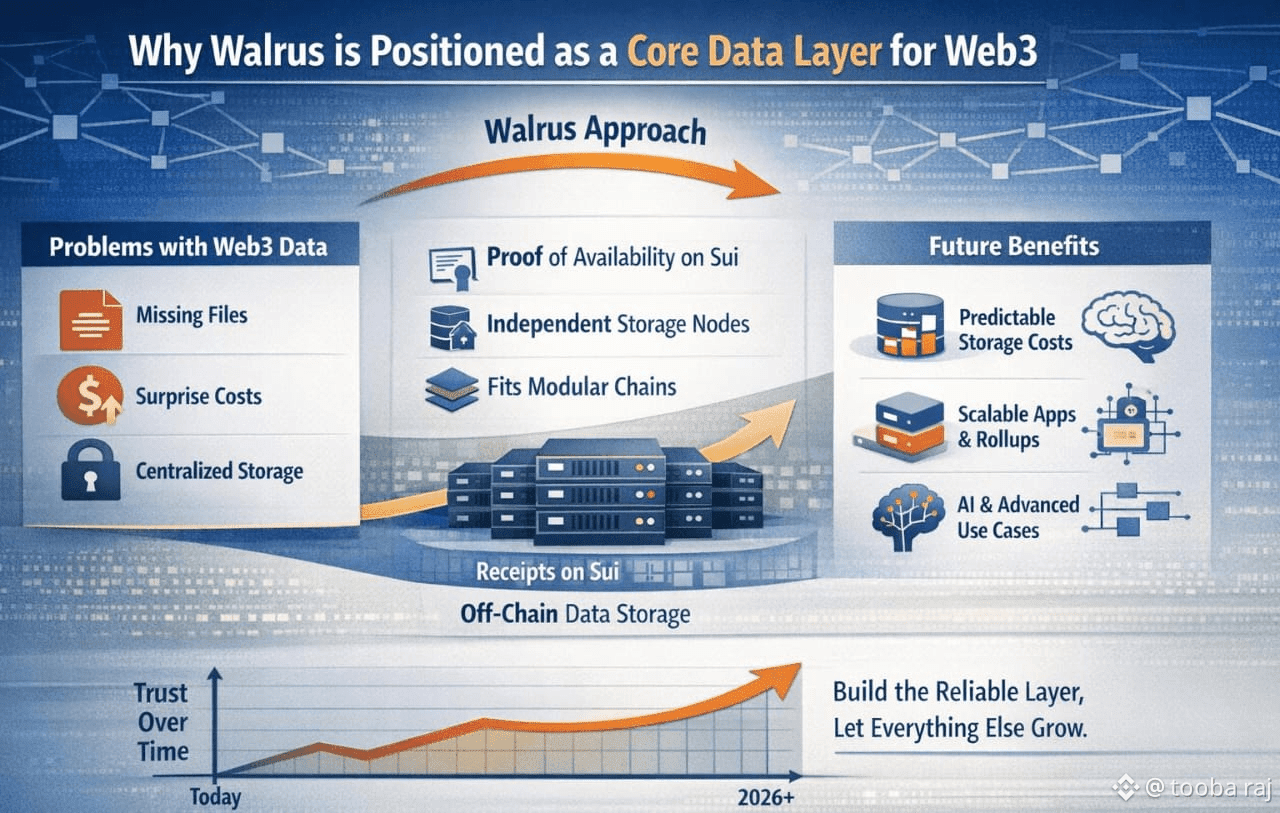
Most conversations about Web3 focus on speed, composability, or financial innovation. Storage is often treated as a solved problem, quietly assumed to “just work.” Yet the reality is harsher: without durable storage, decentralization loses its memory. This is the overlooked space where Walrus is building.
@walrusprotocol approaches decentralized storage not as a convenience layer, but as a long-term commitment. Data placed on a decentralized network must survive hardware failures, market cycles, and shifting incentives. If storage disappears when conditions change, then applications, governance records, and digital culture disappear with it. Walrus seems to recognize that persistence is a design choice, not an accident.
The architecture behind Walrus focuses on distributing responsibility across the network, reducing single points of failure while maintaining availability. This is critical for use cases that depend on continuity: NFT metadata, historical blockchain states, archives, and application assets that cannot be casually replaced. Temporary storage solutions may be cheaper, but they undermine trust over time.
The $WAL token plays a role in aligning incentives around this responsibility. Participants are encouraged to maintain data reliably, not just to optimize for short-term rewards. This creates a system where storage is treated as stewardship rather than speculation.
In a rapidly evolving ecosystem, #Walrus stands out by focusing on what remains after trends fade. Decentralized systems do not just need innovation; they need memory. Walrus is working on the quiet, foundational problem of making sure that memory lasts.