

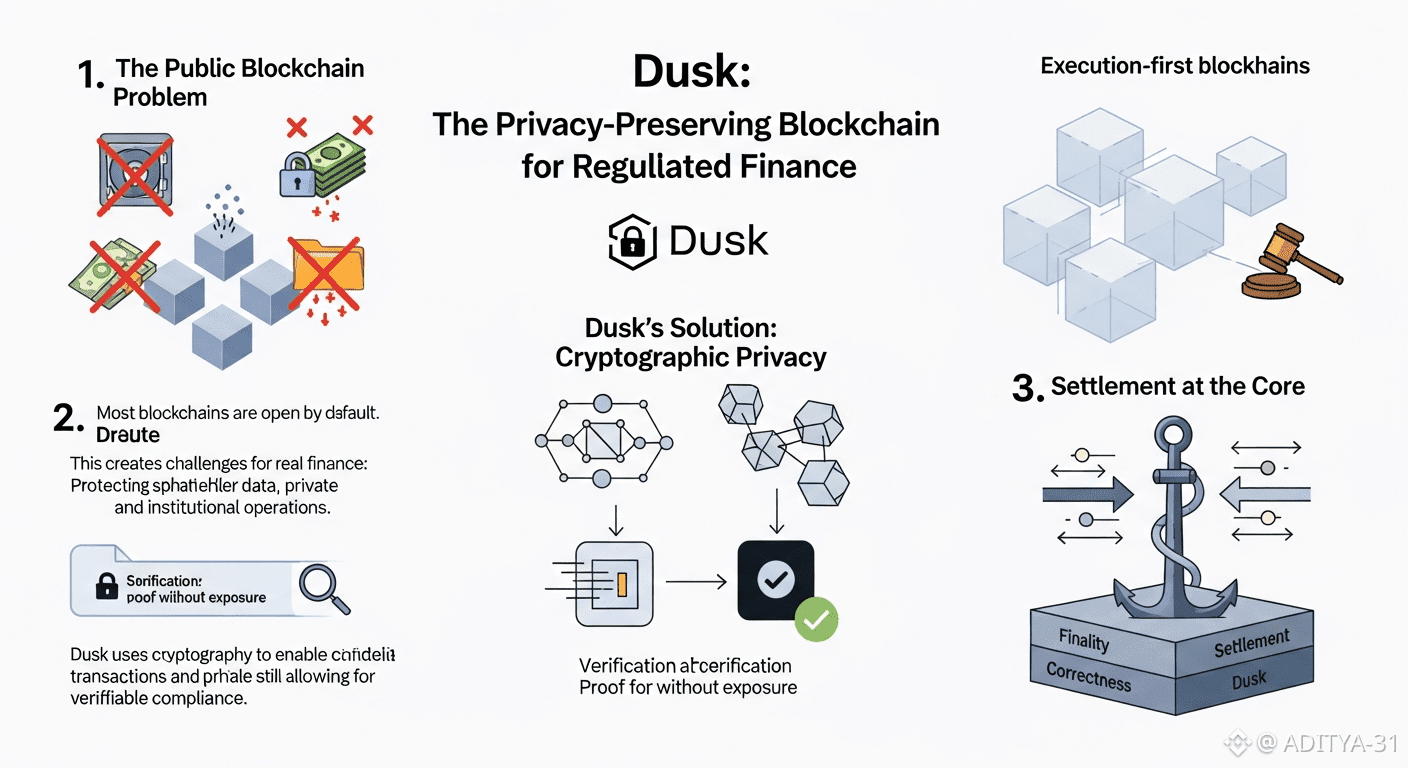
Most blockchains talk a lot about being open and transparent. That sounds good on paper, but the moment you try to use them for real finance, problems start showing up. Not trading tokens, not DeFi experiments — real finance. Things like shares, bonds, regulated assets, investor data.
This is where most chains quietly fail.
If everything is public by default, how do you issue securities? How do companies protect shareholder information? How do institutions operate without exposing balances, positions, and internal activity to the entire internet? In practice, what happens is simple: teams move the sensitive parts off-chain and keep only a thin layer on-chain. Decentralization stops exactly where it matters most.
Dusk was built because of this exact gap.
Instead of assuming that “more transparency = more trust,” Dusk takes a more realistic view. In regulated finance, trust comes from rules being followed, not from everyone seeing everything. With cryptography, you can prove that a transaction is valid and compliant without revealing private details. That’s the core idea behind Dusk.
On Dusk, transactions can stay confidential, balances don’t have to be public, and sensitive data doesn’t leak by default. At the same time, compliance isn’t ignored. Rules are enforced at the protocol level, and verification is still possible when needed. Privacy isn’t used to hide wrongdoing — it’s used to protect legitimate participants.
Another thing Dusk gets right is settlement. Most blockchains are built around execution first and settlement later. Finance works the opposite way. Settlement is the backbone. Dusk places settlement at the core of the system, making finality, correctness, and consistency more important than flashy throughput numbers. That’s a big reason why it fits regulated markets better than general-purpose chains.
At the developer level, Dusk doesn’t try to reinvent everything. With its EVM-compatible environment, builders can still use familiar tools while tapping into privacy features underneath. That lowers friction without compromising the design philosophy. You don’t have to choose between usability and regulation.
The $DUSK token isn’t there just to exist. It’s used for staking, securing the network, paying fees, and participating in governance. In a system designed for real financial activity, incentives matter. Validators are rewarded for doing things correctly, not just quickly.
What makes Dusk interesting isn’t hype or short-term trends. It’s that it’s built for a future most chains aren’t ready for yet. As tokenization moves from experiments to real markets, the need for privacy-aware, compliant infrastructure will stop being optional.
Public blockchains work well for open systems. Regulated finance doesn’t work that way. Dusk accepts that reality instead of fighting it — and that’s exactly why it exists.