
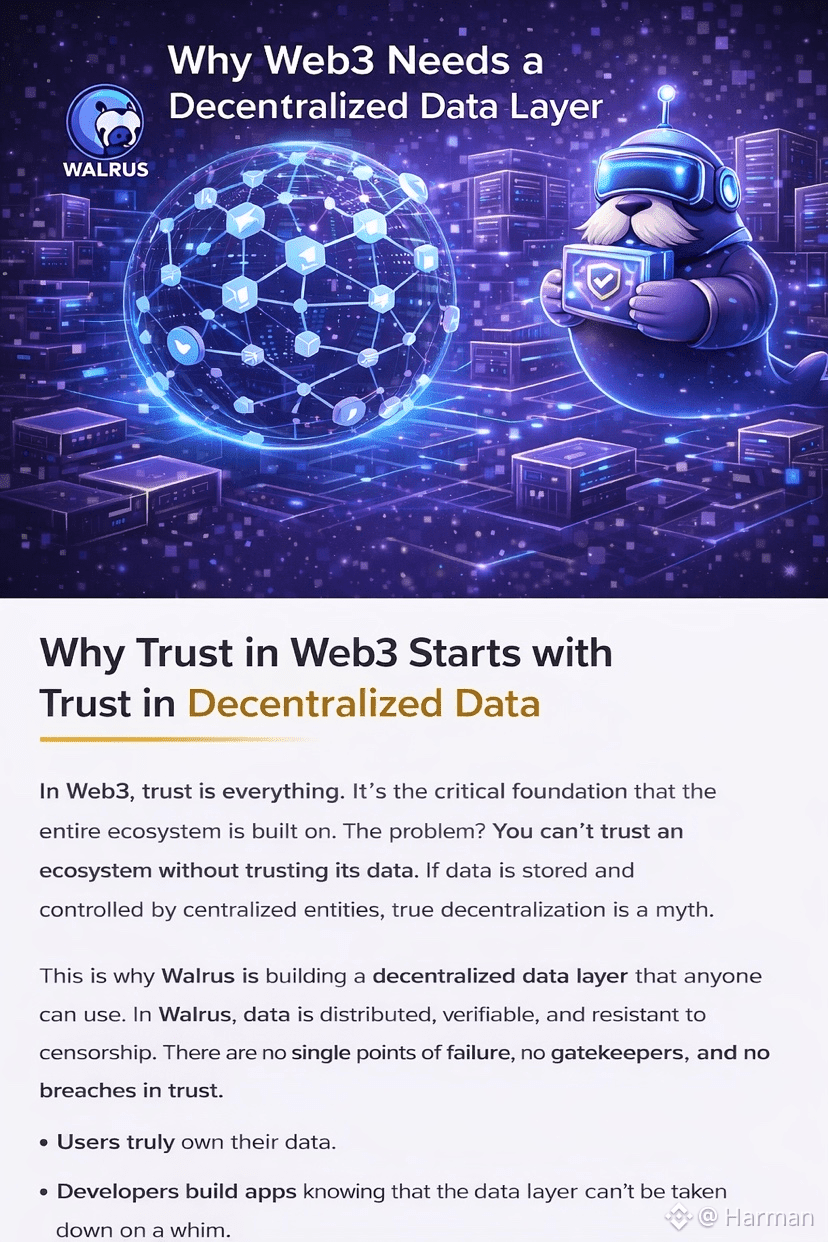
In today’s digital world, most of our data is stored on centralized servers. Social media platforms, cloud providers, and even many Web3 applications rely on a few powerful companies to host and control user information. This creates a major risk: outages, censorship, data loss, and privacy violations can happen anytime. True decentralization is impossible without decentralized data.
This is where Walrus comes in. Walrus is creating a new kind of data infrastructure for Web3—one that is decentralized, secure, programmable, and censorship-resistant. Instead of trusting a single company or server, data is distributed across a network, making it resilient against downtime and manipulation.
One of Walrus’ most powerful ideas is programmable data. This means developers can define how data behaves, who can access it, and under what conditions. This opens doors for new types of decentralized apps, AI agents, DeFi platforms, NFT media storage, and on-chain games that don’t rely on centralized backends.
Walrus also focuses on verifiability. Users and developers can cryptographically prove that their data is authentic and unchanged. This is crucial for trustless systems where transparency and integrity matter more than brand names.
As Web3 adoption grows, data will become more valuable than ever. Without a strong data layer, blockchains alone cannot support real-world-scale applications. Walrus is solving this core problem, making Web3 more resilient, more open, and more user-owned.
In simple words: Walrus is not hype—it is infrastructure. And infrastructure is what real revolutions are built on.