


The phrase privacy-centric blockchain is used often, but rarely with precision. In many cases, it refers to networks that hide transactions entirely or obscure user identities by default. While that approach solves one problem, it creates others—especially when blockchains are expected to support real financial activity, institutions, and legal accountability.
A privacy-centric blockchain, in its most practical form, is not about secrecy for its own sake. It is about controlling information exposure while preserving trust. Dusk fits into this category not because it hides everything, but because it redefines what must be visible and what does not.
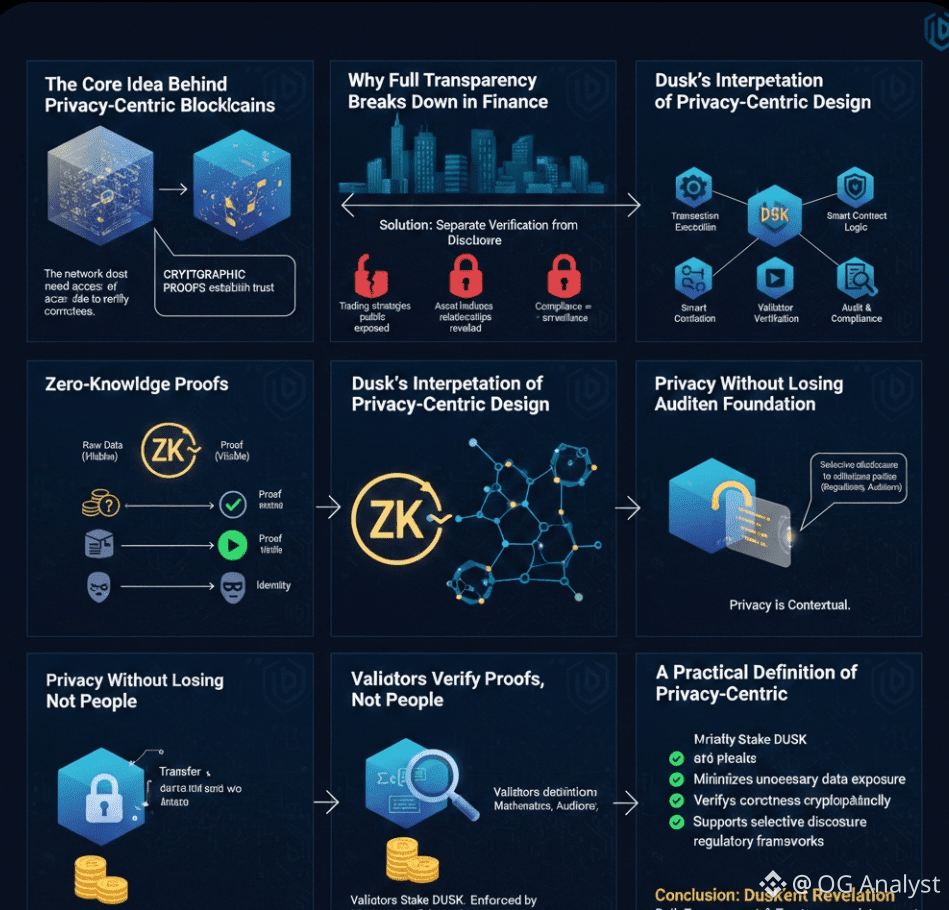
The Core Idea Behind Privacy-Centric Blockchains
Traditional public blockchains operate on radical transparency. Every transaction, balance, and contract state is visible to anyone. This works well for experimentation, but it becomes problematic in financial contexts where confidentiality is a requirement rather than a preference.
A privacy-centric blockchain starts from a different assumption:
> The network does not need access to raw data to verify correctness.
Instead of broadcasting sensitive information, such systems rely on cryptographic proofs to establish trust. Privacy becomes an architectural choice, not an add-on.
Why Full Transparency Breaks Down in Finance
In real-world financial systems, transparency is selective. Banks, exchanges, and regulators see different data, at different times, for different reasons. Public blockchains collapse all of that nuance into a single audience: everyone.
This creates practical issues:
Trading strategies become public
Asset holdings are exposed
Business relationships are revealed
Compliance relies on surveillance rather than verification
Privacy-centric blockchains aim to solve this by separating verification from disclosure.
Dusk’s Interpretation of Privacy-Centric Design
Dusk was founded in 2018 with a specific use case in mind: regulated, privacy-focused financial infrastructure. Its architecture reflects that focus.
Rather than building a general-purpose privacy layer, Dusk embeds privacy into:
Transaction execution
Smart contract logic
Validator verification
Audit and compliance workflows
This ensures that privacy is consistent across the system rather than fragmented.
Zero-Knowledge Proofs as the Foundation
At the heart of Dusk’s privacy model are zero-knowledge proofs. These allow transactions and smart contracts to prove that rules were followed without revealing the underlying data.
For example:
A transfer can be proven valid without revealing the amount
A contract can confirm correct execution without exposing internal state
A participant can demonstrate eligibility without disclosing identity
This approach keeps sensitive information private while maintaining cryptographic trust.
Privacy Without Losing Auditability
Many privacy-focused blockchains struggle with compliance. If nothing can be seen, nothing can be audited. Dusk addresses this by enabling selective disclosure.
Transactions are private by default, but access can be granted to authorized parties—such as regulators or auditors—without exposing data publicly. This aligns closely with how real financial oversight works.
Privacy, in this model, is contextual, not absolute.
Validators Verify Proofs, Not People
In a privacy-centric system, validators must secure the network without becoming data custodians. On Dusk, validators do not see private transaction details. They verify cryptographic proofs and stake the Dusk token as economic assurance.
This reduces the risk of data leakage and eliminates reliance on validator discretion. Trust is enforced by mathematics and incentives, not visibility.
How Dusk Differs from Other Privacy Chains
Many privacy chains focus on anonymity for individual users. Dusk focuses on confidentiality for financial systems.
The difference is subtle but important:
Anonymity hides who
Confidentiality protects what and when
Dusk’s design reflects the needs of institutions, asset issuers, and regulated markets, not just individual transactions.
A Practical Definition of Privacy-Centric
In Dusk’s context, a privacy-centric blockchain is one that:
Minimizes unnecessary data exposure
Verifies correctness cryptographically
Supports selective disclosure
Aligns with legal and regulatory frameworks
Privacy is not a marketing feature. It is an operational requirement.
Conclusion
A privacy-centric blockchain is not defined by how much it hides, but by how intelligently it reveals. Dusk fits this category by embedding privacy into the protocol itself, while preserving auditability, security, and compliance.
Rather than forcing financial systems to choose between transparency and trust, Dusk demonstrates that both can coexist—quietly, precisely, and by design.