@Walrus 🦭/acc can be viewed as a foundational infrastructure initiative that tackles a problem many blockchain projects quietly sidestep: the actual storage of large-scale data. Although blockchains excel at validating ownership, running decentralized logic, and synchronizing shared state, they are inherently ill-suited for storing substantial real-world data. Assets such as images, documents, application data, datasets, and media files are far too large and costly to reside directly on-chain. As a result, much of today’s “decentralized” ecosystem still depends heavily on centralized cloud services in practice. Walrus was created to address this mismatch by delivering a decentralized, verifiable, and economically viable storage layer that complements blockchains instead of attempting to replace their core functions.
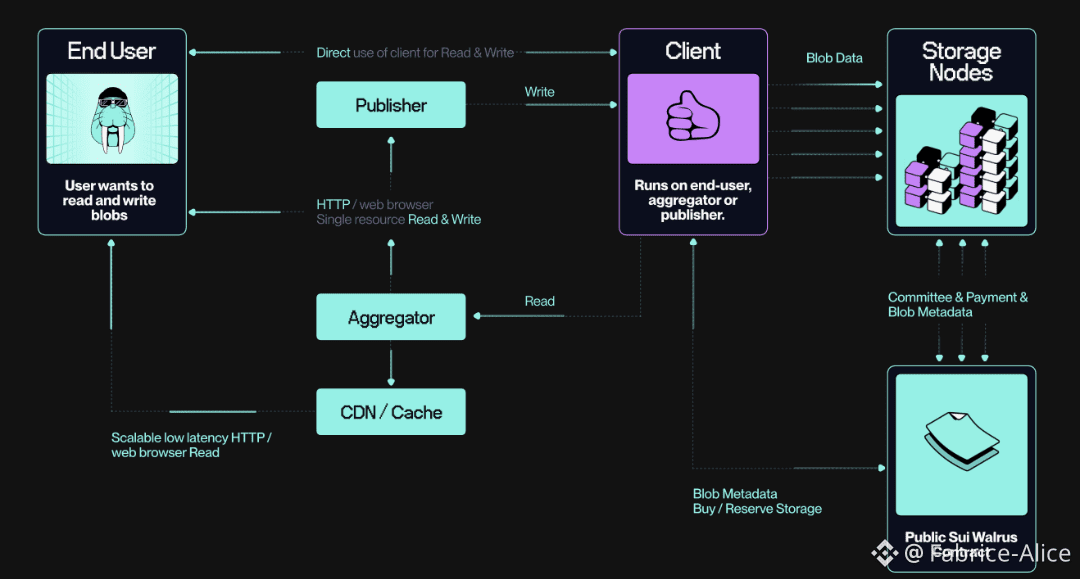
Developed on the Sui blockchain, Walrus is optimized for handling large data objects while maintaining decentralization and usability for real-world applications, developers, and enterprises. Rather than placing raw data directly on-chain, the system relies on blob-based storage combined with erasure coding. Files are split into multiple fragments and distributed across a network of independent storage providers. This approach ensures that data can be reconstructed even when some nodes are unavailable, improving fault tolerance while keeping costs far lower than fully on-chain storage solutions. The blockchain itself serves as the orchestration and verification layer, recording cryptographic commitments and proofs that guarantee data availability and integrity without carrying the data payload. This architectural separation allows the chain to remain efficient while the storage layer scales independently.
The WAL token underpins the network’s incentive structure. Users spend WAL to store and retrieve data, storage providers stake WAL to participate and earn rewards, and token holders help guide governance decisions such as pricing models, protocol rules, and future upgrades. As storage demand grows, value circulates through the system, incentivizing dependable operators and strengthening network security through staking. Because Walrus is embedded within the Sui ecosystem, it integrates seamlessly with smart contracts and decentralized applications that require access to large off-chain datasets without weakening trust assumptions.
This makes Walrus especially suitable for use cases like NFT media hosting, on-chain gaming assets, data-intensive DeFi protocols, regulatory and audit records, and emerging domains such as verifiable AI datasets where data authenticity is critical. While adoption is still in its early stages, Walrus appears focused on becoming core infrastructure rather than a consumer-facing platform, measuring success through integrations and developer uptake rather than short-term hype.
Like any infrastructure-layer project, Walrus faces meaningful challenges. These include attracting sufficient demand to sustain a decentralized network of storage providers, maintaining geographic and economic diversity among nodes, and eventually expanding beyond a single blockchain ecosystem without compromising efficiency or simplicity. Questions also remain around long-term pricing dynamics, competitive pressure from other decentralized storage networks, and how enterprises will balance decentralization against convenience. Even so, the broader trajectory of blockchain development favors modular architectures where execution, settlement, data availability, and storage are handled by specialized layers. In that context, storage becomes a critical strategic component.
Walrus is effectively wagering that the future of Web3 depends on dependable, censorship-resistant data infrastructure that fades into the background because it works reliably. If that vision proves accurate, Walrus’s impact could ultimately be far greater than its current visibility suggests.