

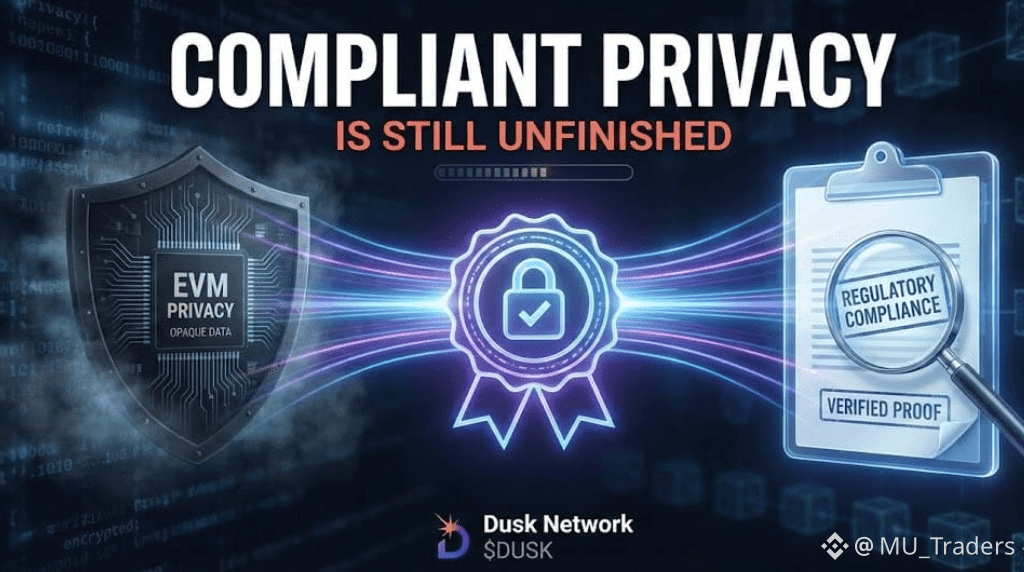
you might think privacy on EVM chains is already a solved problem. Zero-knowledge proofs exist, private transactions exist, and most discussions feel mature. But when you zoom out and look at how regulated applications actually need to operate, something important is still missing.
The missing piece is not secrecy. It is controlled proof.
Where most EVM privacy breaks down
Most privacy-focused EVM designs optimize for hiding information from everyone. That sounds ideal until real-world constraints appear. Regulated financial applications cannot operate on pure opacity. They need to demonstrate that rules were followed, funds were handled correctly, and restrictions were enforced.
On most EVMs, this creates a binary choice. Either you expose data for audits, or you sacrifice compliance for privacy. In practice, privacy usually loses. This is why many so-called private systems quietly revert to transparency when regulation enters the picture.
Dusk Network is approaching this from a different angle.
DuskEVM reframes the problem
Instead of asking how to hide data, DuskEVM asks how to prove correctness without revealing data. That shift sounds subtle, but it changes how smart contracts behave under scrutiny.
In Dusk’s confidential EVM, transaction details can remain hidden while still producing verifiable proofs that conditions were met. Compliance checks do not rely on trust in the application operator. They rely on cryptographic guarantees embedded directly into execution.
This lowers friction for regulated use cases because compliance is no longer an external process layered on top of the chain. It becomes native to execution itself.
Hedger and selective auditability
Hedger is where this approach becomes practical. It enables selective disclosure through proofs rather than raw information. An auditor does not see balances, identities, or transaction flows. They see confirmation that constraints were respected.
That distinction matters. It allows institutions to satisfy legal and regulatory requirements without turning blockchain into a surveillance system. The system reveals only what is necessary, and nothing more.
From a crypto design perspective, this is a more disciplined trust model than full transparency or full secrecy.
Why this matters now
As real-world assets and regulated financial products move on-chain, the conversation is shifting. The question is no longer whether blockchain works, but whether it can coexist with existing legal frameworks without losing its core values.
Dusk Network suggests that privacy and compliance are not opposites. When built into the protocol, they can support each other. That idea is still underappreciated in the broader cryptocurrency space, but its implications are difficult to ignore.