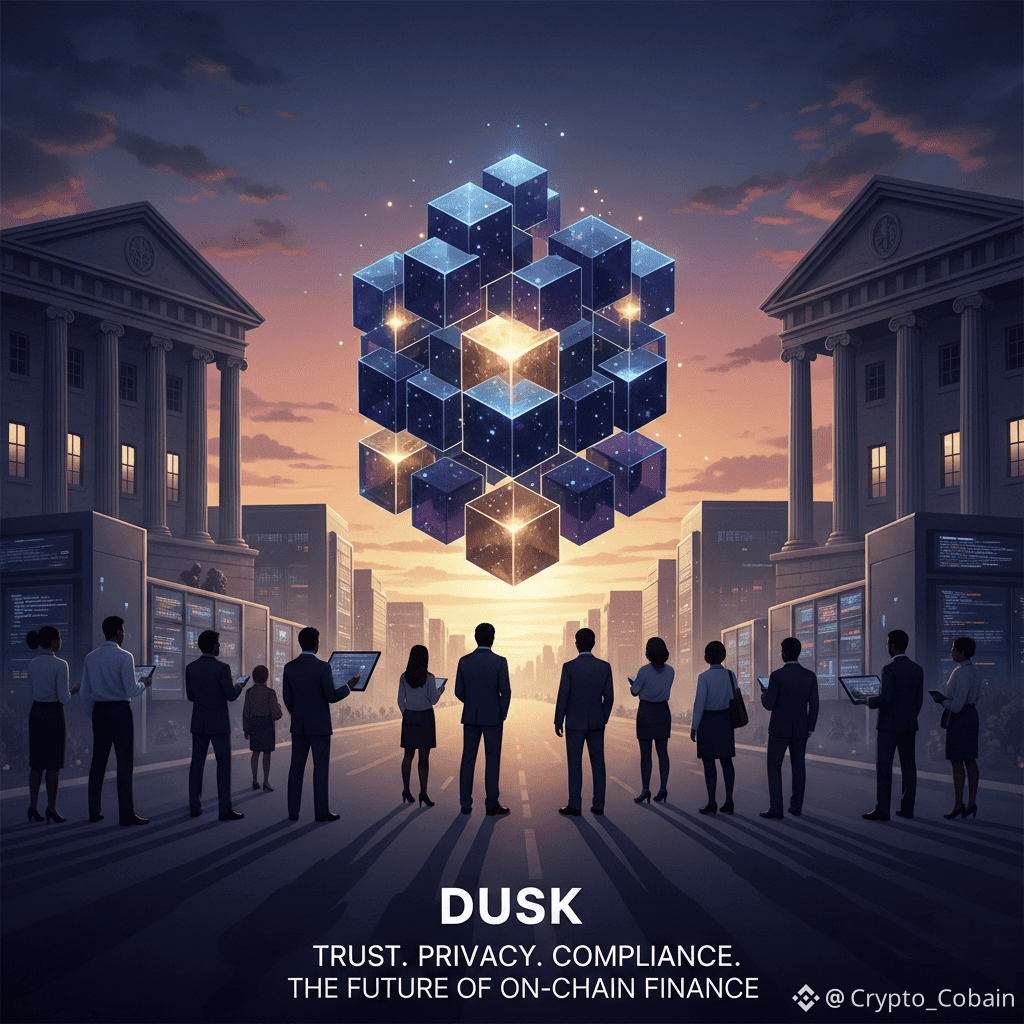
Dusk is a layer 1 blockchain project that started in 2018 with a very specific goal in mind: bringing real financial systems onto blockchain without breaking the rules those systems must follow. From the beginning, the team behind Dusk focused on one big problem in crypto and finance. Traditional finance needs privacy, legal compliance, and clear audit trails, while most blockchains are fully transparent and not designed for regulated assets. Dusk was created to sit exactly in the middle of those two worlds.
Unlike many blockchains that focus mainly on open DeFi or fast payments, Dusk is built for institutions, regulated markets, and real-world assets. This includes things like tokenized shares, bonds, funds, and other financial instruments that must follow strict laws. Dusk does not try to avoid regulation. Instead, it is designed to work with it while still keeping user data private.
Privacy is one of the core ideas behind Dusk, but it is not privacy in the sense of hiding everything forever. The network is built so transactions, balances, and ownership details can stay confidential between parties. At the same time, Dusk allows selective disclosure. This means that when regulators, auditors, or legal authorities need to verify something, the correct information can be revealed in a controlled and provable way. This balance between privacy and auditability is what makes Dusk different from many other privacy-focused blockchains.
At the protocol level, Dusk uses its own proof of stake consensus mechanism. Validators stake the native DUSK token to help secure the network and process transactions. The consensus system is designed to be efficient, secure, and fair, while also protecting validator identities during leader selection. This helps reduce manipulation and front-running while maintaining decentralization.
Dusk also introduces unique transaction models that are designed specifically for financial use cases. One model focuses on confidential transfers similar to UTXO systems, which is useful for privacy-preserving transactions. Another model is designed for regulated assets and allows the system to keep track of ownership and compliance rules without exposing sensitive data to the public. This second model is especially important for security tokens and tokenized real-world assets, where laws often require restrictions on who can hold or transfer assets.
Smart contracts on Dusk run in a WebAssembly-based virtual machine. This makes the network flexible and developer-friendly while allowing advanced cryptographic features like zero-knowledge proofs to be built directly into applications. Developers can create financial products that behave like traditional instruments but run fully on-chain, with privacy and compliance baked in from the start.
One of the biggest use cases for Dusk is tokenization of real-world assets. This includes shares in companies, bonds, private equity, and other instruments that are normally difficult to trade or access. By tokenizing these assets on Dusk, issuers can reduce settlement times, improve transparency for regulators, and give investors more efficient access, all without exposing sensitive financial information publicly.
The Role of Dusk Token
The DUSK token is the native asset of the network. It is used for staking, transaction fees, and participation in network security. DUSK is listed on Binance, which provides liquidity and access for users who want to trade or hold the token. Like most crypto assets, its market value changes over time, but its utility within the network remains central to how Dusk functions.
Dusk has also focused heavily on working with regulated entities and financial infrastructure providers. Instead of chasing hype-driven trends, the project has aimed to build relationships with exchanges, payment providers, and institutions that operate under real legal frameworks. This approach takes longer, but it aligns with Dusk’s long-term vision of becoming a serious blockchain layer for financial markets rather than a short-term speculative platform.
Another important aspect of Dusk is that it is fully permissionless at the base layer. Anyone can run a node, stake tokens, or build applications. The compliance features are implemented at the application and asset level, not by restricting access to the blockchain itself. This keeps the network open while still allowing regulated use cases to exist safely.
The Privacy Blockchain Built for Real-World Finance
In simple terms, Dusk is not trying to replace Bitcoin, Ethereum, or fast payment chains. It is trying to create something that traditional finance can actually use without compromising on privacy or legal requirements. It is designed for a future where real-world assets move on-chain, institutions interact with decentralized infrastructure, and users still maintain control over their data.
Dusk’s progress may feel quieter compared to trend-heavy crypto projects, but that is largely because regulated finance moves slowly and carefully. The focus is on building solid foundations, reliable technology, and legally sound systems. If tokenized securities and compliant DeFi continue to grow, Dusk is positioned as a blockchain that was designed for that world from day one.
Final Thoughts
Overall, Dusk represents a different direction for blockchain technology. It is not about maximum transparency or complete anonymity, but about trust, privacy, and compliance existing together. For institutions, developers, and users who believe the future of finance will live on-chain under real regulations, Dusk offers a clear and thoughtful approach.