
$XPL is entering a different phase of its life. Not the early “what is this?” phase. Not the hype phase. But the phase where a network starts acting like real infrastructure.
When a blockchain publishes a roadmap, that’s normal.
When that roadmap is backed by integrations, liquidity, and real-world payment rails — that’s different.
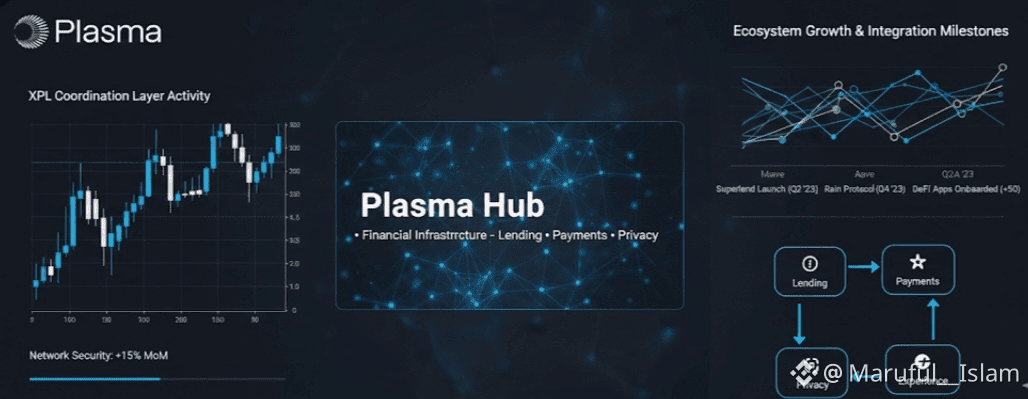
This is where Plasma feels like it’s evolving.
Instead of only talking about vision, Plasma is showing how it plans to move from concept to system. A system where stablecoins, lending, cards, and privacy all work together.
From my point of view, this is what separates serious networks from experiments.
Most chains start with technology.
Very few finish with utility.
Plasma’s roadmap focuses on three things that matter long-term:
• On-chain financial depth
• Real-world money movement
• Developer and user experience
And those three together are powerful.
Let’s start with DeFi.
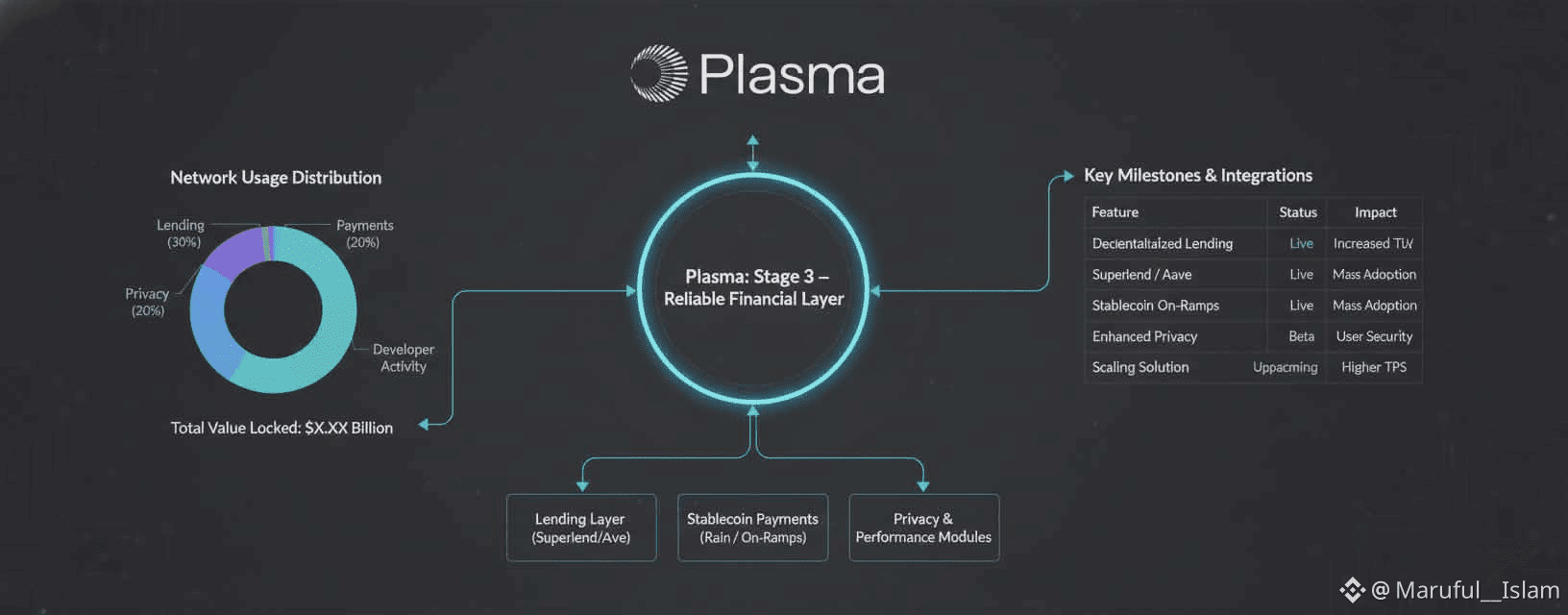
When lending goes live through platforms like Superlend, and protocols like Aave expand into a chain, that tells me something important: capital is willing to trust the network.
Liquidity doesn’t move for fun.
It moves where it can work.
A lending layer gives any chain a financial backbone. It allows users to borrow, leverage, hedge, and build strategies. It’s not flashy, but it’s essential.
That’s one pillar of an ecosystem.
Now let’s talk about payments.
Integrating stablecoin card infrastructure like Rain changes the narrative completely. It’s one thing to move money inside crypto. It’s another thing to move it into the real world.
Cards, on-ramps, and off-ramps are what connect users, merchants, and businesses to a blockchain. Without that, everything stays trapped inside wallets and DEXs.
Plasma is clearly trying to break that wall.
That tells me the goal is not just DeFi users.
The goal is real financial usage.
This is where #plasma stops being “just another L1” and starts looking like a money network.
Then there’s privacy and performance.
Most people don’t talk about it much, but payments without privacy aren’t real payments. Businesses, institutions, and even individuals don’t want every transaction fully exposed forever.
Plasma’s focus on confidential transactions and performance improvements shows that the team understands something important: usability is not optional.
Fast is not enough.
Cheap is not enough.
Private and reliable is what brings adoption.
Now let’s bring this back to XPL itself.
XPL isn’t just a token floating on a chart. It’s the coordination layer of the network. It secures validators, aligns incentives, and underpins everything that runs on Plasma.
As more value moves through the system — in lending, payments, and apps — the role of XPL becomes more important, not less.
In my opinion, this is the stage where narratives change.
Early stage: “What is this?”
Middle stage: “Does this work?”
Late stage: “Can I rely on this?”
Plasma feels like it’s transitioning from stage two into stage three.
And that’s where real ecosystems are born.
I don’t see this as a short-term story.
I see this as a network trying to earn relevance.
Not by shouting.
By building.
And in crypto, the chains that build quietly often end up speaking the loudest later.