
In an era of rapid development in cryptocurrency and blockchain technology, Vanar Chain @Vanar stands out with its unique AI-native Layer 1 architecture. As a platform focused on Web3, gaming, entertainment, and AI integration, Vanar Chain's native token VANRY has become a focal point for investors. Founded in 2020, Vanar Chain operates in an Ethereum-compatible environment, with a total supply of over 2.1 billion tokens, of which about half are currently in circulation. According to CoinMarketCap data, as of January 2026, the price of VANRY is approximately $0.008, with a 24-hour trading volume reaching $3.7 million. Despite a nearly 90% price drop over the past year, it has recently increased by 7% within a week, indicating signs of market recovery. Vanar Chain's core advantage lies in its modular infrastructure, including semantic memory and on-chain reasoning capabilities,enabling dApp developers to easily build AI-enhanced applications, such as real-time risk prediction and cross-chain asset management.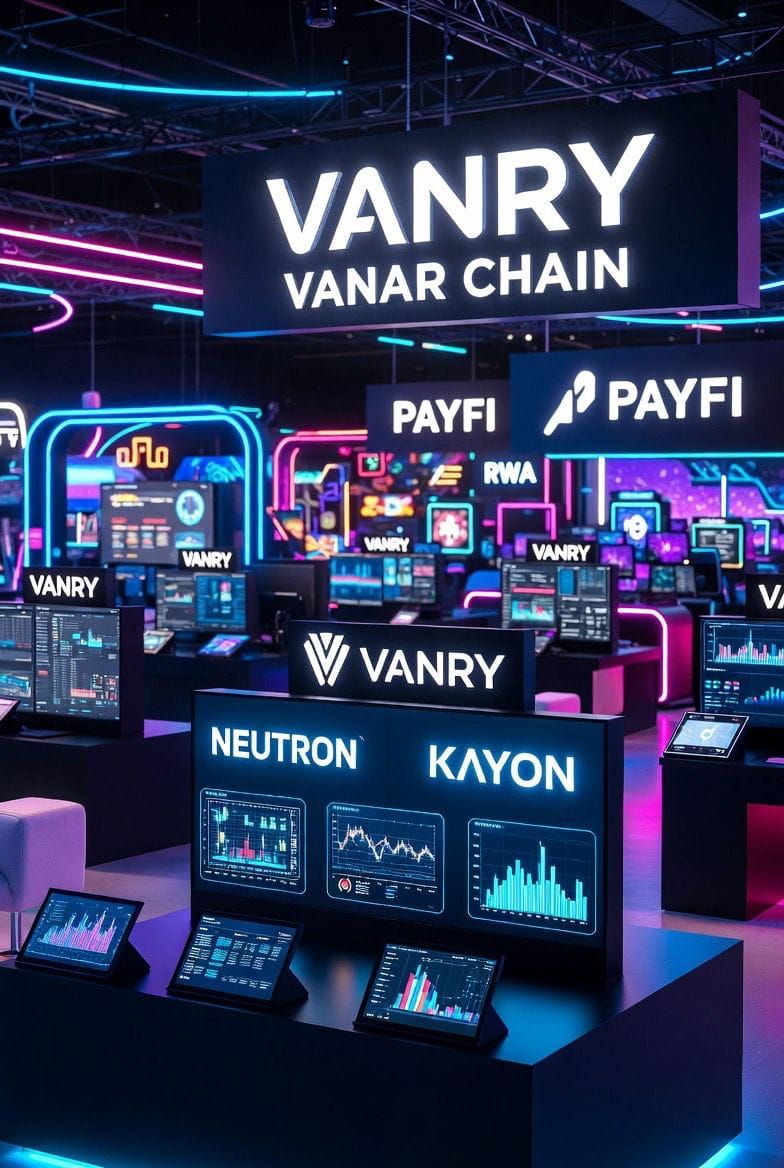

The technology stack of Vanar Chain is worth exploring. It uses a Proof-of-Stake consensus mechanism, supporting high throughput with thousands of transactions per second (TPS), far exceeding traditional blockchains. The built-in Neutron and Kayon AI toolchains allow developers to seamlessly integrate machine learning models into smart contracts. This not only lowers the development barrier but also provides cost-effective solutions for the gaming and entertainment industries. For example, Vanar Chain (VANRY): an AI-driven Web3 newcomer, compared to traditional blockchains.
In an era of rapid blockchain technology development, Vanar Chain stands out with its unique AI-native design. As a Layer 1 (L1) blockchain platform, Vanar Chain's core token, VANRY, supports the operation of NFT systems deployed in games or virtual reality experiences, with gas fees on Web3 being significantly lower than other smart chains. Vanar also emphasizes sustainability, using carbon-neutral design to attract environmentally conscious users. The project team includes former Google and Disney executives. Established in 2020, Vanar Chain aims to integrate entertainment and artificial intelligence infrastructure, particularly in India, to promote the adoption of real-world applications in content ecosystems, entertainment, gaming, and finance. Unlike traditional blockchains that focus solely on transaction speed and security,Vanar Chain locks in the value of a five-layer architecture, providing modular and rapidly scalable solutions, particularly in the Asian L1 market.
In order to fully realize its potential, Vanar Chain must comprehensively assess memory storage and compress data to compare with other blockchain projects. First, the Kayon layer provides an on-chain inference engine, enabling intelligent decision-making for Vanar Chain compared to Ethereum. AxEVMon and compatible chains inherit its security and support automated developer-friendly applications. This design helps avoid Ethereum's high congestion and fee issues, adapting to and optimizing the true TPS implementation of 'smart contracts' in Web3.
The technology of Vanar Chain shines in its scalability, being EVM compatible like Layer 2 solutions, which means developers can easily migrate Ethereum 2 applications while enjoying optimized AI-enhanced features like those provided by Polygon. However, compared to Ethereum, Neutron's ecosystem allows for the compression of complex files like PDFs, transforming them into programmable assets worth up to $69.6 billion, used for real-time Defi data, far surpassing Vanar's predictive analysis of billions. The advantage of Vanar lies in its AI integration (payments, for example, in finance) and real-world asset tokenization (in the RVanWAar field). Currently, VANRY's market cap is about $1.7 billion, with a circulating supply of over 2.1 billion tokens, stabilizing around $0.008, reducing losses due to market volatility.This data suggests that by 2026, Vanar will emerge as a new player. The application platform supports a staking mechanism, allowing users to earn passive NFT market returns through staking at AI-driven anarchain.com, further enhancing competitive incentives, while participating in the Ethereum ecosystem is more suitable for large-scale financial Chain protocols.
Several exchanges have partnered with Vanar, including comparisons with Solana, Bybit, and KuCoin, aiming to support high TPS of up to 65,000. These gaming partners not only enhance liquidity but also accelerate the creation of applications worth $82 billion in both content and gameplay. Both strive for low application fees and high performance, but the implementation faces challenges, such as the stability of the NFT market and the automation issues often criticized.
However, to fully evaluate and optimize the Vanar AI network, we need to reduce value faults and integrate it with other mainstream blockchain projects. First, compared to complex Ethereum, Vanar Chain has advantages in cost and efficiency, particularly for AI applications. For example, while Ethereum generates content for games, Vanar Chain processes AI modules on-chain and optimizes for lower latency and cost, achieving high transaction volumes (processing thousands of transactions per second) while maintaining a market cap in the hundreds of billions, far surpassing Ethereum's reliance on external oracles. With a potential market cap growth, CoinMarketCap data predicts that Ethereum's transaction fees may reach $50 by 2031, while Vanar Chain could drop to $0.0115, benefiting from the AI boom. In contrast,this makes Vanar pure performance more suitable for AI-intensive applications such as real-time data analysis. Compared to Ethereum, other AI-focused blockchains like FetchNFT.ai and its infrastructure are also notable. Fetch.ai emphasizes speed and intelligent network capabilities, while Vanar focuses on entertainment applications. Fetch.ai has a lower TPS and is more academically oriented with a TVL of about hundreds of millions. Vanar's advantage is its entertainment focus, such as the collaboration with Hollywood to launch AI-driven Proof-of-History NFTs to attract user consensus. Another notable aspect is its ability to process high transaction rates, reaching up to 65,000 transactions per second, which far exceeds current levels for building AI services. However, Solana's network stability has faced multiple interruptions and lacks an integrated AI layer. Although Vanar Chain is slightly less speedy, it offers market compatibility through the Kayon engine, suitable for contexts where it is not required to be EVM-compatible. Overall, the understanding of scenarios where Vanar's AI automates contracts and integrates with blockchain provides a balanced advantage in the entertainment industry.
Looking ahead, Vanar Chain faces high challenges in a competitive trading market.
The regulatory landscape remains uncertain and competitive with Polygon. However, as AI becomes more prevalent in Web3 as a Layer 2 solution, VANRY is expected to focus on resilience and low costs. Investors should pay attention to its price fluctuations through ZK-rollups, combined with macro trend analysis on the chain. In summary, the Vanar ecosystem is not only a major technological innovation with a market cap exceeding $50 billion but also represents the potential of Ethereum as an extension layer, lacking independent L1 compatibility. VanarSol Chain's speed as a pure L1 is unique, not only with EAI VM compatibility but also forming a distinct integrated AI positioning stack. In this cryptocurrency world, it reminds us of better efficiency when processing data. For example, in the future,Polygon may be suitable for gaming projects like Axie Infinity that integrate cutting-edge technology.
However, Vanar's AI-driven approach enables intelligent in-game decision-making. Overall, Vanar Chain's AI orientation makes it a leader in the emerging Web3+AI integration field, while Ethereum, Solana, and Polygon focus more on general infrastructure.
Looking to the future, the price prediction for Vanar Chain is optimistic. CoinDCX analysis shows that by 2030, VANRY may reach $0.0115, benefiting from the AI boom and Web3 adoption. However, risks remain, such as market volatility and regulatory uncertainty. Overall, Vanar Chain represents the next generation of blockchain evolution, infused with AI vitality, highlighting its innovative potential compared to traditional platforms. For investors and developers, it is not just a token, but a key to a smart future.