
Most platforms look strong at the beginning. Early users arrive. Actions are light. Everything feels responsive. At that stage almost any system can appear reliable. The real test comes later when usage becomes repetitive. When users stop exploring and start relying on the product to behave the same way every day.
This is where many systems quietly begin to drift.
Nothing breaks loudly. Transactions still go through. Interfaces still load. But uncertainty creeps in. Results feel delayed. Finality feels vague. Users cannot explain what feels wrong but they feel it anyway. Over time that feeling changes behavior. People hesitate. They double check. They leave earlier than planned. Trust erodes without a clear failure.
Vanar is designed for this phase.
Instead of optimizing for first impressions Vanar assumes the system will be used repeatedly under uneven conditions. Sessions will be long. Traffic will spike unexpectedly. Actions will happen back to back without clean breaks. The architecture treats this not as an exception but as the default operating mode.
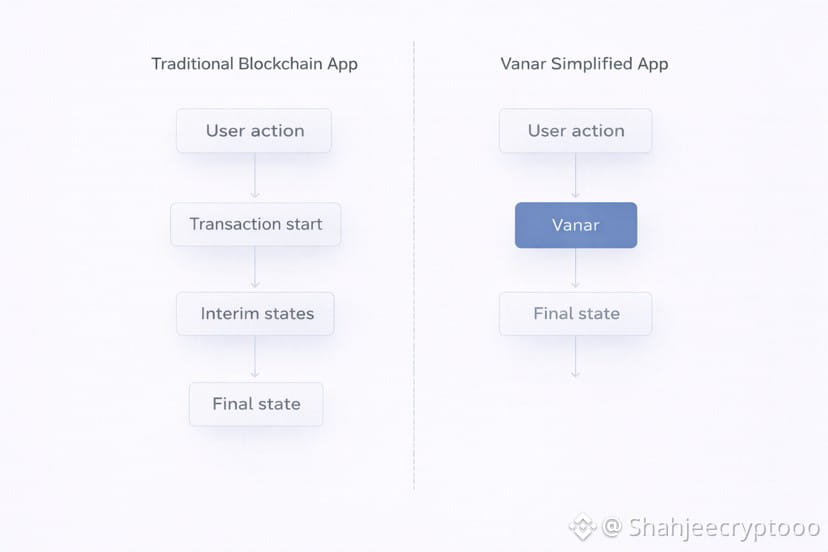
At the center of Vanar is a simple principle. Every action must move cleanly toward a known final state. There is no hidden progress and no ambiguous middle ground exposed to the user. Either something advances or it does not. That clarity removes hesitation even when usage patterns become complex.
This execution model becomes especially important during long sessions. Many platforms slowly degrade over time. Memory builds. State becomes harder to reason about. Responses feel less consistent after prolonged use. Vanar maintains the same execution behavior regardless of session length. The experience at minute five feels the same at minute ninety.
Developers notice this long before users do. Predictable execution means fewer defensive checks scattered across the codebase. Teams stop writing logic to protect against uncertain outcomes. Over time applications remain simpler and easier to maintain. Stability compounds quietly.
Traffic spikes reveal another important difference. Growth is never smooth. A brand campaign launches. A feature goes viral. Thousands of users arrive simultaneously. Traditional systems handle this by queueing uncertainty. Responses slow down. Users are told to wait. Results arrive later than expected.
Vanar absorbs these moments differently. Execution remains orderly even when inputs are chaotic. The system does not leak partial states or temporary approvals. Actions only move forward when the path is clear. This keeps behavior consistent even under pressure.
This matters deeply for consumer facing products. Brands do not want to explain infrastructure behavior to users. They want interactions to feel obvious. Click leads to outcome. No guessing. No second attempts. Vanar preserves that simplicity behind the scenes.
AI driven applications benefit in a similar way. Continuous requests depend on deterministic behavior. If outcomes feel delayed or inconsistent trust drops quickly. Vanar keeps execution explicit even across repeated automated interactions. Nothing feels provisional or temporary.
Another reason Vanar remains calm under stress is its restraint. It does not expose unnecessary internal transitions. Users see outcomes not mechanics. That separation protects confidence. People trust systems they do not need to understand.
The VANRY token supports this ecosystem without demanding attention. It aligns participation with real usage rather than speculative excitement. Value grows alongside sustained activity not momentary hype.
Vanar also avoids the trap of optimizing for speed alone. Speed without certainty creates confusion. A fast response that might later change does more harm than a slightly slower response that is final. Vanar prioritizes clarity over theatrics.
As products mature the importance of this approach becomes obvious. Early adopters tolerate uncertainty. Mainstream users do not. They expect calm predictable behavior without explanation. Vanar is built for that expectation.
Real adoption happens when systems stop surprising users. When nothing feels experimental anymore. When actions behave the same today as they did yesterday. Vanar focuses on this steady phase because that is where long term ecosystems form.
Infrastructure that survives attention cycles is infrastructure that understands human behavior. People trust consistency more than speed. Vanar reflects that understanding at the protocol level.
This is why Vanar continues to perform when novelty fades. It is designed not for launch day but for the years that follow. Systems that last are quiet. They do their job and stay out of the way.
Vanar does exactly that.