
The first thing that pushed me to look deeper at Plasma was not a chart or a headline. It was a small moment that kept repeating. Payments that technically worked still felt unfinished. The balance changed. The transaction hash existed. But the task did not feel done. I noticed how often people hovered, refreshed, waited, or asked support the same quiet question: is this really complete now. That hesitation is subtle, but it matters more than speed or fees. Once you notice it, you start seeing it everywhere.
Most blockchain conversations focus on what happens after execution. Final blocks. Confirmations. Proofs. Dashboards. But real users experience something earlier. They experience the moment where intent turns into action. I want to send value and move on. That moment does not care about how elegant the cryptography is or how many validators exist. It cares about certainty. Either the system knows what is happening or it does not.
In many systems today, execution is optimistic first and clarified later. The transaction is accepted, then reviewed, then finalized, then sometimes reversed, delayed, or reclassified. The system tells you everything is fine while it quietly keeps escape hatches open. That gap is where confusion lives. Even if nothing goes wrong, the user senses that the system itself is unsure.
I started paying attention to how people behave around that uncertainty. They split transfers. They wait longer than required. They avoid reusing the system for important payments. They add human checks to something that was supposed to remove them. None of this shows up in TPS metrics or average confirmation times. But it shows up in adoption patterns very clearly.
Plasma approaches the problem from a different angle. Instead of asking how fast execution can be, it asks when execution should be allowed at all. The system does not rush to say yes. It waits until the rules are fully satisfied. Only then does the payment move forward. That sounds slower on paper, but in practice it removes the longest delay of all: hesitation.
When execution only happens after certainty, the user experience changes quietly. There is no need to watch. No need to guess. No need to interpret intermediate states. The system does not promise that it will fix things later. It simply refuses to move until it already knows the outcome is valid.
I noticed this difference most clearly in stablecoin flows. Stablecoins are unforgiving because they represent completed tasks, not speculation. Payroll does not want excitement. Merchants do not want narratives. They want closure. Once you send value, the only acceptable state is done.
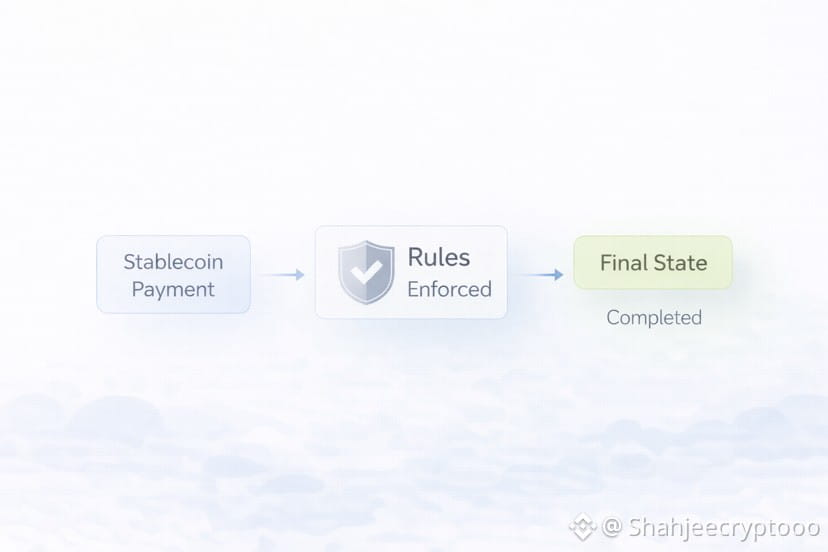
In many chains, stablecoin usage exposes uncomfortable truths. The system was designed for flexible state transitions, not strict completion guarantees. So layers of explanation are added. Wallet messages. Status labels. Confirmations that are not final yet. Every one of those is a signal that the system is asking the user for patience.
Plasma removes that negotiation. The system does the waiting instead of the user. From the outside, this feels calm. Internally, it is strict. Rules are checked before execution, not after. If something cannot be decided cleanly, nothing moves. That design choice shifts stress away from the user and into the protocol, where it belongs.
I also started noticing how this affects downstream systems. Accounting becomes simpler because there are fewer ambiguous states to reconcile. Support tickets drop because there is nothing to explain. Developers stop writing defensive code for cases that should never exist. The ecosystem feels lighter, not because it does less, but because it does things at the right time.
What surprised me most was how this clarity changes behavior over time. Users stop double checking. Businesses automate confidently. Integrations become thinner. The system trains people to trust completion again, not through branding, but through repetition of clean outcomes.
There is a common belief that faster execution alone creates better experience. My observation has been the opposite. Faster uncertainty just means confusion arrives sooner. What people actually want is a clearly defined moment where responsibility ends. Plasma defines that momentum.
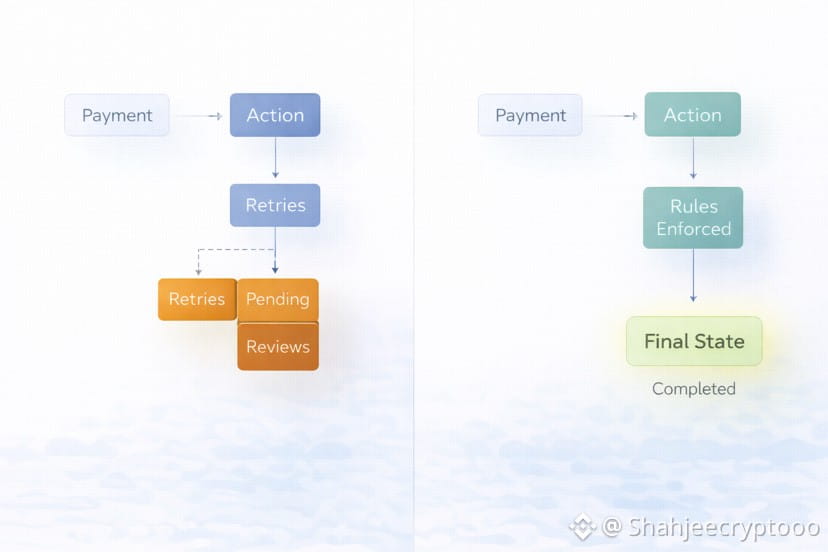
On the left side of most payment systems, execution fans out into retries, pending states, reviews, and time based assumptions. On the right side, there is often a clean final number, but the path between those two is noisy. Plasma collapses that path. There is no middle state that requires interpretation. Either the payment has not happened yet, or it has fully completed.
This design also changes how failures are perceived. A rejection before execution feels honest. A delay after execution feels broken. Plasma chooses honesty early instead of explanations later. That choice is subtle but powerful.
From a personal perspective, what makes this compelling is not that Plasma avoids complexity. It embraces complexity internally so users do not have to. The rules are strict. The gates are real. The system is opinionated about when actions are allowed. That is what creates the calm surface.
Over time, I started to see that adoption does not grow where systems are impressive. It grows where systems feel predictable. People return to places where they do not need to think twice. Plasma builds around that instinct, not by teaching users how the system works, but by removing reasons for them to care.
This is also why many discussions about scaling miss the point. Scaling uncertainty just scales doubt. Scaling clarity scales trust. Plasma focuses on the second path. It does not try to be everything to everyone. It tries to be unambiguous when it matters most.
After watching enough payment flows, retries, and user behaviors, I stopped asking whether a system was fast enough. I started asking whether it knew when to stop. Plasma answers that question clearly. When execution happens, the story is already finished.
That is the difference I keep coming back to. Not performance claims. Not technical diagrams. Just the feeling that once something is done, it is actually done.

