

Why Trust Does Not Start With Rules
Rules create order, but they do not create belief. In financial systems, belief forms only after systems prove themselves. This is a lesson learned repeatedly in traditional finance, where regulatory frameworks exist but trust still depends on track record.
Blockchain systems often invert this logic. They assume that if rules are encoded, trust follows automatically. However, users do not trust systems because rules exist. They trust systems because those rules hold under real conditions.
@Dusk approaches trust differently by recognizing that procedures alone are insufficient.
Procedural Trust Is Necessary but Incomplete
Procedural trust defines boundaries. It ensures that actions follow predefined paths. This is essential for predictability. However, predictability does not equal safety.
In DUSK, procedures exist to enforce privacy, settlement, and compliance. However, the system does not rely on these procedures to generate trust on their own. Instead, they create a stable environment where observation can occur.
This separation matters. Procedures shape behavior. Observation judges results.
Observational Trust Forms Through Absence of Failure
Trust often forms not because something happens, but because something does not happen. In financial privacy systems, the absence of leaks is more important than the presence of features.
DUSK builds observational trust by minimizing negative events. Over thousands of blocks, transactions do not expose sensitive data. Over extended periods, audits do not reveal unintended disclosures. Over time, this absence becomes meaningful.
Quantitatively, consider systems that process hundreds of thousands of transactions per month. Even a failure rate of one tenth of one percent produces hundreds of incidents. Systems that avoid this level of failure stand out quickly.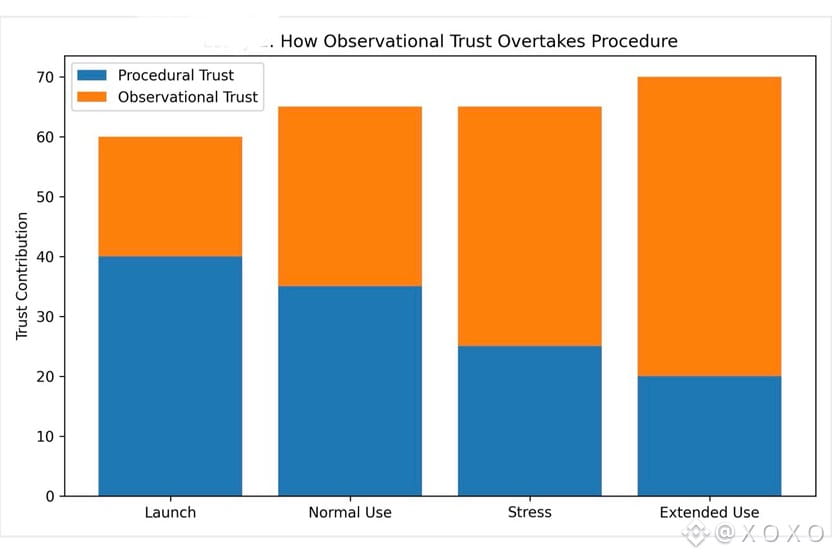
Why Markets Notice Patterns Faster Than Specifications
Markets are pattern sensitive. Participants do not read specifications in detail. They watch outcomes. They notice whether frontrunning occurs. They notice whether privacy holds during volatility. They notice whether systems degrade under load.
DUSK is designed to perform consistently across conditions. This consistency is what creates observational trust.
Procedural trust tells users what should happen. Observational trust shows them what actually happens.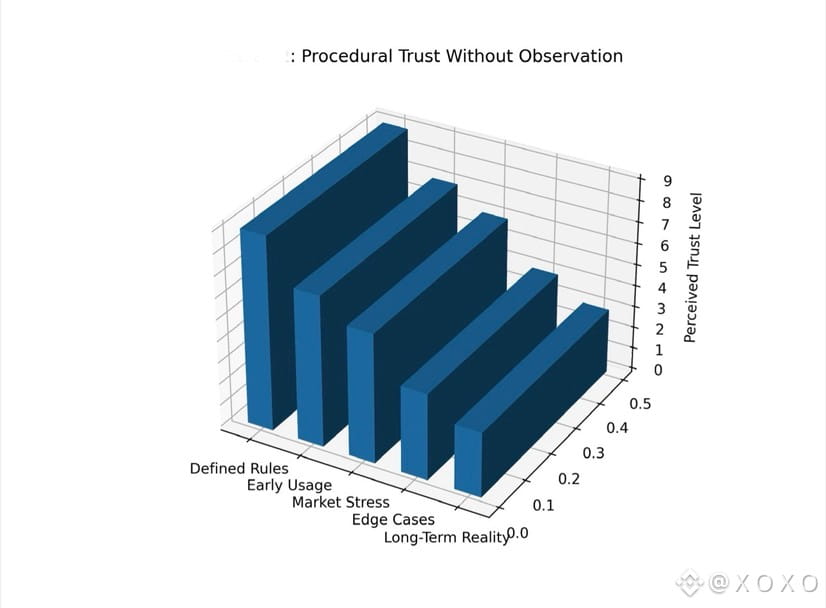
The Role of Time in Trust Formation
Time is the missing variable in most trust models. Trust cannot be rushed. It requires repetition.
DUSK allows time to do its work. It does not force adoption through aggressive incentives. It allows trust to accumulate naturally as the system operates.
This approach may appear slower. However, it produces deeper confidence. Systems trusted through observation are harder to displace than systems trusted through promise.
Why This Matters for Regulated Finance
Regulated finance operates on observation. Regulators observe compliance. Auditors observe records. Institutions observe counterparties.
DUSK fits into this world by making its behavior observable without sacrificing privacy. This balance is difficult. However, it is essential.
Procedures ensure that rules exist. Observation ensures that rules work.
Procedural trust is necessary, but it is not sufficient. DUSK’s strength lies in understanding that trust must be earned through experience. By designing systems that behave predictably over time rather than simply declaring guarantees, DUSK aligns itself with how real financial trust is built. This alignment is subtle, but it is what separates durable infrastructure from theoretical design.