


Dusk is built around one clear problem I keep seeing in crypto: real financial systems can’t operate comfortably on rails where every transfer, balance, and relationship is public forever. Dusk is trying to make “confidential finance” practical, where privacy isn’t an extra feature, it’s part of the base design from day one.
Dusk positions itself as a Layer-1 for financial applications, and that focus shows in what it chooses to prioritize: settlement finality, scalable public infrastructure, and strict data privacy. Dusk isn’t chasing random narratives; it’s aiming at the parts of finance that usually refuse to touch public blockchains because the transparency is too costly.
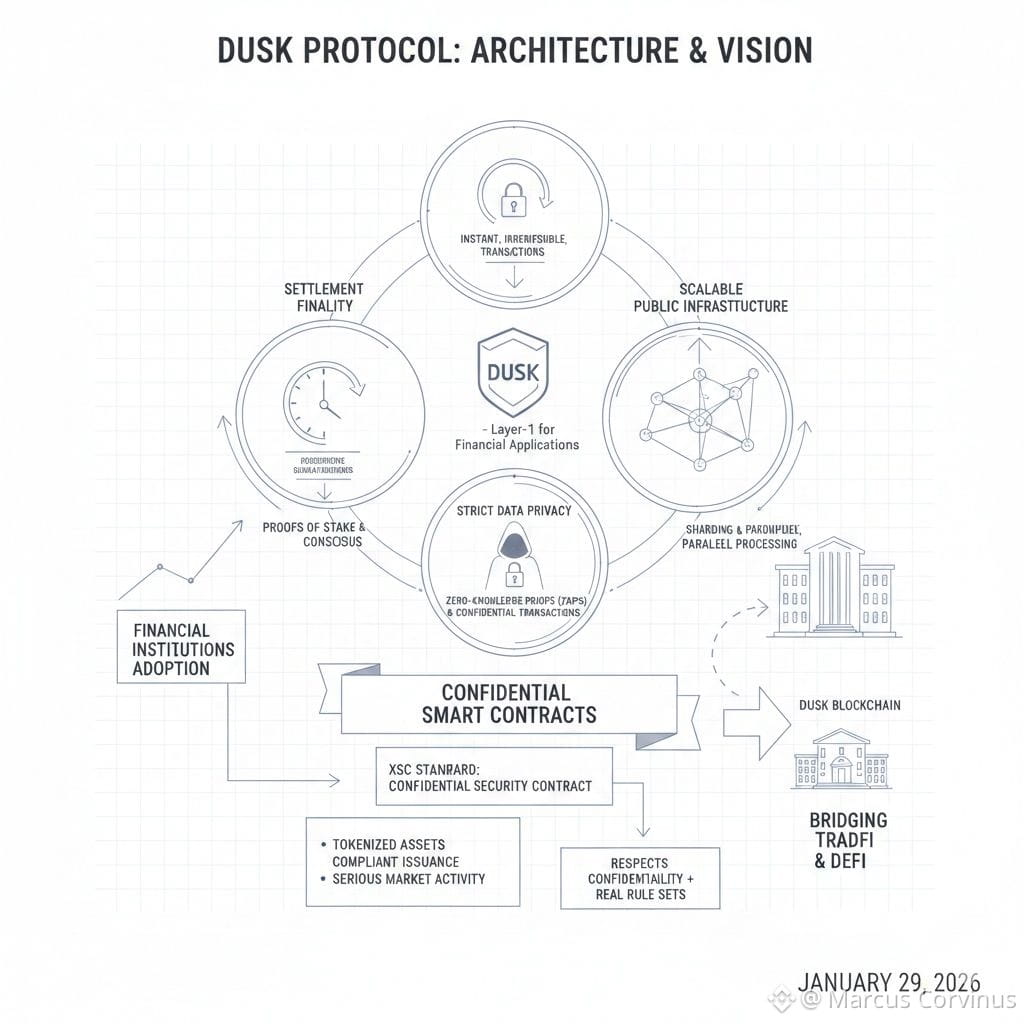
Dusk supports confidential smart contracts through its Confidential Security Contract standard, often referred to as XSC. Dusk is basically saying: if you want tokenized assets, compliant issuance, and serious market activity, you need a smart-contract standard that respects confidentiality and still works inside real rule sets.
Dusk runs privacy through the heart of the chain using its transaction model called Phoenix. Dusk uses Phoenix to enable shielded transactions, so users and institutions can move value without broadcasting sensitive details to the entire world, while still keeping verification and security intact.
Dusk also introduces Moonlight alongside Phoenix, and that matters because it creates two native lanes: public when transparency is fine, and shielded when confidentiality is necessary. Dusk isn’t forcing every use case into one mode; it’s offering choice without breaking the chain’s design.
Dusk goes a step further for regulated assets through a hybrid privacy approach called Zedger, designed specifically around the needs of security tokens. Dusk is trying to make privacy fit the reality of regulated markets, where some information must remain protected, but controlled disclosure and accountability still exist when required.
Dusk’s architecture is modular, with DuskDS handling consensus, settlement, and data availability, while execution environments can sit on top. Dusk benefits from that separation because settlement stays stable and predictable, while developer environments can evolve without constantly rewriting the core of the chain.
Dusk offers an EVM route through DuskEVM to make building easier for teams that already know EVM tooling. Dusk is basically using familiarity as an adoption bridge, while still settling to its own base layer, which keeps the project aligned with its “finance-grade infrastructure” goal.
Dusk has already crossed an important milestone with mainnet going live on January 7, 2025. Dusk moving into a live network phase matters because privacy and regulated infrastructure claims only become real when the chain is running, producing blocks, and supporting real usage.
Dusk’s most recent notable operational update is the Bridge Services Incident Notice dated January 16, 2026, where bridge services were paused as a precaution after unusual activity was detected around a team-managed wallet used in bridge operations. Dusk being transparent about an incident and acting to contain risk is something I pay attention to, because operational discipline is a big part of becoming credible infrastructure.
Dusk’s token story is designed to support long-term network security, with an initial supply of 500,000,000 DUSK and an additional 500,000,000 emitted over decades through staking rewards, reaching a maximum supply of 1,000,000,000 DUSK. Dusk isn’t built as a short sprint token; it’s structured around sustaining validators and network incentives over time.
Dusk also has the ERC-20 version that many people still track on Ethereum,. Dusk’s broader direction is that supply can move into native DUSK, which is where the chain’s full staking and on-chain utility are meant to live.
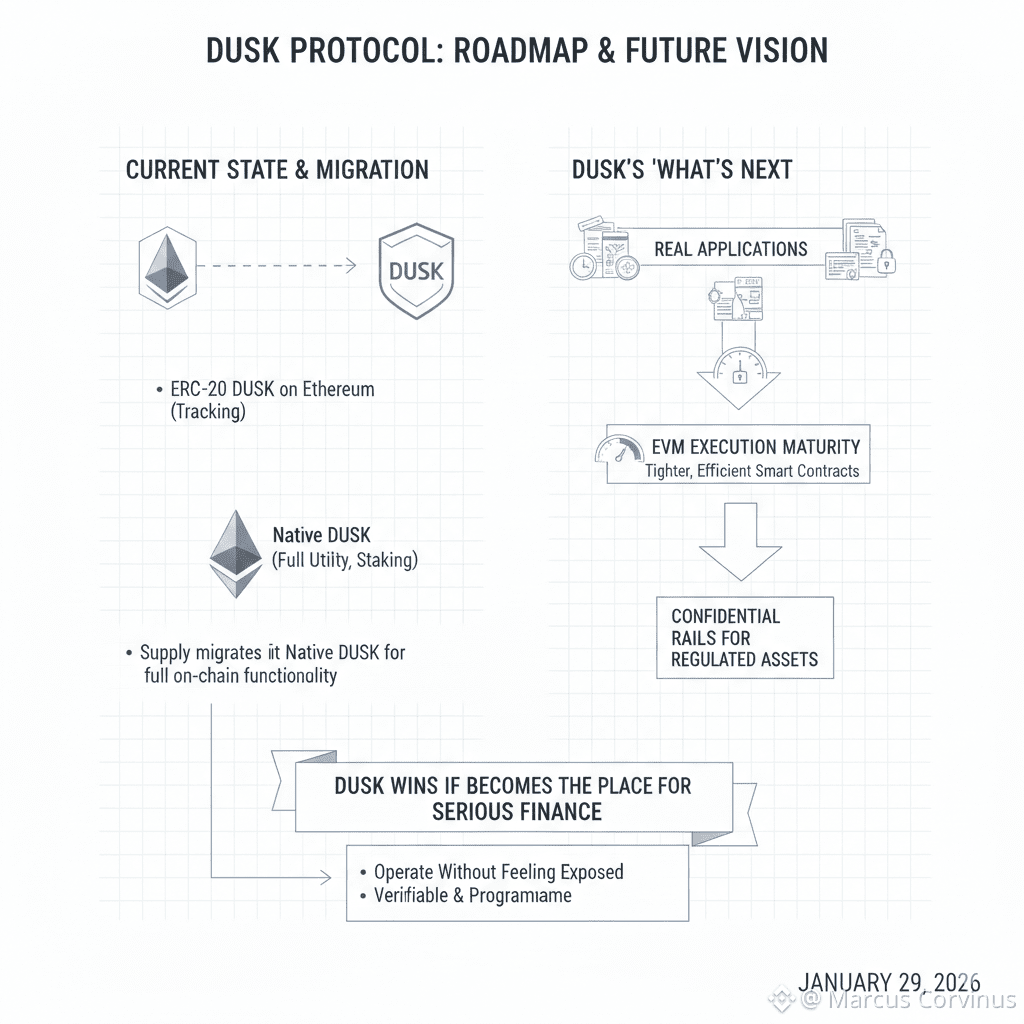
Dusk’s “what’s next” is where the story gets interesting for me: more real applications shipping on the network, tighter execution maturity through the EVM lane, and deeper adoption of confidential rails for regulated-style assets. Dusk wins if it becomes the place where serious finance can operate without feeling exposed, while still being verifiable, programmable, and settlement-sound.
Dusk is my kind of project to watch because it’s not selling privacy as a vibe; it’s trying to build privacy as infrastructure that financial markets can actually use. Dusk will prove itself through shipping, reliability, and real market workflows—not noise—and that’s exactly why I keep it on my radar.
