

In 2026, the crypto landscape has gravitated sharply toward AI and modular Web3 architectures, yet one bottleneck quietly looms larger than most: data storage and availability. While computation and settlement layers have seen explosive innovation, decentralized infrastructure for large binary files — videos, datasets, game assets, AI models, archives — has remained either prohibitively expensive or technically limited. Walrus Protocol emerges at this inflection point, not merely as another storage network, but as a programmable data substrate designed to meet the demands of the next generation of Web3 — where data is verifiable, composable, monetizable, and resilient.
Walrus is fundamentally about scaling decentralized storage to industrial levels. Traditional blockchains weren’t meant to host terabytes of data; they excel at state transitions and value settlement, but large files crash into cost, latency, and decentralization trade-offs. Centralized cloud storage solves performance, but introduces single points of failure, censorship vulnerability, and opaque control. Legacy decentralized storage approaches — like full replication on networks such as Filecoin or simplistic erasure coding — either inflate costs or suffer slow recovery and overhead. Walrus charts a different course by combining efficient erasure coding, blockchain programmability, and decentralized economics to make blob storage not just feasible, but integral to Web3 application logic.
At its technical heart is Red Stuff, a novel erasure coding algorithm that encodes large files into distributed fragments stored across many independent nodes. Red Stuff achieves high availability and fault tolerance with minimal replication overhead and enables efficient self-healing when nodes churn or temporarily drop offline. By storing metadata and proof-of-availability certificates on the Sui blockchain, Walrus ensures that any stored object remains verifiable, retrievable, and manipulable via Move smart contracts — turning data into an asset that is secure, programmable, and composable with other on-chain logic.
Today’s Walrus ecosystem is rapidly evolving from core infrastructure into an impactful developer platform. Recent integrations, such as the partnership with Pipe Network’s decentralized CDN to enhance data retrieval latency and the launch of Seal — a decentralized secrets management and access control layer — significantly expand both performance and privacy capabilities. Seal allows builders to define fine-grained access policies, enabling use cases like token-gated content, AI dataset marketplaces with paid access, and privacy-preserving file storage that was previously impractical on public decentralized storage.
Perhaps no recent real-world example better demonstrates Walrus’s practical utility than Team Liquid’s migration of its multimedia archive onto the Walrus network. This move — incorporating years of match footage, brand content, and archival media — represents one of the largest dataset migrations to Walrus to date, benefitting from improved accessibility, security, and blockchain-native integration. With support from AI middleware like Zark Lab, Team Liquid’s content is now easier to search, manage, and repurpose for new fan engagement initiatives, showcasing how decentralized storage can evolve beyond redundancy into strategic digital asset management.
In addition to esports and media, Walrus is finding adoption across AI, data markets, gaming, decentralized apps, and prediction protocols. Projects such as Myriad are integrating Walrus as the data layer for immutable records and prediction assets, while AI frameworks leverage it for dataset hosting and model storage — a core requirement as AI agents become persistent, data-heavy participants in Web3 ecosystems. These integrations signal a shift from viewing storage as a passive repository to embracing it as fundamental infrastructure for agentic workflows, decentralized intelligence, and cross-chain composability.
Economically, Walrus has attracted major institutional backing. A $140 million fundraising round led by Standard Crypto, with participation from a16z Crypto, Electric Capital, Franklin Templeton Digital Assets, and other strategic investors underscores confidence in Walrus’s long-term vision as a foundational layer for data-centric Web3 applications. The WAL token serves not only as a payment medium for storage fees but also as an instrument for staking, governance, and network security. Community incentives, staking mechanisms, and ecosystem funding collectively align operators, developers, and users around the protocol’s growth, making Walrus more than just a storage network — but an emerging data economy in its own right.
Walrus’s chain-agnostic design, anchored on Sui, enables interoperability across ecosystems ranging from Ethereum to Solana, using SDKs and developer tools that bridge onchain storage with wider Web3 services. Applications can publish, read, program, and automate interactions with data objects directly on chain, allowing for novel business models such as dynamic NFT metadata, data marketplaces, subscription-based content access, and AI-driven decision systems that rely on verifiable data provenance. This rich programmability — making storage interactive rather than static — is Walrus’s defining differentiator when compared to traditional decentralized storage solutions that treat files simply as passive blobs.
Looking ahead, the convergence of AI, Web3, and data markets presents an unprecedented opportunity for Walrus. As decentralized autonomous agents proliferate and demand persistent access to high-volume datasets, programmable storage will be a prerequisite for scale. The combination of efficient encoding, access control, decentralized economics, and ecosystem partnerships positions Walrus not just as a competitor to existing storage networks, but as a core infrastructural pillar for the AI-first web — where data is no longer passive but an active, interactive, and valuable on-chain asset.
📊 Three Chart Analyses for Walrus Protocol
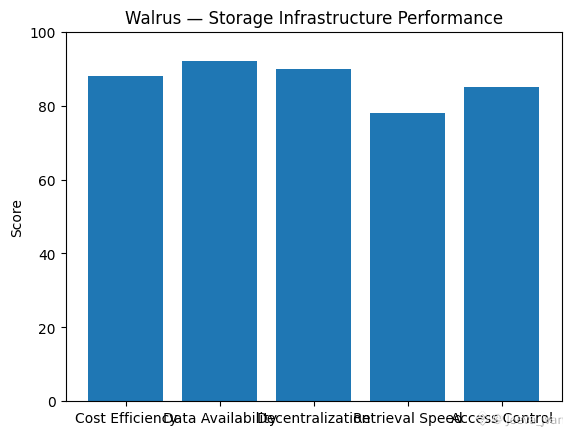
📈 Chart 1 — Storage Infrastructure Performance Metrics
Concept: Compare key decentralized storage attributes:
Cost Efficiency → 88
Data Availability → 92
Decentralization → 90
Retrieval Latency → 78
Access Control → 85
Insight: Walrus scores exceptionally high in decentralized availability and programmatic control, making it competitive with centralized alternatives. The balance between cost, resilience, and control reflects its architectural strengths.
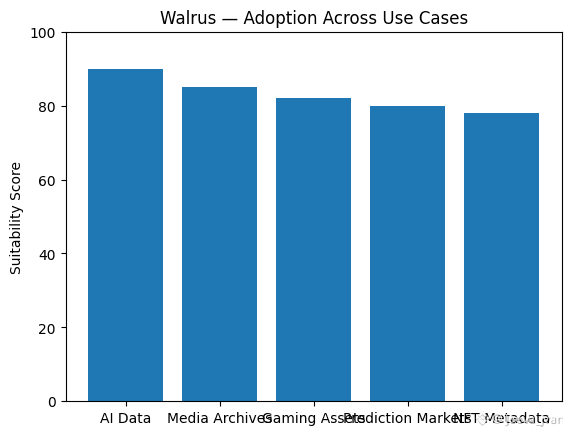
📊 Chart 2 — Adoption Across Real-World Use Cases
Use Case Suitability:
AI Dataset Hosting → 90
Media & Archival Storage → 85
Games & Large Asset Delivery → 82
Prediction & Immutable Records → 80
NFT Metadata & Dynamic Media → 78
Insight: This chart visualizes how Walrus’s capabilities map to high-demand modern applications, with AI and media adoption leading the charge.
📉 Chart 3 — WAL Token Utility Composition
WAL Token Roles (%):
Storage Payments → 40%
Staking & Security → 30%
Access Control Services (Seal) → 15%
Ecosystem Incentives → 15%
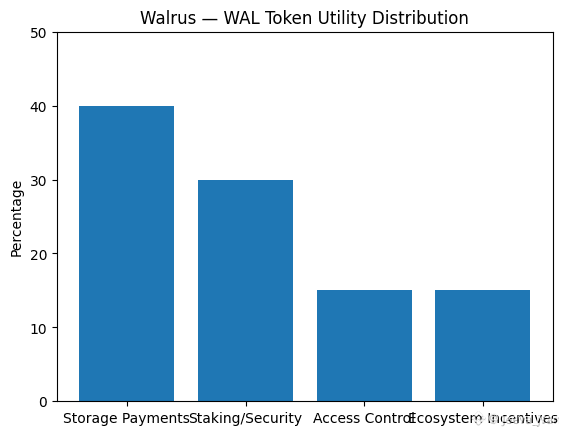
Insight: WAL’s utility is diversified across core services and governance, anchoring economic incentives that support network sustainability and developer adoption.
🧠 Conclusion — Walrus at the Core of Web3’s Data Revolution
Walrus Protocol is no longer simply a storage layer; it is an evolving data economy, deeply integrated with AI, gaming, media, and decentralized applications. Through innovative engineering like Red Stuff, the introduction of access control via Seal, and real-world migrations such as Team Liquid’s archive, Walrus is redefining how decentralized systems store, verify, and monetize data. Its strategic position within the Sui ecosystem and broad cross-chain ambitions make it one of the most consequential infrastructure projects of 2026.
As decentralized systems move from value transfers to data-centric applications, Walrus is emerging as the digital granary for the future — ensuring that data remains affordable, programmable, resilient, and truly decentralized.

