
Plasma & the Discipline of Incentives:


Stablecoin systems do not behave like startups. They behave like balance sheets. This difference is often overlooked in crypto, where growth metrics dominate conversation. However, systems that move money are judged by very different standards. They are evaluated on predictability, cost control, and operational continuity. When incentives are misaligned, the damage does not appear as a chart going down. It appears as hesitation, higher spreads, delayed settlement, and eventually loss of confidence.
@Plasma approaches incentives from this practical perspective. Instead of asking how fast capital can be attracted, it asks how long participation can be maintained without distortion. This shift may seem subtle, but it changes how every decision is made.
Why Stablecoin Users Behave Like Operators
Users of stablecoin chains are rarely casual participants. They include payment processors, treasury managers, fintech platforms and applications that depend on daily settlement. These actors do not rotate capital quickly. They plan ahead. They measure costs. They reduce uncertainty wherever possible.
For these users, incentives that fluctuate dramatically are not appealing. A yield that changes every week introduces operational risk. A reward structure that depends on governance votes or emissions schedules creates planning friction.
Plasma designs incentives that resemble operating income rather than speculative yield. The goal is not to maximize return. The goal is to minimize surprise.
The Cost of Liquidity Instability
Liquidity instability is not an abstract risk. It has measurable consequences.
If a settlement pool loses twenty percent of its liquidity during a period of moderate volatility, spreads can widen by multiple basis points. For a system processing ten million dollars per day, even a five basis point increase translates into five thousand dollars of additional cost daily. Over a year, that becomes nearly two million dollars.
These costs are not borne by speculators. They are borne by users who rely on the system for routine operations.
Plasma’s incentive design treats liquidity stability as a cost center that must be controlled, not a growth metric to be optimized.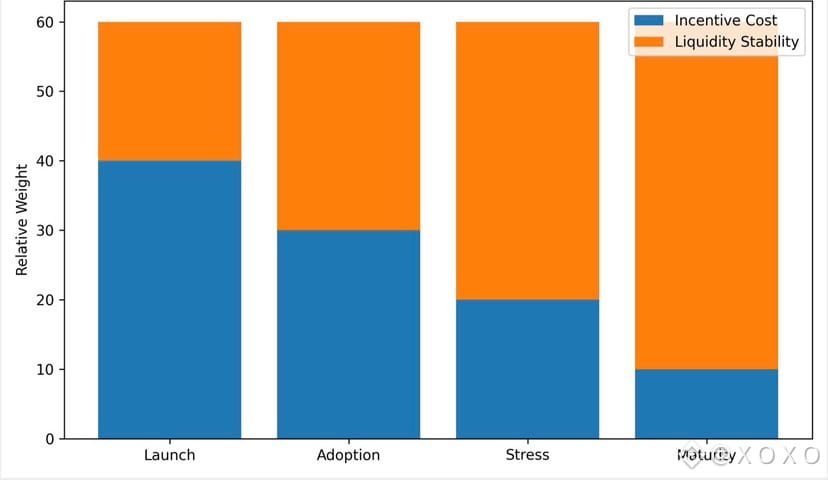
Incentives as Risk Management Tools
In traditional finance, incentives are used to manage risk. Capital requirements, reserve ratios, and fee structures are designed to encourage prudent behavior. Stablecoin infrastructure must adopt a similar mindset.
Plasma uses incentives to reward behavior that reduces system risk. Participants who remain active through low-volume periods help smooth liquidity cycles. Those who support settlement paths during congestion reduce systemic strain.
This is not about generosity. It is about protecting the system from its own success.
Why High Emissions Signal Weak Demand
High incentive emissions are often interpreted as strength. In reality, they often signal weak underlying demand.
If a system requires constant subsidies to maintain participation, it suggests that users do not value the service enough to pay for it. In stablecoin systems, this is a warning sign.
Plasma avoids this trap by allowing demand to reveal itself slowly. Incentives exist to support early usage, but they are not designed to overpower market signals. When usage grows, incentives taper naturally.
This ensures that the system’s economics remain grounded in reality.
Time Weighted Participation Matters More Than Volume
Volume is easy to inflate. Retention is not.
Plasma emphasizes time weighted participation. A participant who contributes steadily over twelve months provides more value than one who enters briefly with large capital and exits quickly. Incentives that recognize this difference shape healthier behavior.
Over time, this creates a participant base that understands the system and adapts to its rhythms. Such participants are less likely to react emotionally to short-term changes.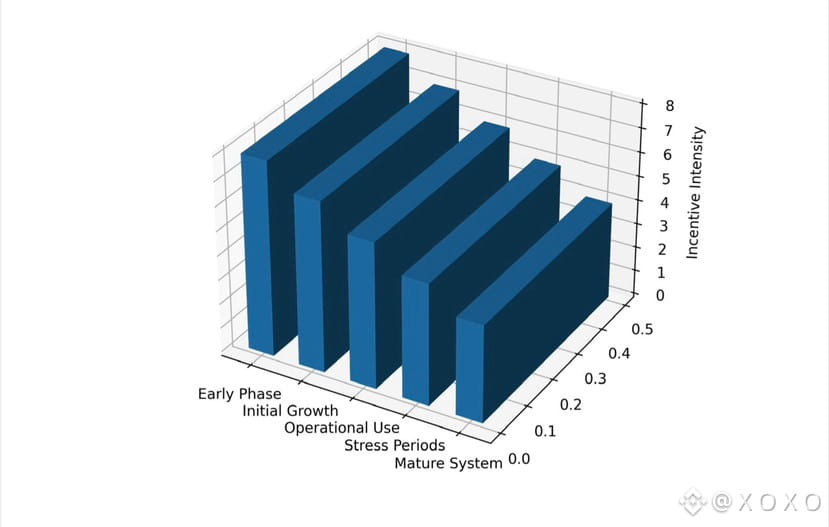
Stablecoin Chains Must Survive Quiet Periods
Quiet periods reveal the true strength of incentive design. When transaction volume slows, speculative participants leave. Infrastructure participants stay.
Plasma designs incentives so that quiet periods do not become destabilizing. Rewards remain predictable. Costs remain manageable. Participants are not forced to exit to remain profitable.
This allows the system to absorb fluctuations without cascading effects.
Incentives That Do Not Compete With Usage
One of the most common failures in crypto incentive design is allowing rewards to compete with actual usage. When incentives become more attractive than using the system, behavior distorts.
Plasma avoids this by ensuring that incentives complement usage rather than replace it. Participants earn because the system is used, not instead of using it.
This keeps incentives subordinate to real economic activity.
The Institutional Lens
Institutions assess systems through a conservative lens. They care about downside scenarios more than upside potential. They ask how systems behave under stress, not how they perform at peak conditions.
Plasma’s incentive philosophy aligns with this mindset. It prioritizes steady operation over aggressive expansion. This makes the system easier to evaluate, easier to integrate, and easier to trust.
Final Take
Sustainable incentives are not exciting. They are reassuring.
Plasma understands that stablecoin infrastructure must behave more like accounting systems than marketing campaigns. Incentives should stabilize behavior, reduce risk, and support long-term participation. When incentives are designed this way, growth may be slower, but confidence compounds.
In the end, stablecoin chains succeed not by attracting the most capital, but by keeping the right capital engaged. Plasma’s discipline around incentives reflects a mature understanding of that reality.