

Trust Is Learned, Not Declared
Understanding Why Trust Feels Different in Financial Systems
Trust behaves differently depending on where it is placed. In daily life, trust often grows through observation. We watch how someone behaves over time. We notice consistency, hesitation, reliability, and patterns. In contrast, formal systems rely on procedures. They define rules, document steps, and enforce outcomes through process rather than memory.
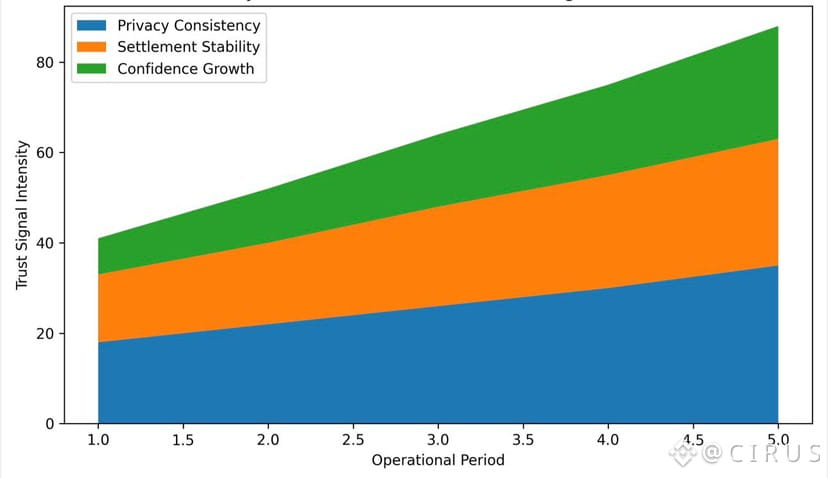
Blockchain systems tend to confuse these two ideas. Many protocols assume that if procedures are clearly defined, trust automatically follows. However, financial systems do not work that way. Markets, institutions, and regulators do not trust systems simply because rules exist. They trust systems when outcomes match expectations repeatedly, especially under pressure.
This is where DUSK introduces a meaningful distinction between observational trust and procedural trust.
What Observational Trust Really Means
Observational trust is built slowly. It does not come from reading documentation or reviewing architecture diagrams. It comes from watching a system behave over time. In financial environments, this means seeing how transactions settle, how privacy is maintained, how failures are handled, and how disputes resolve.
In DUSK, observational trust emerges from consistent behavior rather than declarations. Confidential transactions remain confidential not once, but repeatedly. Selective disclosure works not in theory, but in practice. Settlement does not leak information under stress. These outcomes are observed across months and years.
Quantitatively, this matters because trust compounds. A system that performs correctly ninety nine percent of the time builds a very different reputation from one that performs correctly ninety five percent of the time. That four percent gap is not abstract. Over one million transactions, it represents forty thousand potential points of failure. Observational trust forms when that gap stays small over long periods.
Procedural Trust Has Limits
Procedural trust is easier to design but harder to sustain. It relies on predefined steps. If condition A happens, then action B follows. This works well in controlled environments. However, financial systems are rarely controlled. They are noisy, adversarial, and emotionally charged.
Many blockchains rely heavily on procedural trust. They assume that if rules are enforced mechanically, trust is guaranteed. However, users and institutions do not experience trust mechanically. They experience it emotionally and practically. They ask whether the system protected them yesterday, not whether it promised to protect them tomorrow.
DUSK does not abandon procedures. Instead, it treats them as support structures rather than trust generators. Rules exist, but they are not the source of credibility. Credibility comes from how those rules perform in the real world.
Privacy Is Where Observational Trust Is Tested
Privacy is one of the most fragile aspects of financial infrastructure. A single leak can permanently damage credibility. This is why privacy systems are judged less by design and more by history.
DUSK’s approach to privacy creates observational trust by minimizing exposure events. If confidential transactions consistently avoid leaking metadata, patterns, or counterparties, trust grows naturally. Users do not need to understand the cryptography. They only need to see that privacy holds.
Over time, even small deviations would become visible. Markets notice patterns quickly. The absence of such patterns builds confidence. This is observational trust at work.
Why Institutions Lean Toward Observation
Institutions rarely adopt systems based solely on procedural guarantees. They observe behavior. They run pilots. They test edge cases. They monitor failure handling.
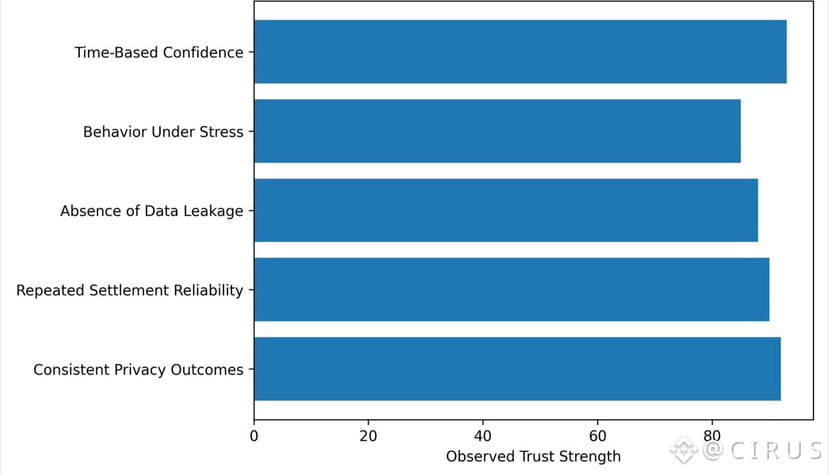
DUSK aligns with this mindset. It allows trust to emerge through repeated interaction rather than forced belief. Institutions can observe how selective disclosure works during audits. They can verify that compliance does not break confidentiality. They can measure stability under real usage.
Procedures define intent. Observation confirms reality.
When Procedures Support Observation, Not Replace It
The strength of DUSK lies in how procedures reinforce observation instead of attempting to replace it. Rules exist to ensure consistency. However, they are designed to produce stable outcomes rather than impressive specifications.
This is subtle but important. Many systems focus on what they promise. DUSK focuses on what it delivers.
My Take
Observational trust is slower, quieter, and harder to market. However, it is the only kind of trust that survives real financial usage. DUSK understands this distinction better than most systems. By allowing trust to form through lived experience rather than procedural assertion, it positions itself closer to real financial infrastructure than experimental technology. Over time, that difference becomes decisive.
