

There is a point in every technology cycle where improvement stops being exciting and starts being assumed. In Web3, that point has arrived for execution. Faster blocks, lower fees, and higher throughput are no longer breakthroughs. They are expectations. New chains still advertise them, but users increasingly treat them as hygiene factors rather than reasons to switch.
This transition is subtle, and that is why it is often misunderstood. Execution has not failed. It has succeeded so thoroughly that it no longer defines advantage. When that happens, the source of differentiation shifts elsewhere.
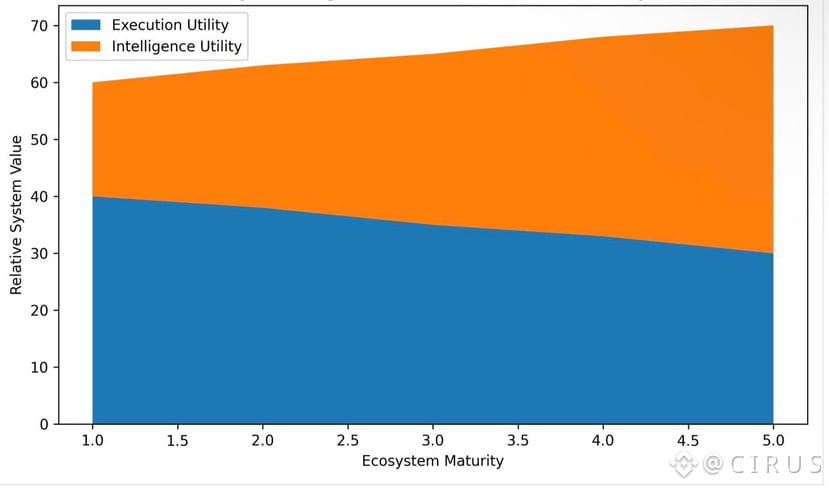
Vanar’s strategy is built around recognizing that shift early.
Execution Solves Movement, Not Meaning
Execution answers a simple question. Can a transaction be processed correctly and efficiently. For years, that was the hard part. Now it is mostly solved.
What execution does not answer is why a transaction happened, how it relates to prior activity, or whether it should have happened at all. Those questions were previously handled by humans, institutions, or off-chain systems.
As Web3 systems grow more complex, that division stops working.
Modern decentralized applications are no longer isolated contracts. They are interconnected systems involving governance, compliance, automation, data, and coordination across time. In such systems, meaning matters as much as movement.
Intelligence is what provides that meaning.
Ecosystems Break Before Chains Do
When systems fail at scale, they rarely fail because a single transaction cannot execute. They fail because coordination breaks down. Rules conflict. Context is lost. Decisions become inconsistent. Accountability disappears.
This is where many blockchains quietly struggle. They can execute anything, but they cannot reason about what they are executing. They rely on applications to handle logic that should arguably live deeper in the stack.
Vanar approaches the problem from the opposite direction. Instead of asking how to execute more efficiently, it asks how systems can coordinate more coherently.
Coordination Requires Shared Understanding
Coordination is not about speed. It is about shared understanding over time. For decentralized systems, this means preserving context across actors, applications, and decisions.
Consider governance decisions, financial workflows, or automated policy enforcement. These processes span weeks or months. They involve multiple inputs and evolving conditions. A stateless execution layer can record actions, but it cannot interpret them.
Without native intelligence, systems depend on external tooling to provide coherence. That introduces fragmentation. Different actors rely on different interpretations of the same data. Over time, trust erodes.
Vanar’s intelligence-first approach is designed to give ecosystems a shared layer of understanding.
Compliance Is Not an Add-On
One of the most revealing stress tests for Web3 infrastructure is compliance. Not compliance as a marketing label, but compliance as an operational requirement.
Regulated environments demand explainability. They require that actions can be justified after the fact. They expect that rules are enforced consistently, not selectively.
Execution-only systems struggle here. They can prove that something happened, but not why it was allowed to happen. Context lives elsewhere, often in proprietary systems that fragment trust.
Vanar treats compliance as a byproduct of intelligence rather than an external constraint. When reasoning and memory are native, enforcement becomes systematic rather than manual.
This matters not only for institutions, but for the long-term credibility of the ecosystem.
Why Intelligence Must Be Embedded
Many projects attempt to solve coordination problems by adding layers on top of execution. Middleware, APIs, and external services fill the gaps. This works temporarily, but it creates new points of failure.
Every off-chain dependency introduces trust assumptions. Every black-box service weakens auditability. Every centralized memory store becomes a bottleneck.
Vanar avoids this by embedding intelligence directly into the infrastructure. Memory, reasoning, and automation become shared primitives rather than optional extensions.
This design is harder to build, but it scales trust rather than eroding it.
Execution Commoditization Changes Competition
When execution becomes cheap and abundant, competition shifts from performance to coherence. Chains that differ only in speed or cost become interchangeable. Value accrues to systems that reduce cognitive and operational overhead.
In practice, this means infrastructure that helps systems reason, adapt, and enforce constraints without constant human intervention.
Vanar is positioning itself in this layer. Not as a faster chain, but as a system that helps other chains and applications make sense of what they are doing.
Intelligence as a Neutral Layer
An important aspect of Vanar’s approach is that it does not try to replace existing execution layers. Instead, it aims to complement them.
The future of Web3 is likely modular. Specialized execution environments will coexist. Compute networks will evolve. What is missing is a shared intelligence layer that provides continuity across them.
Vanar’s architecture reflects this belief. Intelligence is treated as neutral infrastructure that augments rather than competes.
Why This Shift Is Easy to Miss
The move toward intelligence does not produce immediate visual results. There are no simple metrics that capture contextual understanding. Progress is measured in fewer failures, clearer decisions, and smoother coordination.
This makes it harder to communicate and easier to ignore. However, systems that ignore this shift will encounter limits later, when retrofitting intelligence becomes costly and incomplete.
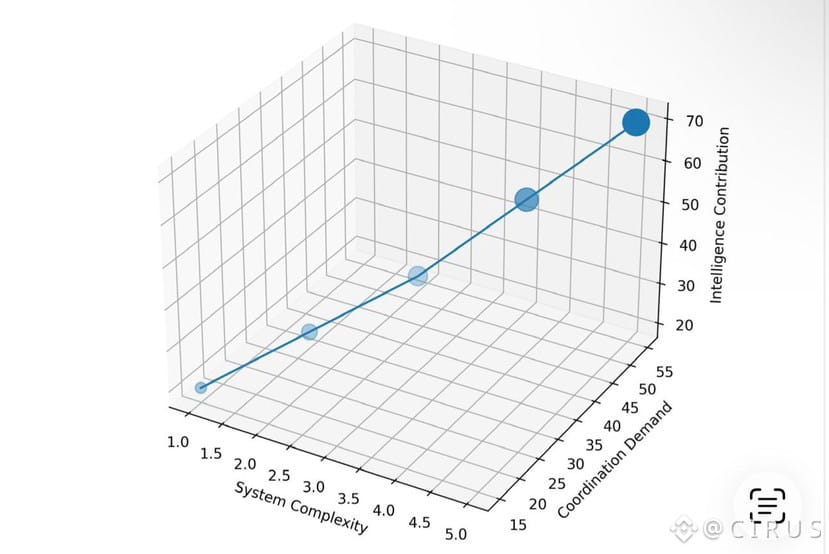
Vanar is choosing to absorb that cost early.
Quantitative Signals of the Shift
Even without flashy metrics, the shift toward intelligence can be observed indirectly. Systems that preserve context reduce error rates over time. Automated workflows that reason about history require fewer manual interventions. Governance processes with embedded logic experience fewer reversals.
These improvements compound quietly. Over thousands of decisions, small reductions in friction produce large gains in stability.
My Take
Execution made Web3 possible. Intelligence will make it sustainable.
Vanar’s decision to build for intelligence rather than compete on speed reflects a clear reading of where the ecosystem is heading. Once execution becomes interchangeable, coherence becomes the real moat. Systems that can understand their own activity, enforce rules consistently, and explain decisions will outlast those that simply run faster.
This shift will not announce itself with headlines. It will show up in which systems keep working as complexity grows. Vanar is building for that future, even if it arrives quietly.
