

Micro payments are one of those ideas that always sound obvious in crypto pay a few cents for an article, tip a creator instantly, buy a $0.20 in-game item without thinking but they’ve historically died on the same hill: fees and friction. When networks get congested, “cheap” becomes relative, and nobody wants to sign transactions like they’re approving a mortgage. That’s why traders keep circling back to chains that are built around predictable costs and fast finality, because micro-payments only work when the user can forget the blockchain is even there.
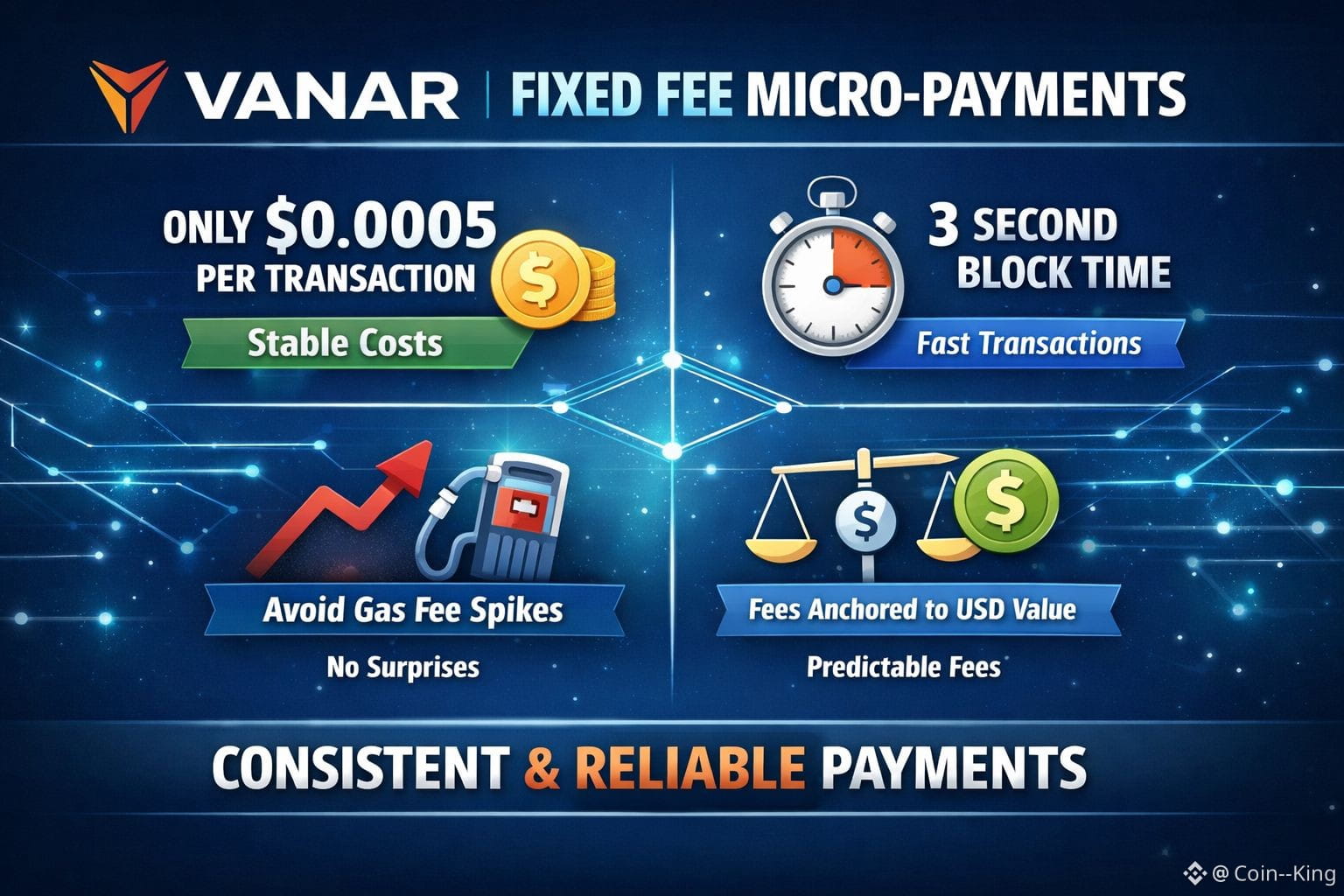
Vanar’s angle is basically: make the economics boring and the UX snappy. In its whitepaper, Vanar describes a fixed-fee model where the target cost is about $0.0005 per transaction and the network aims for a maximum 3-second block time, with design choices like a 30 million gas limit per block to push throughput. The “fixed fee” part matters more than people first realize. Most traders understand gas spikes, but for developers building micro-payment apps, variable fees are a business-model killer. If you’re charging pennies and your transaction fee suddenly costs dimes, the whole product breaks. Vanar frames the solution as anchoring fees to a dollar-value target rather than letting them float purely with token price dynamics.
Now, zoom out to why micro payments are suddenly trending again in 2025 2026. Two reasons keep showing up: the push toward “PayFi” (payments + DeFi rails) and the idea that autonomous software agents will initiate payments as part of workflows. Vanar popped up in that conversation after a public appearance with Worldpay at Abu Dhabi Finance Week 2025, in a session framed around stablecoins, tokenized assets, and “agentic payments” systems that can initiate and reconcile value flows within constraints. Whether you buy the buzzword or not, it’s a real direction of travel: if software agents are going to pay for APIs, data, compute, content, and services, those payments need to be tiny, frequent, and reliable.
As a trader, I tend to separate “narrative” from “market structure.” The narrative here is clear: micro-payments meet AI workflows meet on-chain settlement. The structure is: does the chain actually ship the plumbing developers need? Vanar’s docs and positioning lean heavily into being EVM compatible, which is practical because it lowers the barrier for teams migrating from Ethereum tooling. And $VANRY being both a native gas token and also available as a wrapped ERC-20 on Ethereum and Polygon speaks to interoperability as a distribution strategy, not just a technical feature. For micro-payments, interoperability isn’t academic if users already sit on other chains, bridging friction can decide whether a product ever gets traction.
Progress-wise, there are a few concrete timeline anchors traders can point to. Vanar’s mainnet messaging and ecosystem expansion has been discussed publicly since at least June 9, 2024, when a recap post described a mainnet launch milestone and ongoing exchange integrations. More recently, CoinMarketCap’s January 29, 2026 update highlights community chatter around Vanar’s AI-native infrastructure direction and references an “AI integration goes live” milestone dated January 19, 2026. I treat AI-written summaries as a starting point, not gospel, but they’re useful for one thing: they show what the broader market is paying attention to right now.

Tokenomics matter too, especially when you’re thinking like a trader rather than a fan. Vanar’s whitepaper describes a maximum supply capped at 2.4 billion VANRY, with 1.2 billion minted at genesis to support a 1:1 swap from the legacy TVK supply, and additional issuance over time via block rewards. Whether that’s attractive depends on usage: micro-payment chains win when transaction volume becomes the product. The open question is the one I always come back to: can Vanar turn “cheap and fast” into sticky demand without relying on speculative bursts? If the network becomes a place where payments happen constantly content, gaming, machine-to-machine then the micro-payment thesis stops being a slide deck and starts being a measurable flow.