

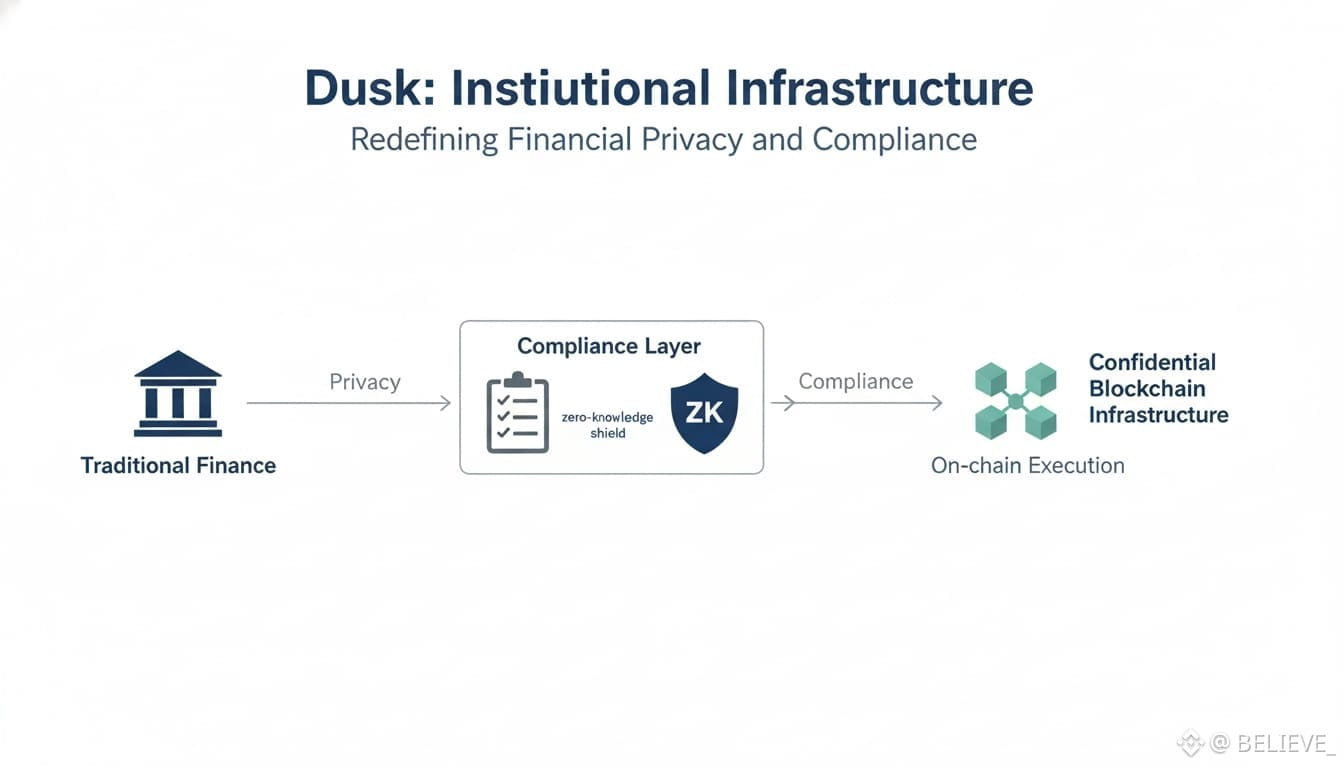
 When most blockchain projects talk about privacy, it’s usually in the context of hiding balances or obfuscating transactions. That’s interesting to retail users and DeFi traders, but it doesn’t move the needle where real capital flows — in regulated markets and institutional finance. Dusk Network is quietly shifting that paradigm by treating privacy as an enabler of real financial markets, not a feature bolt-on.
One of Dusk’s most intriguing design decisions is its focus on confidential smart contracts that satisfy compliance requirements. Unlike typical public chains where contract details and balances are visible to all, Dusk’s contracts use zero-knowledge proof cryptography to prove correctness without exposing sensitive information. This means a contract can enforce regulatory logic — like eligibility rules or reporting conditions — while keeping the underlying data private. That’s a game changer for enterprises that must reconcile privacy with legal obligations.
What’s exciting on a professional level is how this shifts the use case from speculative activity toward enterprise utility. While many chains chase yield, Dusk is focused on enabling regulated asset issuance, custody, and compliant settlement. Its architecture allows institutions to launch digital securities and RWAs on-chain, embed compliance rules, and maintain crypto-native workflows without broadcasting private information publicly — a key concern for regulators and financial institutions alike. 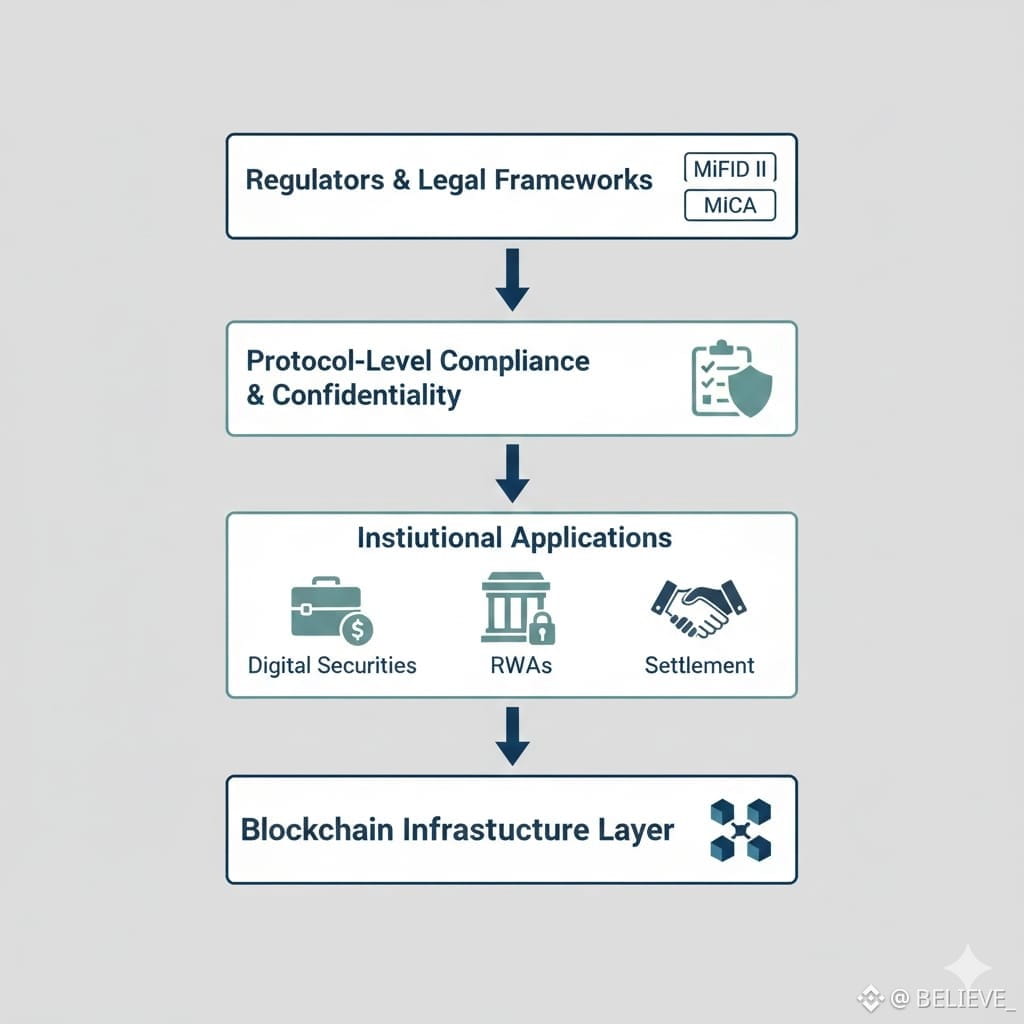
This approach affects not just privacy, but market structure. Dusk treats privacy as a foundation, not a surface layer. Instead of obscuring data after the fact, the system is built so confidential execution is the default mode. Developers can build complex financial logic without exposing strategic internal mechanics. That aligns closely with how institutional systems behave — agreements are binding, but internal reasoning is protected.
Another noteworthy aspect is how Dusk combines privacy with regulatory readiness. It aims to support compliance frameworks like MiFID II and MiCA at the protocol level, embedding rules that would otherwise require off-chain intermediaries or manual oversight. This reduces the friction of integrating blockchain into established financial infrastructure and offers a path for institutions to adopt decentralized technology without sacrificing legal guarantees.
From an architectural standpoint, Dusk’s strategy mirrors how serious enterprises treat data sovereignty — they don’t simply encrypt everything and publish it. They control who can prove what, and under what conditions. Dusk embraces this reality rather than fighting it, making confidentiality and compliance first-class citizens in its design.
Ultimately, Dusk is not trying to be the next high-yield playground. It’s aiming to be the invisible layer beneath real financial infrastructure, where privacy, compliance, and on-chain logic coexist seamlessly. That makes it feel less like a flashy public blockchain project and more like serious financial plumbing — a platform built for institutions that care less about noise and more about guarantees.
In an era where regulators are tightening scrutiny and institutional capital seeks scalable, compliant on-chain solutions, Dusk’s emphasis on privacy with purpose makes it a uniquely relevant contender.