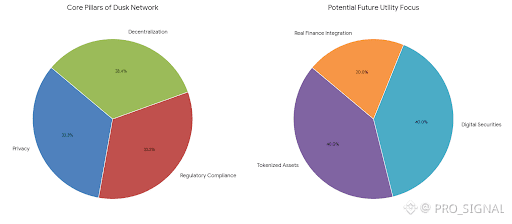
@Dusk Network is a Layer-1 blockchain designed with a specific purpose in mind: supporting real financial systems rather than serving only crypto traders or technology enthusiasts. While many existing blockchains operate as fully transparent public ledgers, this level of openness is often unsuitable for banks, institutions, and regulated businesses that must protect sensitive data and comply with legal requirements. Dusk was developed to address this gap.
The project began in 2018 with a clear focus on connecting traditional finance with blockchain technology. Its long-term vision is to bring real-world financial instruments such as shares, bonds, and other regulated assets onto the blockchain in a compliant and secure way. Instead of exposing every transaction to the public, Dusk integrates advanced privacy mechanisms that allow users to transact confidentially. At the same time, the system supports selective disclosure, meaning regulators can access necessary information for audits when required. This balance between confidentiality and oversight sets Dusk apart from most blockchain networks.
In early 2026, Dusk reached a major milestone with the launch of its mainnet, marking its transition from development to a fully operational network. This means real applications can now be deployed and used in production environments. A key advantage of Dusk is its compatibility with the Ethereum Virtual Machine (EVM). Because of this, developers familiar with Ethereum can build or migrate applications to Dusk without needing to learn an entirely new framework, lowering the barrier to adoption.
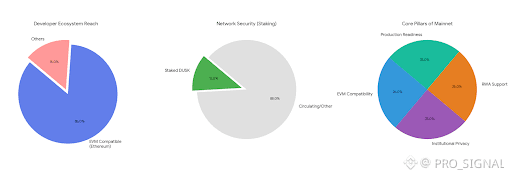
From a technical perspective, Dusk is evolving toward a modular architecture. In this setup, different layers of the network are responsible for specific functions. One layer manages consensus and data availability, another handles smart contracts, and an upcoming layer is dedicated exclusively to privacy. This modular approach improves scalability and flexibility, allowing the network to be upgraded or expanded without overhauling the entire system.
Privacy sits at the heart of Dusk’s design. The network uses zero-knowledge cryptography, which makes it possible to verify transactions without revealing sensitive details. In practice, this allows participants to prove that a transaction is valid while keeping balances, counterparties, and other confidential information hidden. For financial institutions, this is essential, as public exposure of trading activity or client data is not acceptable. Dusk ensures transactions remain private while still being secure and verifiable.
The DUSK token is the native asset of the network. It is used for transaction fees, staking to help secure the blockchain, and participating in governance decisions. The maximum supply is capped at one billion tokens, with distribution taking place gradually over a long period. By early 2026, close to half of the total supply is already circulating. Although the token’s price remains relatively low compared to larger projects, it experiences significant volatility, which is common across the crypto market.
A major focus area for Dusk is real-world asset tokenization. This involves converting traditional financial assets such as equities, bonds, or other securities into digital tokens that exist on the blockchain. These assets can then be traded, settled, and managed more efficiently. Dusk collaborates with regulated partners in Europe, including licensed financial platforms, to ensure that tokenized assets comply with existing laws and regulations. This regulatory alignment distinguishes Dusk from many blockchain projects that operate entirely outside traditional legal frameworks.
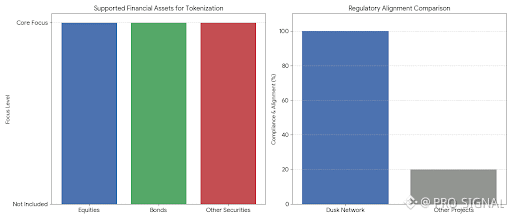
Rather than targeting everyday retail users, Dusk is primarily built for institutional use. Its core applications include regulated decentralized finance, confidential trading, privacy-preserving settlements, and digital securities issuance. Banks, exchanges, and financial service providers can use the network to transfer and settle assets without exposing sensitive information, positioning Dusk as foundational financial infrastructure rather than a typical consumer-focused blockchain.
In terms of visibility, Dusk attracted increasing attention toward the end of 2025 and into early 2026. Significant price movements during this period suggest growing interest from both retail and institutional participants. However, like all projects in the crypto space, Dusk carries risks related to market volatility and evolving regulatory environments.
In summary, Dusk Network addresses one of the most critical challenges in blockchain adoption: integrating decentralized technology into real finance without sacrificing privacy or regulatory compliance. Instead of choosing between decentralization and regulation, Dusk aims to support both. If tokenized assets and digital securities become central to the future financial system, Dusk has the potential to play a key role in enabling that transition.