

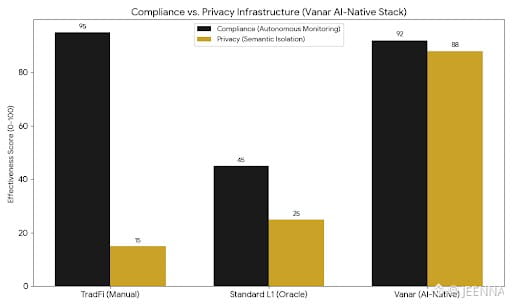
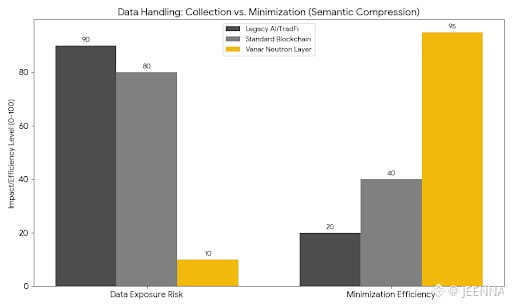
Vanar Chain is positioning itself as one of the more conceptually distinct Layer-1 blockchains by explicitly embedding AI capabilities into the protocol stack — a strategic play to bridge blockchain settlement with autonomous logic, semantic memory, and automated reasoning. Unlike traditional L1s that focus primarily on transaction throughput, general execution, or application composability, Vanar’s foundational design predicates on a core thesis: the next generation of decentralized applications will not only compute deterministic outcomes but will also remember context, infer patterns, and coordinate autonomously across data, state, and user interaction surfaces.
At the heart of Vanar’s architecture is a suite of components that collectively push towards this ambition. Elements such as Neutron (a semantic memory layer) and Kayon (a reasoning/inference engine) are not afterthought add-ons; they are first-class protocol primitives designed to operate alongside consensus and execution. Semantic memory enables on-chain logic to retain structured historical context — a form of state that goes beyond simple account balances or execution logs — while inference engines allow the network to generate new insights or actions based on patterns recognized across datasets. This dual capability is what distinguishes Vanar’s vision from the prevalent stateless computation paradigm.
Recent network developments have underscored this AI-native thesis moving beyond whitepaper conceptualization. Vanar has rolled out deeper layers of its AI integration stack, enabling developers to begin building applications that leverage both on-chain settlement and context-aware behaviors. The launch of production-ready SDKs and developer tooling has accelerated ecosystem engagement, lowering the barrier for builders who seek to prototype use cases that require both deterministic blockchain guarantees and emergent, adaptive logic. This expands possibilities from traditional DeFi and NFT schemas into domains such as autonomous financial orchestration, sanction-aware payment routing, and smart contracts capable of dynamic response patterns driven by learned data correlations.
One of the most attention-grabbing public moments for Vanar in recent weeks was its participation at Abu Dhabi Finance Week 2025 alongside major industry players such as Worldpay. The presence in such a venue — more traditionally frequented by institutional finance leaders — highlights Vanar’s intention to talk not just to crypto builders but to capital markets operators interested in programmable automation, real-world settlement flows, and cross-system orchestration. This institutional engagement is consistent with Vanar’s narrative that future finance will be agentic — capable of negotiating, adjusting, and optimizing outcomes programmatically with minimal human intervention.
From a market perspective, Vanar’s native token VANRY continues to trade with volatility consistent with early-stage infrastructure projects. Price behavior reflects both speculative interest in AI-web3 intersections and waiting for further protocol adoption signals. Yet, token price alone obscures the more substantive evolution underway: the shift in conversation from generic “AI + crypto” buzz to actual technical capabilities that can be productized and deployed. Vanar’s roadmap emphasizes this shift by throttling promotional rhetoric in favor of incremental feature releases, SDK maturity, and documented use cases that illustrate measurable benefits of its AI enhancements over conventional execution environments.
Importantly, Vanar’s design does not naively bundle third-party machine learning or oracles into the consensus layer — a common pattern that conflates AI tooling with fundamental protocol logic. Instead, Vanar integrates reasoning and memory constructs natively, meaning that adaptive logic becomes a peer to consensus rather than an external add-on. This reduces trust surfaces associated with off-chain oracle dependencies and creates a cohesive environment where all on-chain reasoning is subject to the same economic and cryptoeconomic assurances as transaction settlement itself.
The development strategy also reflects a pragmatic understanding of foundational technology adoption curves. AI-native logic is introduced incrementally, with early focus on tooling that complements existing Web3 paradigms (EVM-compatibility, seamless wallet integration, modular state channels). This allows the network to attract developers familiar with traditional Ethereum-style environments while gradually exposing them to Vanar’s more sophisticated AI primitives. Early adopters have responded with experimental dApps that combine DeFi-like incentives with stateful memory heuristics — for example, adaptive yield strategies that adjust parameters based on learned utilization patterns rather than static triggers.
Looking forward, one of Vanar’s most significant inflection points will be the emergence of catalytic use cases — applications whose competitive advantage directly derives from accessible on-chain memory and inference. In traditional blockchains, smart contracts cannot retain learned context without explicit state manipulation, and they cannot reason about unseen patterns without external computation. Vanar’s stack aims to change that by embedding these capabilities at the protocol level, potentially enabling new classes of applications such as on-chain autonomous agents, compliance-aware payment networks, and adaptive cross-chain coordination protocols.
In assessing Vanar’s trajectory, it is essential to differentiate between what the project aspires to enable and what it has already deployed. The former is far more ambitious — the construction of ecosystems where logic can evolve, adapt, and automate across time and interaction histories. The latter is already unfolding through incremental releases, developer engagement, and ecosystem pilots. Both strands matter: the former defines the long-term vision, and the latter defines the immediate path to adoption.
If Vanar can translate its AI-native thesis into measurable, developer-led traction — where applications perform better because they leverage on-chain memory and reasoning — it will mark a meaningful shift in how blockchain infrastructure is conceptualized and built. In an environment where most blockchains compete on throughput or narrative, Vanar’s distinct bet on intelligence and autonomous logic may well position it uniquely for the next generation of decentralized systems.